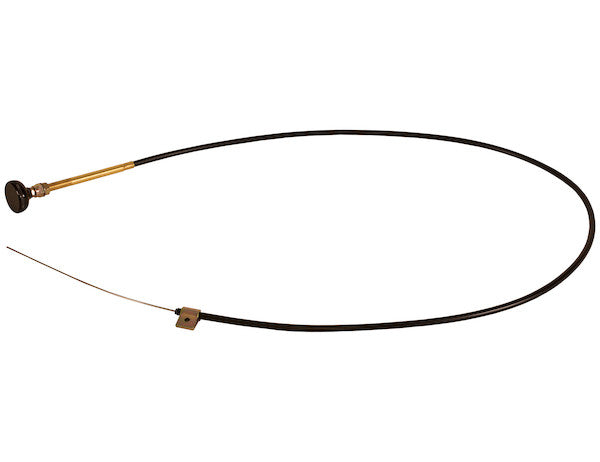
Buyers Products R38D Series Control Cable with 5 Inch Travel features a corrosion resistant stainless steel core to ensure long life. The cable has 5 in. of total travel with no neutral detent. The cable is available in lengths ranging from 6 ft to 30 ft to fit a variety of jobs, and can be easily customized by cutting conduit and core wire. It includes a small clamp to secure the output end for added stability, and a 2 in. control knob.
Specifications
| Cable Length (ft.) | 12.00 ' |
| Conduit Diameter | 0.375 " |
| Cable Core Material | Stainless Steel |
| Knob Material | Polymer |
| Bulkhead Thread Size | - " |
| Mount Thread Size (in.) | 1/2-20 " |
| End Type | Plain |
| Rod End Thread Size | - " |
| Total Travel (in.) | 5.00 " |
| Cable Dia (in.) | 0.088 " |
| Conduit Material | PVC |
| Cable Series | R38D Series |
| Knob Thread Size | 3/8-24 " |
The 12 Foot Stainless Steel Core Wire, specifically the Buyers Products R38D Series Control Cable, represents a robust and versatile solution for a wide array of mechanical control applications. Engineered for durability and precision, this control cable system is designed to facilitate reliable mechanical actuation in environments where resistance to corrosion and consistent performance are paramount. The product’s core features, as highlighted in the initial description, underscore its utility, but a deeper technical dive reveals the meticulous engineering and material science that contribute to its superior operational characteristics.
At the heart of this control cable lies its stainless steel core wire. Stainless steel is chosen for its exceptional properties, particularly its inherent resistance to oxidation and corrosion, which is critical for components exposed to moisture, chemicals, or harsh atmospheric conditions. Unlike conventional steel, stainless steel forms a passive chromium oxide layer on its surface, which self-repairs when scratched or damaged, thereby offering continuous protection. This attribute significantly extends the operational lifespan of the cable, reducing the frequency of replacement and associated maintenance costs. The 0.088-inch diameter of the cable core is carefully specified to balance tensile strength with flexibility, ensuring the cable can transmit significant force while navigating complex routing paths without succumbing to fatigue or kinking. The selection of stainless steel for the core also contributes to a lower coefficient of friction internally, enhancing the smoothness of operation and minimizing wear on both the core wire and its surrounding conduit.
The conduit system plays an equally crucial role in the R38D Series cable's performance. With a conduit diameter of 0.375 inches, manufactured from PVC, it provides a protective sheath for the stainless steel core wire. PVC (Polyvinyl Chloride) is an excellent material choice for this application due to its combination of flexibility, chemical resistance, and dielectric properties. It effectively shields the internal stainless steel core from external abrasive forces, impacts, and environmental contaminants such as dust, dirt, and moisture. The flexibility of the PVC conduit allows for installation in configurations with bends and turns, a common requirement in many industrial and vehicle applications, without impairing the smooth movement of the internal core wire. Furthermore, PVC offers good resistance to various oils, greases, and many common industrial solvents, enhancing the cable's durability in challenging operational settings. The design ensures minimal friction between the core wire and the inner surface of the conduit, which is vital for maintaining the cable's specified 5 inches of total travel with consistent force transmission and minimal backlash.
The specification of "5 Inch Travel" with "no neutral detent" is a critical functional characteristic. This indicates that the cable is designed for applications requiring continuous, precise modulation of an output mechanism over a specified range, rather than discrete, pre-defined positions. The absence of a neutral detent implies a direct, uninhibited linear response to input force, making it ideal for throttle controls, choke controls, or variable position mechanisms where fine adjustment is necessary. The 5-inch travel distance provides ample range for most common actuation requirements, balancing responsiveness with the physical limits of linear motion control. The engineering of the internal components ensures that this travel is achieved smoothly and consistently across the cable's operational life, without binding or excessive play.
The versatility of the R38D Series is further underscored by its availability in lengths ranging from 6 ft to 30 ft, and the capability for customization by cutting both the conduit and the core wire. This "cut-to-length" feature is a significant advantage, allowing installers to tailor the cable precisely to the specific dimensional requirements of an application. This reduces the need to stock multiple fixed-length cables, simplifies inventory management, and ensures an optimal fit, which is crucial for maximizing control efficiency and minimizing potential snagging or excessive slack. The ease of customization suggests a design that accommodates standard cutting tools and termination procedures, making field modifications straightforward for qualified technicians.
For securing the output end and enhancing stability, the cable includes a small clamp. This clamp is instrumental in maintaining the precise positioning of the cable's output mechanism, preventing slippage or unwanted movement under operational loads or vibrations. The stability provided by this clamp is vital for applications where consistent and accurate actuation is non-negotiable, contributing directly to the reliability and safety of the overall system. Furthermore, the inclusion of a 2-inch control knob facilitates ergonomic and effective user interaction. The knob, made from polymer, offers a comfortable grip and durable interface for manual control. The polymer material is selected for its resistance to impact, chemicals, and temperature fluctuations, ensuring longevity and consistent tactile feedback. The knob's thread size of 3/8-24 inches indicates a standard, robust fastening mechanism, allowing for secure attachment to the cable and compatibility with various mounting systems.
The mounting mechanism is further detailed by a "Mount Thread Size (in.)" of 1/2-20 inches. This specification refers to the thread used for securing the cable assembly to a panel or chassis. The 1/2-20 thread is a common and robust size, indicating a secure and stable mounting solution capable of withstanding operational stresses. This ensures that the cable remains firmly in place, transmitting input forces efficiently without compromising structural integrity at the mounting point. The "End Type" is specified as "Plain," suggesting a straightforward, unthreaded core wire at the output end. This design allows for maximum flexibility in connecting the cable to various lever arms, linkages, or custom-fabricated components, offering greater adaptability for specialized applications that do not utilize standard threaded rod ends.
The "Cable Diameter (in.)" of 0.088 inches and "Conduit Diameter" of 0.375 inches are critical dimensions for assessing the physical compatibility and performance characteristics of the cable. The relatively small diameter of the core wire allows for greater flexibility, while the robust conduit diameter provides adequate protection without being excessively bulky. This combination optimizes the balance between mechanical strength, flexibility, and installation footprint.
In summary, the Buyers Products R38D Series 12 Foot Stainless Steel Core Wire control cable is a meticulously engineered component designed for demanding mechanical control applications. Its foundation lies in the choice of high-quality materials: a corrosion-resistant stainless steel core wire encased within a durable PVC conduit. This material synergy ensures prolonged operational life and consistent performance across diverse environmental conditions. The 5 inches of unhindered travel, coupled with the absence of a neutral detent, provides precise and continuous modulation capabilities, essential for applications requiring variable control. The versatility offered by customizability in length, along with robust mounting and securing features like the small clamp and 1/2-20 mounting thread, makes it adaptable to a broad spectrum of industrial, automotive, and marine uses. The ergonomic 2-inch polymer control knob with a 3/8-24 thread size completes the assembly, offering a reliable and user-friendly interface. These technical specifications collectively attest to the R38D Series' capability to deliver reliable, precise, and durable mechanical control, positioning it as an optimal choice for engineers and technicians seeking high-performance control cable solutions.
Expanding further on the technical aspects and applications, the operational integrity of the R38D Series control cable is heavily reliant on the synergistic properties of its constituent materials and precise manufacturing tolerances. The stainless steel core, typically an AISI 300 series alloy such as 304 or 316, is selected for its high tensile strength and fatigue resistance, alongside its excellent corrosion resistance. Type 304 stainless steel offers a good balance of strength, ductility, and corrosion resistance, suitable for general industrial applications. For more aggressive corrosive environments, Type 316 stainless steel, with its added molybdenum content, would provide superior resistance to pitting and crevice corrosion, though the specific grade is not detailed in the general specifications, the term "stainless steel" implies these desirable properties. The smooth surface finish of the drawn stainless steel wire minimizes internal friction within the conduit, ensuring that the input force translates efficiently into output movement with minimal hysteresis.
The PVC conduit's mechanical properties are also critical. Its durometer hardness is optimized to provide sufficient rigidity to prevent buckling or compression under typical operational loads, while retaining enough flexibility for routing through complex paths. The inner diameter of the conduit is precisely matched to the outer diameter of the core wire, maintaining a controlled clearance that allows for smooth linear motion without excessive play. This controlled clearance also helps to prevent the ingress of fine particulate matter that could abrade the core wire or impede its movement over time. The extrusion process for the PVC conduit ensures a consistent wall thickness and a smooth internal bore, which are essential for uniform cable performance.
The "no neutral detent" feature is significant for control systems where proportional control is desired. In contrast to cables with detents that provide tactile feedback for specific positions (e.g., "on," "off," "half"), the R38D Series allows for infinitely variable positioning within its 5-inch travel range. This is particularly advantageous in applications such as variable speed controls for engines, hydraulic valve actuation where precise flow rates are needed, or damper controls where fine angular adjustments are critical. The smooth, continuous movement facilitates precise operator input and avoids abrupt changes in the controlled mechanism, which can be crucial for machinery longevity and operational safety.
The customization capability, allowing for field cutting of both conduit and core wire, requires careful consideration of proper termination techniques. When cutting the conduit, a clean, square cut is paramount to ensure proper alignment and prevent fraying of the PVC. For the stainless steel core wire, specialized cable cutters are recommended to avoid deforming the wire end, which could hinder its passage through the conduit or connection to the controlled device. Proper termination of the plain end typically involves swaging a suitable fitting, crimping, or forming a loop, depending on the connection point of the driven mechanism. The "plain end" design provides maximum flexibility for integrating with custom hardware or non-standard linkages, allowing engineers to design bespoke solutions without being constrained by pre-fabricated end fittings. However, it necessitates the user to have the appropriate tooling and expertise for secure termination, which is a common practice in professional mechanical installations.
The inclusion of a small clamp to secure the output end provides critical mechanical advantage. This clamp typically fixes the conduit at the point where the core wire exits, creating a stable fulcrum for the linear motion. Without such a clamp, the conduit itself could move or flex, absorbing some of the input force and reducing the effective travel or precision of the control. The clamp's design ensures that the conduit remains stationary relative to the mounting point, thereby guaranteeing that all cable travel is translated directly into the movement of the core wire and the attached mechanism. This enhances the linearity of the control and minimizes backlash, which is the lost motion due to clearance or elasticity in the system.
The 2-inch polymer control knob is not merely an aesthetic component; its dimensions and material are chosen for practical reasons. The 2-inch diameter provides a sufficient grip surface for comfortable and effective manual operation, even when wearing gloves or operating in adverse conditions. The polymer material, often a high-impact engineering plastic such as ABS or nylon, offers good resistance to UV radiation, common chemicals, and temperature extremes, ensuring the knob maintains its structural integrity and appearance over time. The 3/8-24 thread size for the knob is a fine thread, which typically provides a stronger and more vibration-resistant connection than coarse threads, ensuring the knob remains securely fastened to the cable assembly during repeated use.
The 1/2-20 mount thread size for attaching the cable to a bulkhead or panel is also a critical specification. This unified fine thread (UNF) is widely used in mechanical applications where a secure, robust connection is required. The fine pitch of the thread offers greater resistance to loosening under vibration and provides a stronger clamping force compared to coarse threads of the same diameter. This ensures the cable assembly remains rigidly mounted, transmitting forces efficiently without unwanted movement at the mounting point. The precise dimensions of the thread allow for seamless integration with standard bulkheads and mounting plates.
Regarding the overall operational environment, the R38D Series control cable is designed to perform reliably across a range of temperatures. While specific operating temperature ranges are not provided, the choice of stainless steel and PVC generally indicates suitability for typical industrial and automotive ambient conditions. Stainless steel maintains its mechanical properties over a very wide temperature range, and PVC, while having a more limited range, is usually adequate for most non-extreme conditions, typically from -20°C to +60°C (-4°F to +140°F). For applications outside this range, specialized conduit materials might be required, but for standard uses, the PVC offers good thermal stability and flexibility.
Installation considerations for the R38D Series cable also warrant attention. Proper routing is essential to avoid tight radius bends that could lead to excessive friction, kinking of the core wire, or premature wear of the conduit. Manufacturers typically specify minimum bend radii for control cables to ensure optimal performance and longevity. Avoiding sharp edges or abrasive surfaces where the conduit passes is also important to prevent external damage. When cutting the cable to length, it is imperative to ensure that the core wire is cut precisely to the required dimension relative to the conduit, taking into account any necessary extensions for termination and connection to the controlled mechanism. The process of installing these cables often involves routing, clamping, and then finally connecting the plain end to the actuator, followed by securing the control knob at the operator interface.
In conclusion, the 12 Foot Stainless Steel Core Wire, as part of the Buyers Products R38D Series, represents a sophisticated piece of engineering tailored for precise and durable mechanical control. Its construction, marrying a corrosion-resistant stainless steel core with a protective PVC conduit, ensures a long service life and reliable operation in challenging environments. The specific design elements, such as the 5-inch travel without a neutral detent, the customizability in length, and the robust mounting and operational components (clamp, knob, mounting threads), all contribute to a highly versatile and professional-grade control cable. Understanding these technical nuances allows for optimal application and installation, maximizing the benefits of this high-performance component in critical control systems across various industries. This detailed technical description aims to provide engineers, designers, and maintenance professionals with a comprehensive understanding of the R38D Series' capabilities and its suitability for their specific project requirements.