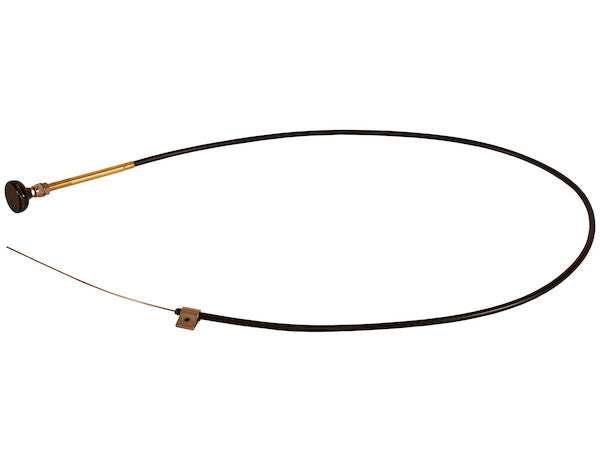
Buyers Products R38D Series Control Cable with 5 Inch Travel features a corrosion resistant stainless steel core to ensure long life. The cable has 5 in. of total travel with no neutral detent. The cable is available in lengths ranging from 6 ft to 30 ft to fit a variety of jobs, and can be easily customized by cutting conduit and core wire. It includes a small clamp to secure the output end for added stability, and a 2 in. control knob.
Specifications
| Cable Dia (in.) | 0.088 " |
| Rod End Thread Size | - " |
| End Type | Plain |
| Knob Material | Polymer |
| Cable Length (ft.) | 20.00 ' |
| Bulkhead Thread Size | - " |
| Mount Thread Size (in.) | 1/2-20 " |
| Conduit Material | PVC |
| Cable Core Material | Stainless Steel |
| Total Travel (in.) | 5.00 " |
| Cable Series | R38D Series |
| Knob Thread Size | 3/8-24 " |
| Conduit Diameter | 0.375 " |
The Buyers Products R38D Series Control Cable, specifically the 20-foot variant, represents a robust and versatile solution for precision mechanical control in a multitude of demanding applications. Engineered for environments where reliability and resistance to degradation are paramount, this cable system embodies a thoughtful integration of material science and mechanical design principles. Its primary function is to transmit push-pull motion over a significant distance, enabling remote operation of various mechanisms with a high degree of fidelity and minimal maintenance.
At the heart of the R38D Series cable’s exceptional performance lies its corrosion-resistant stainless steel core wire. This choice of material is not incidental; stainless steel, typically an alloy of iron with a minimum of 10.5% chromium, forms a passive layer of chromium oxide on its surface. This invisible, self-repairing layer provides superior resistance to oxidation, rust, and attack from a wide array of corrosive agents encountered in industrial, marine, and outdoor settings. Unlike conventional carbon steel, which is prone to rusting when exposed to moisture and oxygen, stainless steel maintains its structural integrity and smooth operating characteristics over extended periods, directly translating to a prolonged operational lifespan for the control cable. This inherent corrosion resistance is critical for applications such as heavy machinery, off-highway vehicles, agricultural equipment, marine throttles, and industrial plant controls, where exposure to water, chemicals, salts, and abrasive elements is a common operational reality. The 0.088-inch diameter of the core wire is optimized to provide an excellent balance between tensile strength, flexibility, and fatigue resistance, ensuring that the cable can withstand repeated cycles of tension and compression without premature failure. This specific diameter ensures efficient transmission of force while minimizing internal friction and potential for kinking or permanent deformation under typical operating loads.
Encasing this resilient stainless steel core is a durable PVC conduit, with an external diameter of 0.375 inches. Polyvinyl Chloride (PVC) is selected for its advantageous properties as an outer jacket material. PVC offers excellent resistance to abrasion, oils, greases, and many common industrial chemicals, thereby protecting the delicate internal core from external damage and contaminants. Furthermore, PVC provides a degree of UV resistance, mitigating the degradation effects of prolonged sun exposure, which is crucial for outdoor installations. The flexibility of the PVC conduit allows for routing around obstacles and through complex pathways, a significant advantage over rigid linkages, which often require precise alignment and can be difficult to install in confined spaces. This flexibility also contributes to the smooth operation of the cable by maintaining a consistent pathway for the core, reducing friction and ensuring consistent performance across its 5 inches of total travel. The conduit’s robust construction acts as a crucial barrier, preventing ingress of dirt, dust, and moisture, which could otherwise impede the smooth motion of the stainless steel core wire and accelerate wear. The synergy between the stainless steel core and the PVC conduit ensures a robust, long-lasting, and highly reliable control system capable of enduring harsh environmental conditions.
The R38D Series Control Cable is characterized by its 5 inches of total linear travel. This specific travel length is strategically designed to accommodate a broad spectrum of control functions, offering sufficient displacement for precise actuation of throttles, chokes, valves, power take-offs (PTOs), and various other mechanical components. The absence of a neutral detent is a defining characteristic of this cable system. A detent is a mechanism that holds the control in a specific position, often indicating an "off," "idle," or "neutral" state. By omitting this feature, the R38D series cable provides continuous, smooth, and infinitely adjustable control throughout its 5-inch range. This non-detent design is particularly advantageous in applications requiring granular control and a "feel" for the adjustment, where the operator needs to hold the control at any point within its travel without it snapping into a preset position. For instance, in finely tuning engine RPM, adjusting hydraulic flow, or precisely positioning a directional valve, the ability to maintain any intermediate position is paramount. This design necessitates that the operator actively holds the control in the desired position or that an external friction device is incorporated into the control lever mechanism, depending on the application’s specific requirements for positional retention.
Customization is a significant benefit offered by the R38D Series cables. While the 20-foot length is a standard offering, the product’s design allows for easy customization of both the conduit and the core wire. This means that if a job requires a length shorter than 20 feet, the cable can be readily trimmed to the exact required dimension. The process of cutting the conduit and core wire, while requiring appropriate tools and careful execution, allows for precise tailoring to specific installation requirements, eliminating excess cable length that could introduce friction or create routing challenges. When performing such modifications, it is crucial to use specialized cable cutters designed for steel wire to ensure a clean, fray-free cut that maintains the integrity of the stainless steel strands. Similarly, the PVC conduit should be cut cleanly to avoid burrs that could interfere with core movement. Proper re-termination or sealing of the cut end of the conduit is also advised to prevent moisture and debris ingress, thereby preserving the long-term performance and protective qualities of the conduit. This adaptability significantly reduces inventory complexities for distributors and users, as a single bulk length can be adapted for multiple applications, enhancing efficiency and cost-effectiveness.
The R38D series control cable integrates practical design elements to facilitate robust installation and user interaction. A small clamp is included to secure the output end of the cable. This clamp is critical for ensuring mechanical stability and preventing unwanted movement of the conduit at the point of connection to the controlled mechanism. By firmly anchoring the conduit, the clamp ensures that all the motion generated by the core wire is directly translated into the desired actuation, eliminating lost motion due to conduit shift. This prevents wear and tear on the cable components and the connection points, contributing to the system's overall longevity and reliability. Without such a securing mechanism, the conduit could "bow" or flex, dissipating some of the force intended for actuation and leading to imprecise control or premature cable failure. The inclusion of a 2-inch control knob, fabricated from polymer material, further enhances the user experience. Polymer is chosen for its ergonomic properties, providing a comfortable and secure grip for operators, even in wet or greasy conditions. The 2-inch diameter offers a substantial surface area for comfortable manipulation, reducing operator fatigue during prolonged use. Furthermore, polymer materials are generally resistant to many chemicals and UV radiation, ensuring the knob retains its aesthetic and functional integrity over time. The knob attaches via a 3/8-24 thread size, a common standard that ensures a secure and vibration-resistant connection to the core wire assembly.
From a mechanical integration perspective, the R38D series cable features a 1/2-20 inch mount thread size. This standardized threading provides a robust and widely compatible method for securing the cable assembly to a panel, bulkhead, or bracket. The fine pitch of the 20 threads per inch ensures a secure and stable attachment, minimizing the risk of loosening due to vibration or operational stresses. This mounting system allows for flexibility in installation, enabling the cable to be routed through an enclosure wall or mounted to a structural member with confidence, ensuring that the input control mechanism is firmly held in place. The "Plain" end type for the rod end further emphasizes the customization aspect. Without a pre-threaded or specific terminal, the plain end allows installers to attach a variety of custom fittings, clevises, ball joints, or custom linkage adapters directly to the stainless steel core wire. This versatility is invaluable for integrating the cable into diverse machinery where specific attachment points or motion transfer geometries are required, offering maximum adaptability for unique application demands. This design philosophy underscores the cable's utility as a foundational component for custom mechanical control systems.
The 20-foot cable length is a critical specification, positioning this particular model for applications requiring significant separation between the control input and the controlled output. Common scenarios include heavy-duty trucks where the throttle control in the cab needs to actuate an engine mechanism located some distance away, agricultural machinery with remote implement controls, or industrial processes where hazardous environments necessitate operating equipment from a safe distance. While long cables introduce considerations for increased friction and potential for larger bend radii, the robust design of the R38D series, with its smooth PVC conduit and corrosion-resistant core, is engineered to minimize these effects, ensuring efficient power transmission over the specified length. Proper routing is paramount for optimal performance of a 20-foot cable; careful consideration must be given to avoiding sharp bends, excessive loops, or points where the cable could be pinched or subjected to abrasive forces. Maintaining generous bend radii, consistent with the cable’s capabilities, helps to preserve the longevity of both the core and the conduit, reducing internal stresses and friction.
In summary, the 20 Foot Stainless Steel Core Wire, part of the Buyers Products R38D Series Control Cable lineup, is an expertly engineered component designed for uncompromising performance in challenging environments. Its foundation is a high-strength, corrosion-resistant stainless steel core, providing exceptional durability and smooth operation over its 5 inches of travel. The protective PVC conduit shields the core from physical and chemical degradation, while the absence of a neutral detent offers precise, infinitely variable control. With its generous 20-foot length, easy customizability, and robust mounting hardware including a 1/2-20 inch mount thread and a comfortable polymer knob with a 3/8-24 thread, this cable system stands as a testament to thoughtful industrial design. It provides a reliable, adaptable, and long-lasting solution for transmitting mechanical motion, ensuring that critical operations can be managed remotely and effectively across a broad spectrum of heavy-duty, commercial, and industrial applications. Its technical specifications and material choices are carefully balanced to deliver a product that is not only functional but also highly resilient, reducing downtime and maintenance requirements for end-users and equipment operators alike.