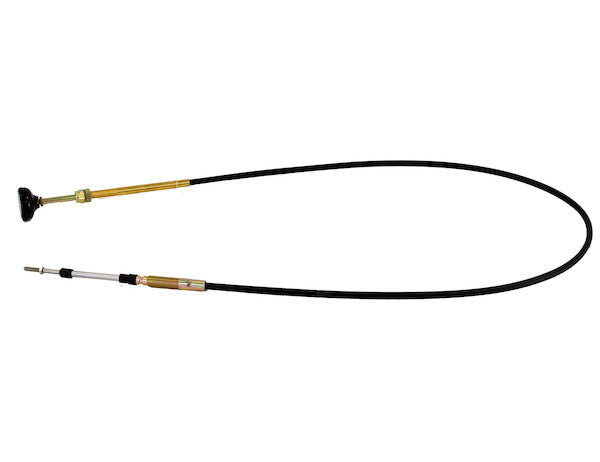
R38DR Series Control Cable with 3 Inch Travel and Rod End Control from Buyers Products is designed for heavier applications. The cable is built to last with a rust-resistant stainless steel core, and long lay construction. Replaceable control knob included. Order nuts and washers separately. For bulkhead applications order the BNW015 Control Cable Nut and Washer Kit.
Specifications
| End Type | Rod |
| Cable Series | R38DR Series |
| Cable Dia (in.) | 0.088 " |
| Rod End Thread Size | 1/4-28 " |
| Conduit Diameter | 0.375 " |
| Bulkhead Thread Size | 5/8-18 " |
| Knob Material | Polymer |
| Cable Length (ft.) | 8.00 ' |
| Cable Core Material | Stainless Steel |
| Conduit Material | PVC |
| Mount Thread Size (in.) | 1/2-20 " |
| Knob Thread Size | 3/8-24 " |
| Total Travel (in.) | 3.00 " |
The R38DR Series Control Cable: Precision Engineered for Demanding Industrial and Mobile Applications
The 8-foot R38DR Series Control Cable with a Rod End Control represents a pinnacle of mechanical control system engineering, meticulously designed to meet the rigorous demands of heavier applications across a multitude of industries. This robust control cable system, from Buyers Products, is engineered for superior longevity, reliability, and precision, ensuring optimal performance in environments where standard control solutions might falter. Its construction emphasizes durability through a rust-resistant stainless steel core, a highly resilient long lay construction, and a comprehensive set of specifications tailored for seamless integration and steadfast operation.
Unparalleled Durability: The Stainless Steel Core and Long Lay Construction
At the heart of the R38DR Series Control Cable lies its extraordinary core, crafted from high-grade stainless steel. This choice of material is not arbitrary; it is a critical design decision that imparts exceptional characteristics essential for heavy-duty applications. Stainless steel, particularly the common grades employed in such applications (e.g., 302/304 series, or potentially 316 for enhanced corrosion resistance, though specific grade is not disclosed), is renowned for its inherent corrosion resistance. This resistance is due to the formation of a passive chromium oxide layer on its surface, which self-repairs in the presence of oxygen, effectively shielding the underlying metal from rust, oxidation, and chemical degradation. This attribute is paramount in environments exposed to moisture, salt spray, harsh chemicals, and varying atmospheric conditions, such as those encountered in marine, agricultural, construction, and municipal vehicle operations.
Beyond its anticorrosive properties, the stainless steel core offers superior tensile strength and fatigue resistance. These mechanical properties ensure the cable can withstand significant push and pull forces without stretching or deforming permanently, thereby maintaining control accuracy over its operational lifespan. Its inherent rigidity, balanced with appropriate flexibility, allows for precise force transmission, minimizing lost motion and maximizing the responsiveness of the controlled mechanism. The 0.088-inch cable diameter, while seemingly modest, is precisely calibrated to provide an optimal balance between strength and flexibility, enabling the cable to navigate complex routing paths while delivering robust control.
Complementing the superior material selection is the cable's "long lay construction." In cable manufacturing, "lay" refers to the direction and length of the helix formed by the strands around the core. Long lay, in contrast to regular or short lay constructions, involves strands that spiral more gently around the central axis. This engineering choice yields several profound benefits:
- Enhanced Flexibility: The gentler spiral of long lay cables significantly increases their flexibility. This is crucial for applications requiring the cable to bend around curves or through confined spaces without inducing excessive internal stresses or causing premature fatigue failure.
- Superior Fatigue Life: With a longer lay, the internal stresses within the cable are more evenly distributed across the strands. This reduces localized stress concentrations, which are common points of failure in shorter lay constructions, thereby extending the cable's operational life, particularly under repetitive flexing and load cycles.
- Improved Wear Resistance: The greater surface area contact between individual strands in a long lay cable contributes to better wear distribution. This translates to reduced abrasion between strands as the cable flexes, further enhancing its durability.
- Smoother Operation: The inherent stability and reduced tendency for "birdcaging" (where outer strands separate from the core) in long lay cables ensure smoother, more consistent operation, minimizing friction within the conduit and contributing to a more precise control feel.
- Increased Strength Efficiency: While the ultimate tensile strength of a cable is primarily determined by its material and cross-sectional area, long lay construction optimizes the utilization of each strand's strength, leading to a more efficient and reliable force transmission system.
This synergistic combination of a rust-resistant stainless steel core and long lay construction guarantees an exceptional level of resilience and performance, making the R38DR Series Control Cable a trusted component for applications that demand uncompromised reliability and an extended service life in challenging conditions.
Robust Protection and Smooth Operation: The PVC Conduit System
Effective control cable performance hinges not only on the core but also on the integrity and design of its protective conduit system. The R38DR Series Control Cable features a conduit constructed from Polyvinyl Chloride (PVC), a material selected for its balanced blend of protective properties and operational characteristics. The conduit, with a diameter of 0.375 inches, encases the stainless steel core, providing a critical barrier against environmental elements and mechanical abrasion.
PVC offers numerous advantages as a conduit material for control cables:
- Chemical Resistance: PVC exhibits excellent resistance to a wide range of chemicals, including oils, greases, acids, and alkalis, which are frequently encountered in automotive, industrial, and heavy equipment environments. This resistance prevents the degradation of the conduit material, preserving its protective function.
- Abrasion Resistance: The robust nature of PVC provides a durable shield against external abrasion, preventing damage to the internal cable core from friction against mounting points or other components during operation.
- Weatherability and UV Stability: Modern PVC compounds are formulated to withstand exposure to sunlight (UV radiation) and varying weather conditions without significant degradation, cracking, or discoloration, ensuring long-term outdoor performance.
- Temperature Range Performance: PVC maintains its flexibility and protective qualities over a broad operating temperature range, crucial for applications exposed to both extreme cold and heat.
- Flexibility and Routing: Despite its robustness, PVC remains sufficiently flexible to allow for the intricate routing required in complex machinery layouts, without kinking or compromising the smooth movement of the inner core.
- Contaminant Exclusion: The conduit acts as a hermetic or semi-hermetic seal, preventing the ingress of dust, dirt, moisture, and other particulate matter that could otherwise impede the smooth operation of the cable or accelerate wear.
The precision engineering extends to the internal bore of the conduit, which is designed to minimize friction between the cable core and the conduit wall. This low-friction interface, often enhanced with an internal liner or specialized lubrication, ensures that the 3.00 inches of total travel is delivered smoothly and consistently, translating user input into immediate and accurate mechanical action. The combination of a resilient PVC conduit and a meticulously crafted internal channel guarantees sustained performance, reduces operational effort, and prolongs the service life of the entire control cable assembly.
Precision Actuation: The Rod End Control Mechanism
The choice of a rod end as the control mechanism end type is a testament to the R38DR Series Cable's commitment to precision and robust articulation. A rod end, sometimes referred to as a spherical plain bearing, is a mechanical articulating joint that is mounted at the end of a rod or control cable. Its primary function is to provide a linkage between a control cable and a lever, pedal, or valve, enabling the efficient and precise transmission of linear push-pull motion into an angular or linear motion of the controlled component.
Key attributes of the rod end control include:
- High Precision and Repeatability: Rod ends are engineered to provide very low backlash and minimal slop, ensuring that every millimeter of the cable's 3-inch travel is accurately translated. This precision is vital for applications requiring fine adjustments or consistent actuation points, such as throttle control or hydraulic valve modulation.
- Self-Alignment Capabilities: The spherical bearing within the rod end allows for a degree of angular misalignment between the control cable and the attached component. This self-aligning feature compensates for minor misalignments during installation or dynamic shifts during operation, reducing stress on the cable and the connected linkage, thereby preventing binding and premature wear.
- Robust Interface: The 1/4-28 inch thread size on the rod end provides a standardized, high-strength connection point. This threading ensures a secure and vibration-resistant attachment to mating components, preventing loosening under operational stresses and maintaining the integrity of the control system. The materials chosen for the rod end itself, typically hardened steel with protective coatings, ensure durability and resistance to wear and corrosion.
- Efficient Force Transmission: The design of the rod end minimizes friction at the pivot point, allowing for efficient transmission of force from the cable to the controlled mechanism. This contributes to a lighter control feel for the operator and reduces the power required to actuate the system.
The 3.00 inches of total travel offered by this cable is a critical specification, defining the range of motion available for the controlled application. This specific travel length is suitable for a wide array of functions, from actuating a full-stroke valve to providing a nuanced throttle response, or engaging/disengaging a power take-off (PTO) unit. The precise control afforded by the rod end mechanism, combined with this optimized travel, ensures that the R38DR Series cable delivers reliable and accurate command over its designated functions.
Ergonomics and User Interface: The Polymer Control Knob
The operational interface of any control system is crucial for user comfort, safety, and efficiency. The R38DR Series Control Cable includes a replaceable control knob, crafted from high-quality polymer. This material choice is deliberate, offering a range of benefits that enhance the user experience and contribute to the overall durability of the control system.
- Ergonomic Design: Polymer knobs can be molded into shapes that are comfortable to grip, even with gloves, reducing operator fatigue during prolonged use. Their tactile properties often provide a better grip compared to metal knobs.
- Thermal Insulation: Unlike metal, polymer is an excellent thermal insulator. This means the knob will remain comfortable to the touch in extreme hot or cold environments, enhancing operator safety and comfort, particularly in unconditioned cabs or outdoor machinery.
- Chemical Resistance: The polymer material is resistant to many common industrial chemicals, greases, and cleaning agents, ensuring the knob maintains its appearance and structural integrity over time.
- Impact Resistance: Polymers can be formulated to be highly impact-resistant, withstanding incidental bumps and knocks without cracking or shattering, a common occurrence in demanding work environments.
- UV Stability and Color Retention: High-quality polymers used in such applications are typically UV-stabilized, preventing material degradation and color fading when exposed to sunlight, maintaining a professional appearance.
The control knob is secured with a 3/8-24 inch thread size, a standard dimension that ensures a robust and stable connection to the cable assembly. The provision for a "replaceable control knob" is a practical design feature. It allows for easy maintenance, customization, or replacement should the knob become damaged or if a different ergonomic design is preferred for specific applications. This modularity extends the service life of the entire cable assembly, as only the knob needs to be replaced rather than the entire cable.
Secure Integration and Installation: Mounting Hardware Considerations
Proper installation is paramount for the optimal performance and longevity of any control cable. The R38DR Series Control Cable is designed for versatile and secure mounting, featuring specific thread sizes for bulkhead and general mounting applications. The "Order nuts and washers separately" instruction underscores the importance of utilizing appropriate hardware to ensure a stable and enduring installation.
- Bulkhead Thread Size (5/8-18"): This specification indicates that the cable is designed for secure panel or bulkhead mounting. Bulkhead mounting is common in vehicle dashboards, equipment consoles, or machinery enclosures where the control cable needs to pass through a panel and be firmly anchored. The 5/8-18 thread is a robust size, providing ample surface area for secure fastening, capable of withstanding operational vibrations and forces without loosening.
- Mount Thread Size (1/2-20"): This additional mount thread size offers further versatility, allowing the cable to be secured in various configurations, perhaps at intermediate points or for specific bracket-mounted applications. The different thread sizes cater to diverse installation requirements, providing engineers and technicians with flexibility in system design.
The necessity to order nuts and washers separately, particularly the BNW015 Control Cable Nut and Washer Kit for bulkhead applications, highlights critical aspects of installation:
- Vibration Resistance: Proper nuts and washers, especially those with locking features (e.g., nyloc nuts, split washers, or serrated washers), are essential to prevent loosening due to continuous vibration, common in mobile and industrial machinery.
- Load Distribution: Washers distribute the clamping force over a larger area, reducing the risk of damage to the mounting panel and ensuring a more secure hold.
- Preventing Galling: In stainless steel applications, specific types of washers can help prevent galling (cold welding) between mating stainless steel threads.
- Standardization and Compatibility: By recommending a specific kit (BNW015), Buyers Products ensures that users can procure hardware specifically designed for the cable, guaranteeing proper fitment, material compatibility, and optimal performance for bulkhead installations.
Adherence to recommended installation practices, including the use of appropriate torque specifications for tightening mounting hardware, is crucial to fully realize the engineered reliability of the R38DR Series Control Cable.
Designed for Demanding Applications
The R38DR Series Control Cable is explicitly engineered for "heavier applications," signifying its suitability for demanding operational environments where robustness, precision, and longevity are non-negotiable. Its technical specifications and material choices make it an ideal solution across a broad spectrum of industries:
- Heavy-Duty On-Highway Vehicles: For commercial trucks, buses, and specialized utility vehicles, this cable is perfectly suited for critical functions such as throttle control, power take-off (PTO) engagement, transmission shifting for auxiliary equipment, and heavy-duty dump body or refuse collection controls. Its resistance to road salt, engine bay heat, and constant vibration ensures consistent performance.
- Construction Equipment: In excavators, bulldozers, loaders, graders, and compact utility equipment, the R38DR cable can reliably actuate hydraulic valves, control engine RPM, manage implement functions, or operate parking brakes. The stainless steel core and PVC conduit withstand exposure to mud, dirt, water, and abrasive debris common on job sites.
- Agricultural Machinery: Tractors, harvesters, planters, and other farm equipment require robust controls for PTO engagement, implement depth control, throttle management, and auxiliary hydraulic functions. The cable's corrosion resistance is vital for exposure to fertilizers, pesticides, and varying weather conditions inherent in agricultural operations.
- Marine Applications: For boats, ships, and offshore equipment, the rust-resistant stainless steel core is indispensable for throttle, gear shift, and auxiliary steering controls, providing reliable operation in the corrosive salt-water environment.
- Industrial Machinery: Within manufacturing plants, processing facilities, and heavy industrial settings, the cable can be employed for remote valve actuation, damper control, conveyor speed regulation, safety interlocks, and other push-pull control mechanisms, offering consistent performance in harsh factory environments.
- Off-Highway and Utility Vehicles: For ATVs, UTVs, snowmobiles, and specialized utility vehicles, the R38DR series provides reliable control for chokes, differential locks, four-wheel drive engagement, and other auxiliary functions that demand durability in rugged terrain and extreme weather.
In all these applications, the R38DR Series Control Cable provides a critical link for operator interface with the machinery's core functions, delivering reliability, consistent performance, and reducing the total cost of ownership through its extended service life and minimal maintenance requirements.
The Buyers Products Advantage: Engineering Excellence and Reliability
Buyers Products is renowned for its commitment to quality and engineering excellence, and the 8-foot R38DR Series Control Cable with Rod End Control is a prime example of this dedication. Every aspect of its design, from the choice of material for the core to the specific lay of the strands, the protective conduit, and the precision of the rod end, is optimized for maximum performance and durability. This cable is not merely a component; it is an engineered solution developed through rigorous testing and empirical validation to meet the highest standards of the industry.
Investing in the R38DR Series Control Cable means investing in a control system that offers:
- Exceptional Longevity: Designed to outlast conventional cables, reducing downtime and replacement costs.
- Unwavering Precision: Delivers consistent and accurate control, enhancing operational safety and efficiency.
- Superior Corrosion Resistance: Ensures reliable operation in the most aggressive environments.
- Robust Construction: Built to withstand heavy loads, constant flexing, and abrasive conditions.
- Ease of Integration: Standardized thread sizes and thoughtful design facilitate straightforward installation.
- Low Maintenance: Engineered for sustained performance with minimal intervention, contributing to lower operational expenses.
For applications demanding a control cable that stands up to the toughest challenges, the R38DR Series from Buyers Products provides an uncompromising solution, ensuring reliable operation and peace of mind.