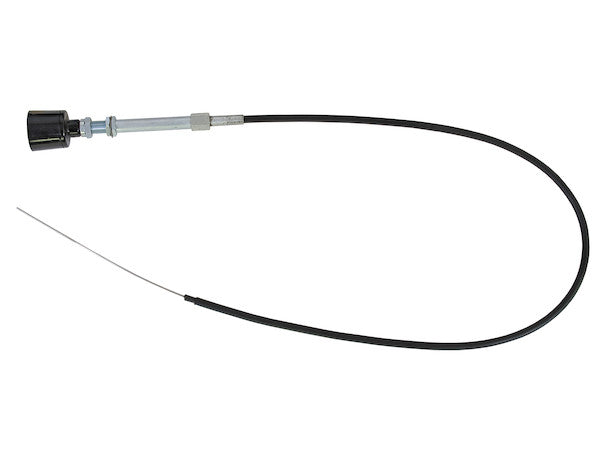
The Plain End Mid-Latch Control Cable with 5 Inch Travel from Buyers Products provides smooth operation of hydraulic valves and forward-reverse PTOs on dump bodies and other heavy machinery. The cable has a 5 in. total travel and is designed to travel 2.5 in. from neutral in either direction. It features a large, easy-to-grab knob that allows gloved hands to activate and deactivate the cable. The mid-latch controls satisfy OSHA requirements for latching hoist controls for dump body applications. It has a strong .091 stainless steel core wire for stable operation and can be cut to fit your specific needs.
Specifications
| Detent Type | Mid-Latch |
| Mount Thread Size (in.) | 5/8-18 " |
| End Type | Plain |
| Conduit Diameter | 0.375 " |
| Bulkhead Thread Size | - " |
| Knob Material | Polyethylene |
| Conduit Material | PVC |
| Cable Length (ft.) | 12.00 ' |
| Cable Core Material | Stainless Steel |
| Total Travel (in.) | 5.00 " |
| Cable Dia (in.) | 0.091 " |
| Rod End Thread Size | - " |
| Cable Series | R38L Series |
| Knob Thread Size | - " |
Advanced Technical Overview: The 12-Foot Plain End Mid-Latch Control Cable for Heavy-Duty Applications
This comprehensive technical overview delves into the design, operational principles, material science, and application specifics of the 12-Foot Plain End Mid-Latch Control Cable from Buyers Products, a critical component engineered for robust and reliable control in heavy machinery. Building upon the foundational description, this analysis provides an in-depth understanding for engineers, maintenance professionals, and procurement specialists.
Precision Engineering and Operational Mechanics
The core function of this control cable lies in its ability to transmit mechanical force over a significant distance, enabling remote actuation of critical systems such as hydraulic valves and power take-offs (PTOs). Its 12-foot length offers considerable flexibility in installation within the complex spatial constraints of heavy equipment, facilitating optimal ergonomic placement of control interfaces for operators. The "Plain End" designation indicates a versatile termination, allowing for custom fitting and attachment mechanisms to be integrated on-site, adapting the cable to a diverse range of mechanical linkages, levers, or clevis systems.
A key distinguishing feature is the "Mid-Latch" detent type. This mechanism is paramount for applications requiring a stable, defined neutral position, from which movement in either direction initiates a specific action. The design specifies a total travel of 5 inches, symmetrically distributed as 2.5 inches from the neutral position in both forward and reverse directions. This bidirectional travel capability is essential for controlling functions like forward/reverse PTO engagement, or modulating the flow direction in a hydraulic valve. The mid-latch system inherently provides tactile feedback to the operator, confirming the cable's position and preventing inadvertent actuation, thereby enhancing operational safety and precision. This mechanical detent is meticulously engineered to maintain its latching integrity under typical operational vibrations and forces experienced in heavy machinery environments, ensuring that selected positions are held until intentionally overridden by the operator.
Material Science and Durability
The longevity and consistent performance of control cables in demanding environments are intrinsically linked to their material composition. This control cable is constructed with materials selected for their superior mechanical properties and resistance to environmental degradation.
Cable Core: Stainless Steel (.091 inch diameter)
The heart of this control cable is its .091-inch diameter stainless steel core wire. Stainless steel is chosen for several compelling reasons:
- High Tensile Strength: It provides the necessary tensile strength to transmit force efficiently without undue stretching or deformation, ensuring precise control.
- Corrosion Resistance: Heavy machinery frequently operates in conditions exposed to moisture, road salts, chemicals, and abrasive particles. Stainless steel inherently resists rust and corrosion, extending the cable's operational life significantly compared to plain carbon steel alternatives.
- Fatigue Resistance: The cable core is subjected to repetitive push-pull cycles. Stainless steel exhibits excellent fatigue resistance, mitigating the risk of material failure due to cyclical stress over extended periods of operation.
- Stable Operation: A robust core wire minimizes backlash and ensures a direct, responsive connection between the control knob and the actuated mechanism.
Conduit: PVC (0.375 inch diameter)
Encasing the stainless steel core is a protective conduit made of Polyvinyl Chloride (PVC) with a nominal diameter of 0.375 inches. The PVC conduit serves multiple critical functions:
- Protection: It shields the internal core wire from external contaminants such as dirt, dust, moisture, and chemical splashes, which could otherwise impede smooth operation or accelerate wear.
- Lubrication Retention: The inner lining of the conduit often incorporates a low-friction polymer or retains factory-applied lubricant, facilitating smooth gliding of the core wire and reducing frictional losses.
- Flexibility and Routing: PVC offers a balance of rigidity and flexibility, allowing the cable to be routed around obstacles within the machinery while maintaining its structural integrity.
- Environmental Shielding: It provides a degree of UV resistance and can withstand a range of temperatures typically encountered in heavy equipment operation.
Control Knob: Polyethylene
The operator interface, the control knob, is fabricated from Polyethylene. This material choice is driven by ergonomic and environmental considerations:
- Durability: Polyethylene is a tough, impact-resistant polymer, capable of withstanding the rigors of frequent use in industrial settings.
- Ergonomics: The design incorporates a large, easy-to-grab knob, which is particularly beneficial for operators wearing work gloves, enhancing grip and reducing the effort required for actuation.
- Chemical Resistance: It resists common chemicals, oils, and greases, ensuring the knob maintains its structural integrity and appearance over time.
- Temperature Stability: Polyethylene performs reliably across a broad range of operating temperatures without becoming brittle in cold conditions or overly soft in hot conditions.
Compliance and Safety Features
A crucial aspect of this control cable's design is its compliance with safety regulations, specifically addressing OSHA requirements for latching hoist controls for dump body applications. The mid-latch mechanism is integral to meeting these standards. For dump bodies, accidental or unintended activation of the hoist mechanism can lead to severe accidents. A latching control ensures that the hoist remains in its current state (e.g., lowered, raised, or paused) unless the operator deliberately disengages the latch and moves the control. This deliberate action minimizes the risk of unintended movement, thereby significantly enhancing workplace safety. The tactile and auditory feedback provided by a well-engineered detent system further reinforces operator awareness of the control's status.
Installation and Customization
The "Plain End" design offers significant advantages in terms of installation flexibility. Unlike pre-terminated cables, plain end cables allow for on-site customization of the attachment mechanism. This means that whether the application requires a custom clevis, a threaded rod end, or a specific bracket, the cable can be cut to fit and appropriately terminated by qualified personnel using standard cable swaging or crimping tools. This adaptability reduces inventory requirements and allows for precise integration into a variety of OEM and aftermarket configurations.
The stated "Mount Thread Size (in.)" of 5/8-18 inches indicates the standard threading for securing the cable's conduit to a control panel or bulkhead. This standardized thread size ensures compatibility with a wide range of mounting hardware and allows for a secure, vibration-resistant installation of the control assembly. The "Conduit Diameter" of 0.375 inches is also a standard dimension, simplifying the selection of appropriate glands, clamps, and support components for routing and protecting the cable.
Applications and Operational Context
The primary applications highlighted — hydraulic valves and forward-reverse PTOs on dump bodies and other heavy machinery — underscore the cable's suitability for demanding, high-cycle operations. Let's explore these applications in more detail:
- Hydraulic Valves: In hydraulic systems, these cables are used to actuate spool valves, directing hydraulic fluid flow to cylinders or motors. The mid-latch feature is critical for maintaining a valve position (e.g., "raise," "hold," "lower") until intentionally changed. This prevents creep or drift in hydraulic functions, which is vital for precise load handling in applications like crane operation, excavator bucket control, or snowplow blade positioning.
- Forward-Reverse PTOs: Power Take-Off (PTO) systems transfer mechanical power from an engine to auxiliary equipment. For applications like salt spreaders, concrete mixers, or winches, a forward-reverse PTO allows the operator to control the direction of the auxiliary equipment's operation. The mid-latch ensures the PTO remains engaged in the selected direction or disengaged until a deliberate action is taken, preventing accidental reversal or engagement.
- Dump Body Hoist Controls: As previously mentioned, compliance with OSHA requirements is paramount here. The mid-latch control provides a fail-safe mechanism, ensuring the dump body remains in its intended position (e.g., raised for unloading, lowered for transport) without accidental movement.
Beyond these specific examples, the cable's robust design makes it suitable for a multitude of other heavy-duty applications where remote, precise, and secure control is required, including:
- Agricultural machinery (e.g., controlling implement depth, steering, or auxiliary functions).
- Construction equipment (e.g., controlling auxiliary attachments, throttle, or transmission linkages).
- Utility vehicles (e.g., controlling boom functions, outriggers, or specialized equipment).
- Marine applications (e.g., controlling throttles, gears, or steering in workboats).
Technical Specifications in Detail
Revisiting the specifications table with a deeper technical lens:
- Detent Type: Mid-Latch - Confirms the central, stable neutral position with positive engagement in either direction. This is a critical safety and operational feature.
- Mount Thread Size (in.): 5/8-18" - Standardized thread for secure panel or bulkhead mounting, ensuring robust installation. This specification is crucial for design engineers and fabricators for integration.
- End Type: Plain - Emphasizes customization flexibility for terminal fittings, offering adaptability across various mechanical interfaces.
- Conduit Diameter: 0.375" - The outer diameter of the protective sheath, important for selecting appropriate cable clamps, routing guides, and grommets.
- Bulkhead Thread Size: - " - Indicates that this specific model does not feature a pre-threaded bulkhead fitting on the cable itself; the mount thread size refers to the control head assembly.
- Knob Material: Polyethylene - Selected for durability, ergonomic grip (even with gloves), and resistance to environmental factors.
- Conduit Material: PVC - Provides protection, flexibility, and environmental resistance to the core wire.
- Cable Length (ft.): 12.00' - A generous length allowing for versatile routing in large vehicles, minimizing the need for extension cables or convoluted paths.
- Cable Core Material: Stainless Steel - Ensures high strength, corrosion resistance, and fatigue life.
- Total Travel (in.): 5.00" - The total linear displacement of the core wire, with 2.5 inches in each direction from neutral. This determines the potential range of motion for the actuated mechanism.
- Cable Dia (in.): 0.091" - The precise diameter of the stainless steel core wire, directly impacting its tensile strength and stiffness.
- Rod End Thread Size: - " - Reconfirms the "Plain End" nature, implying that any rod end threading would be added post-purchase or as part of a custom assembly.
- Cable Series: R38L Series - Identifies the specific product line or family, useful for cross-referencing with manufacturer documentation for detailed drawings, installation guides, or replacement parts.
- Knob Thread Size: - " - Indicates that the knob is likely press-fit or permanently affixed, rather than threaded onto a separate shaft.
Maintenance and Longevity
While designed for minimal maintenance, periodic inspection of the control cable assembly is recommended. This includes checking for:
- Conduit Integrity: Look for cracks, abrasions, or kinks in the PVC conduit that could compromise its protective function.
- Smooth Operation: Ensure the cable moves freely without excessive friction or binding. Any stiffness may indicate internal contamination or lubrication degradation.
- Mounting Security: Verify that the control head and cable supports are securely fastened, preventing strain on the cable and ensuring stable operation.
- End Fitting Wear: For custom-attached plain ends, inspect the terminal connection for wear, corrosion, or loosening.
Proper lubrication, as specified by the manufacturer or standard industry practices for push-pull cables, can significantly extend the life of the cable by reducing internal friction and preventing corrosion of the core wire.
Conclusion
The 12-Foot Plain End Mid-Latch Control Cable from Buyers Products represents a meticulously engineered solution for critical control functions in heavy-duty machinery. Its combination of robust materials, precise mechanical design (especially the mid-latch detent), and compliance with safety standards ensures reliable, safe, and durable performance. The inherent flexibility offered by its plain end design and generous length makes it a highly adaptable component for a wide array of industrial, construction, and agricultural applications, providing operators with precise and secure control over essential equipment functions. This product stands as a testament to practical engineering tailored for the challenging environments of heavy equipment operation.