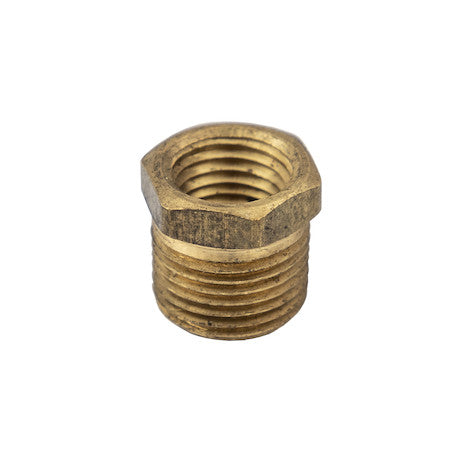
Buyers Products Reducer Bushing is constructed from brass and allows you to connect two different sizes of air tubing in-line. Available in 3/8 in. by 1/4 in. or 1/2 in. by 3/8 in. sizing.
Specifications
| Finish | Plain |
|---|---|
| Material | Brass |
| Shape | Run Tee |
| Side 1 | 3/8 NPT |
| Side 2 | 1/4 NPT |
| Style | MF |
Brass Reducer Bushing - Precision Engineering for Seamless Air System Integration
In the intricate world of pneumatic systems, the integrity and efficiency of connections are paramount. The Brass Reducer Bushing, specifically designed for a transition from 3/8 NPT to 1/4 NPT, represents a critical component for ensuring robust and reliable air tubing integration. This meticulously engineered fitting from Buyers Products is crafted from high-grade brass, providing a durable and effective solution for connecting air tubing lines of disparate diameters. This detailed description will delve into the technical specifications, material advantages, application scenarios, and installation considerations that underscore the value of this essential pneumatic fitting.
Understanding the Core Functionality: Reducer Bushings
A reducer bushing serves as a vital adapter, facilitating the connection between two components with different thread sizes. In the context of the Buyers Products Reducer Bushing, its primary role is to enable the seamless transition from a 3/8-inch NPT threaded connection to a 1/4-inch NPT threaded connection. This capability is indispensable in systems where varying flow requirements, pressure zones, or existing infrastructure necessitate the integration of different tubing or piping diameters. The in-line configuration ensures a straightforward and compact connection, minimizing system complexity and potential leak points.
National Pipe Taper (NPT) Threads Explained
The specification of NPT (National Pipe Taper) threads is crucial for understanding the design and application of this reducer bushing. NPT threads are a U.S. standard for tapered threads used in pipes and fittings to create a liquid-tight and gas-tight seal. The taper allows the threads to wedge into each other when tightened, forming a seal without the need for additional gaskets or washers, although thread sealants (like PTFE tape or pipe dope) are highly recommended for optimal performance, especially in pneumatic applications where leak prevention is critical. The 3/8 NPT and 1/4 NPT designations refer to the nominal pipe size, which does not directly correspond to the actual thread diameter but rather to the internal diameter of the pipe it is designed to fit. The precise machining of these tapered threads on the brass bushing ensures compatibility and a secure mechanical interlock with corresponding NPT components.
Material Excellence: The Advantages of Brass Construction
The choice of brass as the construction material for this reducer bushing is a deliberate decision rooted in its exceptional physical and chemical properties, making it an ideal candidate for pneumatic and fluid handling applications. Brass is an alloy primarily composed of copper and zinc, often with small additions of other elements like lead (for machinability), tin, or manganese to enhance specific characteristics. Its inherent qualities provide a multitude of benefits:
- Corrosion Resistance: Brass exhibits excellent resistance to corrosion, particularly from water, air, and various chemicals commonly encountered in industrial environments. This property is vital for maintaining the integrity and longevity of the fitting, preventing material degradation that could lead to leaks or system failures.
- Durability and Strength: While ductile, brass possesses significant strength and hardness, allowing it to withstand the mechanical stresses and pressures inherent in pneumatic systems. This durability translates into a longer service life and reduced need for frequent replacements.
- Malleability and Machinability: Brass is highly malleable, allowing it to be easily formed and machined into complex shapes with high precision. This characteristic is critical for manufacturing the intricate NPT threads and the precise internal geometry required for optimal flow characteristics.
- Thermal Conductivity: Brass has good thermal conductivity, which can be beneficial in applications where temperature regulation or heat dissipation is a factor, though less critical for air tubing connections compared to other fluid systems.
- Low Friction: The smooth surface finish attainable with brass, combined with its inherent properties, contributes to low friction losses within the fitting, aiding in efficient air flow.
- Aesthetics and Professional Appearance: The natural golden hue of brass provides a clean and professional appearance, which can be an advantage in visible installations or equipment. The "Plain" finish indicates the natural brass state without additional coatings or treatments, allowing its inherent properties to shine through.
- Recyclability: Brass is a highly recyclable material, making it an environmentally responsible choice for manufacturing components.
Design and Configuration: MF Style and Sizing
The "Style: MF" designation indicates a Male-Female configuration. This means one end of the bushing features an external (male) thread, while the other end incorporates an internal (female) thread. This design is highly versatile, allowing for direct connection to both internally and externally threaded components. Specifically, with "Side 1: 3/8 NPT" and "Side 2: 1/4 NPT," it implies a male thread on one size and a female thread on the other, facilitating the reduction in pipe size while providing the necessary male/female interface for a secure connection within an existing system.
The available sizing options, 3/8 in. by 1/4 in. and 1/2 in. by 3/8 in., demonstrate the product's utility across a range of common pneumatic tubing diameters. This particular model focuses on the 3/8 NPT to 1/4 NPT reduction, addressing a frequent requirement in many industrial and commercial applications.
While the specifications table lists "Shape: Run Tee," it is important to clarify based on the title "Brass Reducer Bushing" and description "connect two different sizes of air tubing in-line" that this product functions as a direct, concentric reducer. A run tee typically has three ports forming a 'T' shape. Given the context of a "reducer bushing" with specified "Side 1" and "Side 2" and "MF" style, this product is designed for a straight-line reduction between two different pipe sizes, not a branching connection. This ensures a compact and efficient transition within a single air line.
Diverse Applications of the Reducer Bushing
The utility of the Brass Reducer Bushing extends across a broad spectrum of industries and applications where pneumatic systems are employed. Its reliability and precise engineering make it an indispensable component in:
- Automotive and Heavy-Duty Truck Systems: Essential for air brake lines, suspension systems, and auxiliary pneumatic controls where varying pipe sizes need to be integrated for different pressure zones or components.
- Industrial Automation and Manufacturing: Used in assembly lines, robotic systems, and processing equipment for connecting air cylinders, valves, and other pneumatic actuators that may have different port sizes.
- HVAC Systems: For control air lines, damper actuators, and other pneumatic components within heating, ventilation, and air conditioning infrastructure.
- Agricultural Equipment: In machinery utilizing air power for various functions, such as seeding, spraying, or pneumatic tools.
- Construction Equipment: For integrating pneumatic tools and systems on heavy machinery.
- Marine Applications: Where resistance to corrosion and robust connections are critical in harsh environments.
- General Compressed Air Systems: Facilitating the adaptation of larger main lines to smaller branch lines for specific tools or processes.
The ability to connect 3/8-inch lines to 1/4-inch lines (or 1/2-inch to 3/8-inch for the alternative option) provides flexibility in system design and repair, allowing engineers and technicians to adapt existing infrastructure or optimize new installations without replacing entire sections of tubing.
Technical Considerations for Installation and Performance
Proper installation of the Brass Reducer Bushing is critical to ensuring a leak-free and high-performance pneumatic system. Several technical considerations must be observed:
- Thread Compatibility: Always ensure that the mating threads are also NPT compliant and of the correct nominal size (3/8 NPT for Side 1 and 1/4 NPT for Side 2). Incompatible threads can lead to damage, leaks, and potential system failure.
- Thread Sealant Application: While NPT threads are designed to seal through wedging, the use of an appropriate thread sealant is paramount for pneumatic applications. PTFE (Teflon) tape, applied correctly (clockwise along the threads, typically 2-3 wraps), or a high-quality pipe dope suitable for air systems, will fill any microscopic gaps and ensure an airtight seal.
- Torque Specifications: Fittings should be tightened to the manufacturer's recommended torque specifications. Over-tightening can deform the brass, damage the threads, or crack the mating component, leading to leaks or component failure. Under-tightening will result in an insufficient seal and leaks. A general guideline for NPT brass fittings is to hand-tighten until snug, then use a wrench for an additional 1 to 2 turns, but specific recommendations should always be followed if available.
- System Pressure and Temperature Ratings: While brass is robust, it is essential to confirm that the bushing, along with all other components in the system, is rated for the maximum operating pressure and temperature. Exceeding these limits can lead to catastrophic failure. Brass fittings are generally suitable for a wide range of common pneumatic operating conditions.
- Cleanliness: Before installation, ensure that both the bushing and the mating components are clean and free of dirt, debris, or metal shavings. Contaminants can prevent a proper seal or introduce foreign particles into the air system, potentially damaging downstream components.
- Vibration and Movement: In systems subject to significant vibration or movement, consider using appropriate bracing or supports for the tubing and components to prevent excessive stress on the fittings, which could lead to premature wear or failure.
Long-Term Value and Maintenance
The Brass Reducer Bushing, due to its inherent material properties and precision manufacturing, offers significant long-term value. Its resistance to corrosion and durable construction minimizes the need for frequent replacement, contributing to lower maintenance costs and reduced downtime. While brass fittings typically require minimal maintenance themselves, periodic inspection of the entire pneumatic system is advisable to check for any signs of wear, corrosion, or loosening. Early detection of potential issues can prevent costly repairs and maintain optimal system performance. For instance, air leaks, even minor ones, can significantly impact energy efficiency and the overall operation of a pneumatic system. Regular leak checks using soap solutions or ultrasonic detectors can help identify and rectify issues promptly.
Environmental Responsibility and Sustainability
The selection of brass as a material for industrial components also aligns with principles of environmental responsibility. Brass is a material with a high scrap value and is fully recyclable without degradation of its properties. This closed-loop material cycle significantly reduces the demand for virgin raw materials and minimizes waste, contributing to a more sustainable manufacturing and usage paradigm for industrial fittings.
Conclusion: The Intelligent Choice for Air System Optimization
The Buyers Products Brass Reducer Bushing, engineered for a 3/8 NPT to 1/4 NPT transition, stands as an exemplar of quality and functional design in pneumatic fittings. Its robust brass construction ensures exceptional durability, superior corrosion resistance, and reliable performance across a myriad of challenging applications. The precision-machined NPT threads, coupled with the versatile Male-Female configuration, guarantee secure and leak-free connections crucial for maintaining system efficiency and safety. By providing an effective means to integrate disparate air tubing sizes, this reducer bushing offers a practical and economical solution for system design, modification, and repair. Choosing this brass reducer bushing means investing in a component that delivers consistent performance, longevity, and contributes to the overall integrity of your pneumatic systems. It is not merely a connector, but a critical element in achieving optimal functionality and reliability in air-driven operations.