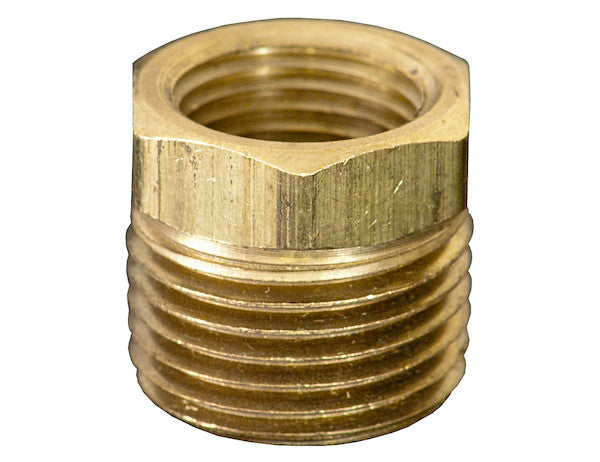
Buyers Products Reducer Bushing is constructed from brass and allows you to connect two different sizes of air tubing in-line. Available in 3/8 in. by 1/4 in. or 1/2 in. by 3/8 in. sizing.
Specifications
| Finish | Plain |
|---|---|
| Material | Brass |
| Shape | Combination Nipple |
| Side 1 | 1/2 NPT |
| Side 2 | 3/8 NPT |
| Style | MF |
Advanced Technical Overview: Brass Reducer Bushing - 1/2 NPT to 3/8 NPT
In industrial and commercial fluid power systems, the precise and reliable connection of dissimilar pipe sizes is a foundational requirement for optimal operational efficiency and system integrity. The Brass Reducer Bushing, specifically designed for a transition from 1/2 NPT to 3/8 NPT, embodies a critical component for facilitating such transitions within pneumatic and low-pressure hydraulic circuits. This technical discourse aims to thoroughly delineate the engineering principles, material science, application specifics, and performance characteristics inherent in this vital fitting, providing a comprehensive understanding for engineers, system designers, and maintenance professionals.
Product Functionality and Design
The primary function of this Brass Reducer Bushing is to enable a secure, leak-free connection between two air tubing segments of differing nominal diameters: a larger 1/2-inch National Pipe Taper (NPT) connection and a smaller 3/8-inch NPT connection. Categorized as a "Combination Nipple" with an "MF" (Male-Female) style, this bushing features a male NPT thread on one end, intended to screw into a female 1/2 NPT port, and a female NPT thread on the other end, designed to accept a male 3/8 NPT fitting or pipe. This configuration allows for a direct in-line reduction, eliminating the need for multiple fittings and thereby reducing potential leak points, installation complexity, and overall material costs. The robust brass construction ensures mechanical stability and chemical compatibility within its specified operating parameters.
Material Science: The Superiority of Brass
The selection of brass as the foundational material for this reducer bushing is a deliberate engineering choice, predicated on its exceptional metallurgical properties that are highly conducive to fluid conveyance applications. Brass, an alloy primarily composed of copper and zinc, typically contains other elements such as lead (for machinability), tin, or aluminum, each contributing to specific enhanced characteristics. For pneumatic and hydraulic fittings, common brass alloys like C36000 (Free-Machining Brass) or C37700 (Forging Brass) are often utilized due to their balanced properties.
Key properties of brass that make it ideal for this application include:
- Corrosion Resistance: Brass exhibits excellent resistance to corrosion from moisture, air, and various industrial fluids. Unlike ferrous metals, brass does not readily rust, which is critical for maintaining system cleanliness and preventing degradation that could lead to leaks or blockages. This property is particularly advantageous in environments with fluctuating humidity or where condensation might occur within air lines.
- Machinability: Brass is renowned for its outstanding machinability, allowing for the precise fabrication of intricate thread profiles and tight tolerances. This ease of machining is crucial for producing high-quality NPT threads that ensure effective mechanical sealing and consistent dimensional accuracy, which is paramount for reliable connections.
- Strength and Durability: While not as strong as some steels, brass provides sufficient tensile and yield strength for pneumatic and low-pressure hydraulic applications. It possesses good ductility, which means it can withstand moderate mechanical stress and vibration without fracturing, contributing to the long-term durability of the fitting.
- Thermal Conductivity: Brass has a higher thermal conductivity than many other common metals, which can be beneficial in certain applications where heat dissipation is required, or where rapid temperature equalization across the fitting is desirable.
- Galling Resistance: Brass-on-brass or brass-on-steel connections tend to exhibit good galling resistance, which prevents cold welding or seizing of mating threads during assembly and disassembly, thereby extending the service life of both the fitting and the mating components.
- Cost-Effectiveness: When considering the balance of performance, machinability, and longevity, brass fittings often present a highly cost-effective solution compared to alternatives like stainless steel for non-aggressive fluid systems.
The "Plain" finish further indicates that the brass material has not undergone any additional surface treatments such as plating (e.g., nickel or chrome) or painting. This is often preferred in applications where the inherent properties of brass are sufficient, and the natural appearance and galvanic compatibility of brass are desired. It also contributes to cost efficiency and simplifies recycling processes at the end of the product's lifecycle.
Thread Specifications: Understanding NPT
The designation "NPT" refers to National Pipe Taper, a widely adopted standard for tapered threads used on pipes and fittings in the United States and Canada. The tapering of the thread is fundamental to its sealing mechanism. Unlike parallel threads that require a separate gasket or O-ring for sealing, NPT threads create a seal by metal-to-metal interference as the male and female threads are tightened. This interference, combined with the application of an appropriate thread sealant (such as PTFE tape or pipe dope), compresses the thread flanks, effectively filling any helical leak paths and achieving a robust, pressure-tight seal.
Key characteristics of NPT threads:
- Taper Angle: Both the male and female NPT threads have a 1°47' (1.7899°) taper from the axis of the pipe. This critical angle ensures the wedging action that forms the seal.
- Thread Form: NPT threads typically have a 60° included angle with flattened crests and roots.
- Nominal Pipe Size: It is crucial to understand that the numerical designation (e.g., 1/2 inch, 3/8 inch) for NPT threads refers to the nominal bore (inside diameter) of the pipe, not the actual measured outside diameter of the thread. For instance, a 1/2 NPT thread has an approximate outside diameter of 0.840 inches, and a 3/8 NPT thread has an approximate outside diameter of 0.675 inches. This distinction is vital to prevent misidentification and ensure compatibility.
- Thread Engagement: Proper sealing requires sufficient thread engagement. Over-tightening can strip threads or crack the fitting, particularly with softer materials like brass. Under-tightening will result in leaks.
The 1/2 NPT to 3/8 NPT specification means the larger end of the bushing features a male 1/2 NPT thread, designed to interface with a female 1/2 NPT port. The smaller end is a female 3/8 NPT port, ready to accept a male 3/8 NPT fitting or pipe. This precise dimensional adherence to the NPT standard guarantees interoperability with a vast array of existing pneumatic and low-pressure hydraulic components.
Applications and System Integration
The Brass Reducer Bushing (1/2 NPT to 3/8 NPT) is an indispensable component across a multitude of industrial and commercial applications, primarily within pneumatic systems but also applicable in certain low-pressure liquid handling contexts where brass is suitable. Its utility stems from the frequent requirement to adapt system components with varying port sizes, optimizing flow, pressure, or component compatibility.
Typical applications include:
- Pneumatic Control Systems: Often used to connect larger main air supply lines (1/2 NPT) to smaller feeder lines (3/8 NPT) that supply air to individual pneumatic actuators, valves, or instruments, enabling precise control and optimizing air consumption.
- Air Compressor Systems: Facilitating connections from larger discharge ports on compressors or air tanks to smaller distribution manifolds or auxiliary equipment.
- Industrial Machinery: Integration into complex machinery where different pneumatic components (e.g., cylinders, FRL units, solenoid valves) possess varying port sizes, requiring a robust and adaptable connection.
- Automotive and Heavy Equipment: Applications such as air brake systems on trucks and buses, or pneumatic suspension systems where air lines and components often feature different thread sizes requiring reliable reduction.
- HVAC and Building Automation: Connecting larger compressed air lines to smaller gauge lines or control devices within climate control or building management systems.
- Water and Fluid Handling (Non-Potable/Low Pressure): In specific industrial scenarios involving non-aggressive, low-pressure fluids where brass compatibility is established, these bushings can be used for pipe size transitions. However, for potable water or high-pressure applications, specific regulatory compliance and pressure ratings must be strictly adhered to.
The ability to transition efficiently between pipe sizes ensures that system designers are not constrained by fixed port configurations, offering flexibility in component selection and layout. This contributes to streamlined designs, reduced inventory of specialized components, and greater adaptability in system modification or expansion.
Installation Best Practices and Considerations
Proper installation of the Brass Reducer Bushing is paramount to achieving a leak-free and durable connection. Adherence to established engineering practices will optimize performance and longevity:
- Thread Sealant Application: Always use an appropriate NPT thread sealant. Polytetrafluoroethylene (PTFE) tape is widely used for pneumatic applications; apply 2-3 wraps in a clockwise direction (for right-hand threads) on the male NPT thread, starting from the second thread in and ensuring the tape does not overhang the pipe opening to prevent contamination. Alternatively, a high-quality pipe thread compound (pipe dope) suitable for the application’s pressure and media can be used.
- Torque Specifications: Brass is a relatively softer metal compared to steel. Over-tightening can deform or crack the fitting, leading to catastrophic failure. Consult specific torque recommendations for NPT fittings of these sizes, or perform a hand-tight plus additional turns method (typically 1 to 2 turns past hand-tight) for pneumatic applications. Avoid using excessive force.
- Tool Selection: Use appropriate wrenches (e.g., pipe wrenches or adjustable wrenches with smooth jaws) to prevent damage to the fitting's exterior or deformation of the threads.
- System Cleanliness: Ensure both the male and female threads, as well as the interior of the bushing and mating components, are free from debris, metal shavings, or foreign particles before assembly. Contaminants can compromise the seal and potentially damage downstream components.
- Leak Testing: After installation, always conduct a thorough leak test using an appropriate method (e.g., soap solution for air lines, pressure decay test) to confirm the integrity of the connection before putting the system into full operation.
- Vibration and Stress: For systems subject to high vibration or mechanical stress, consider additional support or flexible connections to minimize strain on the rigid threaded joint, prolonging its service life.
Quality Assurance and Manufacturing Excellence
The reliability of a reducer bushing is directly correlated with the precision of its manufacturing. High-quality Brass Reducer Bushings are produced using advanced CNC machining processes to ensure strict adherence to NPT thread specifications (ANSI/ASME B1.20.1) and dimensional tolerances. This precision is critical for:
- Thread Profile Accuracy: Ensuring the correct taper, pitch diameter, and crest/root configuration for optimal sealing engagement.
- Concentricity and Alignment: Maintaining proper alignment between the 1/2 NPT and 3/8 NPT ends to prevent undue stress on connected piping and components.
- Surface Finish: Achieving a smooth, consistent surface finish on both threads and sealing faces to minimize friction during assembly and enhance sealing performance.
Reputable manufacturers employ rigorous quality control protocols, including in-process inspections and final product verification, to guarantee that each fitting meets stringent performance criteria for pressure ratings, temperature resistance, and mechanical integrity. Traceability of materials and manufacturing batches is also a hallmark of quality, providing assurance of consistency and accountability.
Maintenance and Longevity
While brass fittings are generally robust and require minimal maintenance, periodic inspection is advisable, especially in critical applications or harsh environments. Checks should include visual inspection for signs of corrosion, mechanical damage (e.g., cracks, deformation from over-tightening), and evidence of leakage (e.g., discoloration, residue). In the event of a detected leak, the connection should be depressurized, disassembled, cleaned, re-sealed with fresh thread sealant, and re-torqued to appropriate specifications. The inherent durability of brass, coupled with proper installation and preventative inspection, ensures an extended operational lifespan for these reducer bushings within their intended application parameters.
Conclusion
The Brass Reducer Bushing, specifically designed for a 1/2 NPT to 3/8 NPT transition, represents a cornerstone component in the efficient and reliable construction of fluid power systems. Its meticulous design, leveraging the inherent advantages of brass material and adherence to the NPT threading standard, ensures a high-performance, durable, and easily integrated solution for connecting disparate pipe sizes. From its exceptional corrosion resistance and machinability to its precise thread geometry, every aspect of this bushing is engineered for maximum operational integrity and longevity in demanding industrial environments. Understanding these technical nuances empowers professionals to deploy this component effectively, optimizing system performance and ensuring long-term reliability.