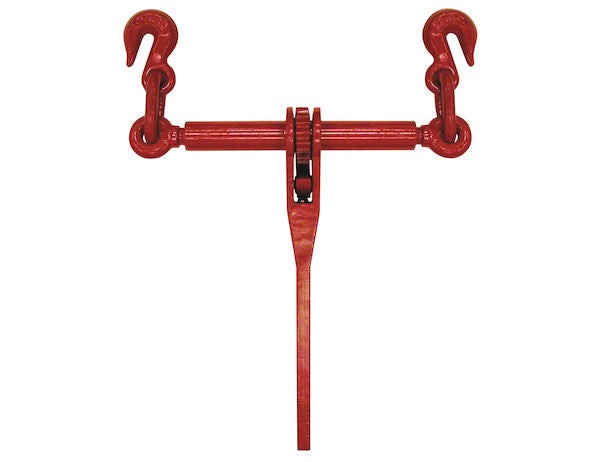
The Ratcheting Load Binder from Buyers Products is a double-acting, ratchet-style load binder that features forged hooks and a cast steel handle with a corrosion-resistant red powder-coated finish. RLB5638 has a working load limit of 6,600 lb, and a minimum breaking strength of 23,100 lb. RLB3812 has a working load limit of 9,200 lb, and a minimum breaking strength of 33,000 lb.
Specifications
| Chain Size (in.) | 5/16-3/8 |
|---|---|
| Handle Length (in.) | 14.25 |
| Minimum Breaking Strength (lbs) | 23,100 |
| W.L.L. (lbs) | 6,600 |
Advanced Technical Overview: 5/16 - 3/8 Inch Ratcheting Load Binder
The Ratcheting Load Binder represents a critical component in the securement of cargo across diverse industrial and transportation sectors. Designed for robust performance and operator safety, this double-acting, ratchet-style load binder from Buyers Products is engineered to meet the stringent demands of heavy-duty hauling. Its precise design, incorporating high-quality materials and manufacturing processes, ensures reliable tensioning and securement for various load configurations, particularly when utilizing 5/16 inch or 3/8 inch transport chains.
Cargo securement is not merely a logistical necessity but a paramount safety and regulatory concern. The Federal Motor Carrier Safety Administration (FMCSA) and other regulatory bodies impose strict guidelines on the methods and equipment used for securing cargo during transit. Non-compliance can lead to severe penalties, accidents, cargo damage, and even fatalities. The Ratcheting Load Binder is explicitly designed to integrate seamlessly into a compliant cargo securement system, providing a robust anchor point and a controlled tensioning mechanism that minimizes risks inherent in dynamic transportation environments.
Mechanism and Operational Advantages of Ratcheting Load Binders
At the core of this product's efficacy is its double-acting, ratchet-style mechanism. Unlike traditional lever binders, which employ an over-center action to apply tension, ratcheting binders utilize a gear-and-pawl system. This design allows for incremental tensioning of the chain in small, controlled steps, providing significant advantages in terms of safety and precision. The double-acting nature implies that the mechanism can both tension and release the chain under continuous control, eliminating the sudden snap-back or recoil commonly associated with lever binders during release. This controlled operation significantly reduces the risk of operator injury, which can occur due to the potential energy stored in a tensioned system. The gradual application and release of tension also protect the cargo itself from shock loads, making this binder ideal for securing sensitive or fragile equipment.
The ratcheting action allows operators to achieve optimal tension with less physical effort, as the force is applied incrementally rather than requiring a single, forceful pull. This also enables more precise adjustments, ensuring even distribution of tension across multiple securement points and preventing localized stress concentrations on the cargo or trailer. Furthermore, the inherent design of a ratcheting binder ensures that the tension remains locked even if the operator releases the handle, preventing accidental loosening and enhancing overall load security during transit.
Engineered for Durability: Materials and Construction
The structural integrity and longevity of a load binder are dictated by the quality of its components. The Buyers Products Ratcheting Load Binder excels in this regard through the thoughtful selection of materials and manufacturing techniques.
Forged Hooks
The hooks, which are the primary interface between the binder and the transport chain, are subjected to immense tensile forces. To withstand these forces without yielding, bending, or fracturing, these hooks are drop-forged. Forging is a manufacturing process that involves shaping metal through localized compressive forces, typically using hammers or dies. This process results in a superior metallurgical grain structure compared to casting. In forged components, the grain flow of the metal follows the contour of the part, enhancing its strength, toughness, and fatigue resistance by eliminating internal voids and refining the grain. This makes forged hooks exceptionally durable and resistant to impact and wear, critical attributes for safety-critical components like load binders. The precise alloy steel used in the forging process contributes to their high strength-to-weight ratio and resistance to environmental stressors.
Cast Steel Handle
The handle of the Ratcheting Load Binder is constructed from cast steel. Casting involves pouring molten metal into a mold to form the desired shape. For handles, cast steel offers several advantages. It allows for the creation of complex, ergonomic shapes that provide a comfortable and secure grip for the operator, reducing hand fatigue during operation. Cast steel possesses excellent strength and rigidity, ensuring that the handle can withstand the forces required for tensioning without deforming. While forging enhances ductility and fatigue resistance, casting offers design flexibility and sufficient strength for the handle's primary function, which is to provide leverage for the internal ratcheting mechanism. The robust nature of cast steel ensures the handle maintains its structural integrity through repeated use in demanding conditions.
Corrosion-Resistant Red Powder-Coated Finish
Exposure to the elements – moisture, road salts, chemicals, and UV radiation – can significantly degrade metal components, leading to corrosion and compromising structural integrity. To combat this, the cast steel handle, and often other metal components, are finished with a corrosion-resistant red powder coating. Powder coating is a dry finishing process where finely ground particles of pigment and resin are electrostatically charged and sprayed onto a grounded metal surface. The charged powder particles adhere to the electrically grounded surfaces until heated and fused into a smooth coating in a curing oven. This process creates a much thicker, harder, and more durable finish than conventional liquid paint. The red color serves a practical purpose beyond aesthetics: it enhances visibility, making the binder easy to locate on a trailer, particularly in low-light conditions, and contributes to rapid identification of equipment. The powder coating provides excellent resistance to chipping, scratching, abrasion, and fading, ensuring the binder maintains its functional integrity and appearance over an extended service life, even when subjected to harsh operational environments.
Detailed Specifications and Performance Metrics
The performance capabilities of a load binder are quantified by specific technical parameters, paramount among which are the Working Load Limit (WLL) and Minimum Breaking Strength (MBS). These values are critical for compliance with safety regulations and for ensuring the safe operation of cargo securement systems.
Chain Size Compatibility (5/16 - 3/8 Inch)
This Ratcheting Load Binder is designed for versatility, compatible with both 5/16 inch and 3/8 inch transport chains. This dual compatibility is highly advantageous for operators who utilize various chain sizes depending on the load and regulatory requirements. It is imperative that the load binder's chain size rating matches or exceeds the chain being used. Transport chains are typically graded by their strength, with common grades being Grade 70 (G70), Grade 80 (G80), and Grade 100 (G100). For instance, a 5/16 inch Grade 70 chain typically has a WLL of 4,700 lbs, while a 3/8 inch Grade 70 chain has a WLL of 6,600 lbs. Matching the binder's capacity to the chain's WLL is fundamental to creating a safe and compliant securement system, preventing the binder from being the weak link. The dual compatibility allows for operational flexibility without compromising safety, provided the WLL of the binder is appropriately considered for the specific chain in use.
Working Load Limit (WLL)
The Working Load Limit (WLL) is the maximum mass or force that a piece of lifting or securing equipment can safely support when new and in an undamaged condition. For the RLB5638 variant of this binder, the WLL is specified at 6,600 lb. This value is not arbitrary; it is determined by applying a safety factor to the Minimum Breaking Strength. Industry standards and regulatory bodies typically mandate a safety factor, often 3:1 or 4:1, meaning the WLL is one-third or one-fourth of the MBS. Adhering strictly to the WLL is non-negotiable. Exceeding the WLL significantly increases the risk of equipment failure, which can lead to catastrophic consequences. When calculating the total securement capacity for a load, the WLL of each component (binder, chain, tie-down point) must be considered, and the lowest WLL among all components in the securement system dictates the overall WLL of that specific securement assembly. It's also important to note the existence of other models, such as the RLB3812, which offers a higher WLL of 9,200 lb, catering to even heavier duty applications and emphasizing the product line's breadth.
Minimum Breaking Strength (MBS)
The Minimum Breaking Strength (MBS), also referred to as Ultimate Tensile Strength (UTS), is the minimum force required to cause a component to break or fail under tension. For the RLB5638 model, the MBS is 23,100 lb. This value is critical in establishing the safety margin for the equipment. A safety factor is inherently built into the design by specifying the WLL as a fraction of the MBS. For instance, a WLL of 6,600 lb against an MBS of 23,100 lb implies a safety factor of approximately 3.5:1 (23,100 / 6,600 = 3.5). This robust safety factor provides a critical buffer against unforeseen dynamic forces, shock loads, or minor wear and tear that might occur during transit, ensuring that the binder maintains its integrity even under stresses approaching, but not exceeding, the WLL. The MBS value is typically determined through destructive testing of multiple samples under controlled laboratory conditions to ensure consistent performance.
Handle Length (14.25 Inches)
The handle length of 14.25 inches is a carefully considered ergonomic and mechanical design parameter. A longer handle provides greater leverage, allowing the operator to apply the necessary tension with less effort. However, an excessively long handle could lead to overtightening, which can damage the cargo, the securement chain, or the binder itself, or even create a safety hazard by allowing operators to stand too far from the work area. The 14.25-inch length represents an optimal balance, providing sufficient leverage for the rated WLL while encouraging controlled and safe operation. It facilitates the precise, incremental adjustments characteristic of a ratcheting binder, enhancing both efficiency and operator safety by preventing the need for extensions or excessive force.
Applications Across Industries
The robust design and operational safety features of the 5/16 - 3/8 Inch Ratcheting Load Binder make it indispensable across a spectrum of industries that involve the transportation of heavy or oversized cargo. Its primary applications include:
- Trucking and Logistics: Essential for flatbed, step deck, and lowboy trailer operations, securing construction materials, machinery, steel coils, lumber, and other general freight.
- Construction: Transporting excavators, bulldozers, loaders, generators, and large pre-fabricated structures to job sites.
- Agriculture: Securing farm machinery such as tractors, combines, planters, and other implements for transport between fields or to service centers.
- Forestry: Crucial for bundling and securing logs, timber, and specialized logging equipment on dedicated trailers.
- Heavy Haul: Employed in conjunction with other securement devices for the transport of exceptionally heavy and dimensionally critical loads.
- Utility and Energy: Securing transformers, poles, pipes, and other infrastructure components.
In each of these contexts, the controlled tensioning and release offered by the ratcheting mechanism contribute significantly to preventing load shift, minimizing transit damage, and safeguarding personnel.
Safety, Compliance, and Best Practices
Operating load binders and cargo securement systems requires strict adherence to safety protocols and regulatory standards. The Ratcheting Load Binder is designed to facilitate compliance, but operator diligence remains paramount.
Regulatory Compliance
In North America, the Federal Motor Carrier Safety Administration (FMCSA) regulations (specifically 49 CFR Part 393, Subpart I – Protection against shifting and falling cargo) govern cargo securement. These regulations specify the minimum number of tiedowns required based on cargo weight and length, the WLL of securement devices, and proper securement methods. The 6,600 lb WLL of the RLB5638 (and 9,200 lb for RLB3812) is a key metric in calculating the aggregate working load limit of a securement system to ensure it meets or exceeds the required securement capacity, typically at least 50% of the cargo's weight for general freight.
Pre-Trip and In-Transit Inspections
Before each trip, a thorough inspection of all cargo securement equipment is mandatory. This includes checking the binder for signs of wear, deformation, cracks, excessive corrosion, or bent components. The hooks must be free of nicks or gouges, and the ratcheting mechanism must operate smoothly without binding. Chains should be inspected for bent, stretched, or cracked links. During transit, especially after the first 50 miles and then periodically, the securement system must be re-tensioned as loads can shift and chains can stretch, potentially loosening the binders.
Proper Use Techniques
Operators should always apply tension evenly across multiple binders. Avoid overtightening, as this can damage cargo, chains, or the binder itself. Never use cheater bars or handle extensions with load binders, as this dramatically increases the leverage beyond the design limits, risking component failure and serious injury. Ensure that the chain is correctly seated in the hooks and that there are no twists or kinks in the chain. When releasing tension, use the controlled, incremental release mechanism of the ratchet binder to prevent sudden load shifts or recoil.
Maintenance and Longevity
Proper maintenance significantly extends the service life and ensures the continued safe operation of the Ratcheting Load Binder. Regular cleaning to remove dirt, grit, and debris is essential, as these can interfere with the smooth operation of the ratchet mechanism. Periodic lubrication of the moving parts, such as the gears and pawls, with a suitable grease or oil will prevent wear and ensure ease of operation. Storage in a dry, protected environment away from corrosive chemicals will preserve the integrity of the powder coating and the metal components. Any binder showing signs of significant wear, deformation, or damage should be immediately removed from service and replaced to maintain safety standards.
Conclusion
The 5/16 - 3/8 Inch Ratcheting Load Binder from Buyers Products is a sophisticated and robust solution for cargo securement, engineered for performance, durability, and operator safety. Its double-acting ratchet mechanism provides unparalleled control during both tensioning and release, significantly mitigating risks associated with traditional lever binders. Constructed with forged hooks for superior strength and a cast steel handle protected by a corrosion-resistant powder coating, it is built to endure the harshest operational demands. With a Working Load Limit of 6,600 lb (for model RLB5638) and an impressive Minimum Breaking Strength of 23,100 lb, it offers a substantial safety margin for securing a wide range of cargo types. This binder is an essential tool for professionals who prioritize safety, efficiency, and compliance in their heavy-duty transportation operations, representing a strategic investment in reliable and secure logistics.