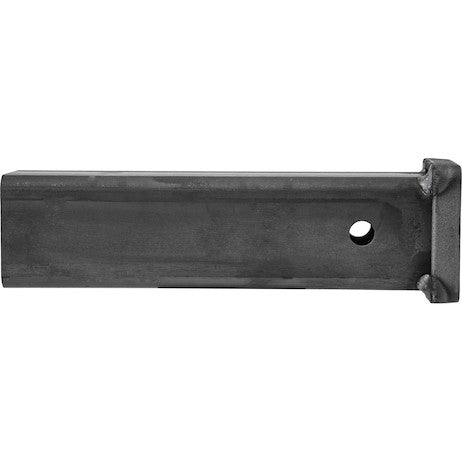
Receiver Tubes from Buyers Products are available in a variety of lengths, dimensions, and finishes to match your towing needs. The 2, 2-1/2, and 3 in. tubes have a cast steel collar. All tubes feature a solid stress collar opening. The 2, 2-1/2, and 3 in. tubes have a 5/8 in. hitch pin hole.
Specifications
| Finish | Plain |
|---|---|
| Length (in.) | 12.00 |
| Material | Carbon Steel |
| Mount Type | Weld On |
| Mounting Hole Size (in.) | 0.656 |
| Receiver Size (in.) | 2.50 |
The 2-1/2 Inch Plain Receiver Tube with a 12 Inch Shank, manufactured by Buyers Products, represents a critical component in the fabrication of robust and reliable towing and attachment systems. Engineered for demanding applications, this receiver tube is meticulously designed to offer superior structural integrity, operational versatility, and long-term durability, making it an indispensable asset for custom vehicle builders, equipment manufacturers, and heavy-duty vehicle upfitters. Its specifications, including the 2.50-inch receiver size, 12.00-inch length, carbon steel material, plain finish, and weld-on mount type, are carefully selected to meet stringent performance requirements.
Precision Engineering and Material Excellence
At the core of this receiver tube's performance is its precision engineering and the selection of high-grade carbon steel. The 2.50-inch nominal receiver size is a standard dimension for medium to heavy-duty towing applications, providing a secure interface for a wide range of drawbars, ball mounts, and specialized attachments. This size class is particularly suited for applications requiring greater load capacity than typical 2-inch receivers, without escalating to the often oversized 3-inch alternatives, striking an optimal balance between strength and compatibility. The internal dimensions are manufactured to precise tolerances, ensuring a snug yet functional fit for mating components, thereby minimizing play and potential for wear under dynamic loads.
The 12.00-inch shank length offers significant flexibility in custom fabrication. This extended length allows fabricators to integrate the receiver tube into diverse frame configurations, accommodating varying frame rail widths, bumper designs, and chassis clearance requirements. It provides ample material for secure welding to structural crossmembers or frame extensions, ensuring that the attachment point is robustly integrated into the vehicle's chassis. The ability to cut the shank to a custom length also minimizes material waste and simplifies the fabrication process, providing an adaptable solution for unique installation challenges.
Constructed from high-strength carbon steel, this receiver tube is designed to withstand the severe stresses associated with towing and heavy equipment operation. Carbon steel is renowned for its excellent mechanical properties, including high tensile strength, yield strength, and fatigue resistance, which are crucial for components subjected to repetitive loading and dynamic forces. The material's inherent ductility allows it to absorb significant energy before fracturing, a vital safety characteristic in towing applications where sudden impacts or overloading can occur. Furthermore, carbon steel exhibits superior weldability, facilitating strong, durable connections that are essential for the weld-on mounting methodology. The material's composition is carefully controlled to ensure consistent quality and predictable performance across all units.
Design Features for Enhanced Performance and Durability
A distinctive feature of this receiver tube is the cast steel collar. This collar is strategically integrated at the opening of the tube, serving as a critical reinforcement point. Unlike tubes with simple cut ends, the cast collar significantly enhances the structural integrity of the receiver opening, mitigating stress concentrations that could otherwise lead to premature fatigue cracking. The casting process allows for complex geometries that optimize material distribution for maximum strength at this high-stress interface. This solid stress collar opening ensures that the forces from the hitch pin and the coupled accessory are distributed evenly around the receiver opening, preventing deformation and preserving the tube's dimensional stability over its operational lifespan.
The mounting hole, precisely drilled to 0.656 inches (approximately 21/32 inch), is designed to accommodate standard 5/8-inch hitch pins. This slightly oversized dimension provides the necessary clearance for easy pin insertion and removal, even when minor surface imperfections or paint accumulation might be present on the pin or tube. The accuracy of this drilling is paramount, as a precisely aligned hole is crucial for secure coupling and for ensuring the hitch pin bears the load correctly without excessive shear stress on the pin or deformation of the hole itself. The consistent diameter throughout the collar and the tube wall ensures a straight path for the pin, facilitating quick and reliable connections.
The plain finish of the receiver tube is a deliberate design choice, optimized specifically for weld-on applications. A plain finish, free from paint, powder coating, or galvanization, ensures direct metal-to-metal contact, which is essential for creating high-quality, structurally sound welds. Any surface coating would necessitate removal prior to welding, adding an extra, time-consuming step to the fabrication process. By providing a clean, unadulterated steel surface, this receiver tube allows fabricators to achieve optimal weld penetration and fusion, minimizing the risk of weld defects. Post-welding, the fabricator has complete control over the final protective coating, which can be tailored to the specific environmental and aesthetic requirements of the end application, whether it be a robust powder coat, industrial paint, or even galvanization for extreme corrosion resistance.
Weld-On Mounting: Advantages and Installation Considerations
The weld-on mount type is a significant advantage for applications demanding the highest levels of structural integration and load capacity. Unlike bolt-on receivers, which rely on mechanical fasteners and often involve drilling through vehicle frames, a weld-on receiver becomes an integral part of the chassis structure. This direct fusion eliminates potential points of weakness associated with bolt holes and ensures that towing forces are distributed directly into the vehicle's frame, offering superior strength and rigidity. This method also allows for optimal placement, enabling fabricators to customize the receiver's position to achieve specific tongue heights, departure angles, or clearance requirements that might be unachievable with pre-manufactured bolt-on solutions.
Successful installation of a weld-on receiver tube requires adherence to best practices in welding and structural fabrication. Prior to welding, the mating surfaces on both the receiver tube and the vehicle frame must be thoroughly cleaned to remove any contaminants such as rust, scale, grease, or moisture, which could compromise weld quality. The joint design should be appropriate for the anticipated loads, often involving full penetration welds or robust fillet welds with adequate leg length. Qualified welding personnel, proficient in processes such as Shielded Metal Arc Welding (SMAW), Gas Metal Arc Welding (GMAW/MIG), or Gas Tungsten Arc Welding (GTAW/TIG), should perform the installation. The selection of appropriate filler metals, compatible with carbon steel, is crucial to ensure the weld metal's mechanical properties match or exceed those of the base material. For thicker sections or specific carbon steel grades, pre-heating the base material may be necessary to prevent hydrogen embrittlement and reduce residual stresses, followed by a controlled cooling process.
Post-welding inspection is also vital. Visual inspection should confirm proper weld bead appearance, penetration, and the absence of surface defects such as cracks, porosity, or undercut. For critical applications, non-destructive testing (NDT) methods like ultrasonic testing or magnetic particle inspection may be employed to ensure internal weld integrity. Once the welding is complete and inspected, the welded area, including the receiver tube, should be prepared for its final protective finish. This typically involves grinding any sharp edges or spatter, cleaning the surface, applying a suitable primer, and then a topcoat (paint, powder coat, or other specialized coating) to prevent corrosion of the now-exposed carbon steel surfaces.
Adherence to Industry Standards and Safety
While the product itself is a component for custom fabrication, its integration into a complete towing system must align with relevant industry standards and safety regulations. In North America, the Society of Automotive Engineers (SAE) J684 standard for "Trailer Couplings, Hitches, and Safety Chains – Automotive Type" and SAE J2638 for "Receiver-Type Hitches for Vehicles" provide guidelines for hitch performance, testing, and ratings. Fabricators utilizing this receiver tube are responsible for designing and constructing the complete hitch system to meet or exceed these standards, ensuring that the assembled unit can safely handle its intended Gross Trailer Weight (GTW) and Tongue Weight (TW) capacities. Proper load path analysis and stress calculations are essential to verify that the frame attachment points and the overall structure can safely transmit the towing forces without compromising vehicle integrity.
Regular inspection and maintenance are also crucial for ensuring the long-term safety and performance of any towing system incorporating this receiver tube. This includes routine checks for signs of wear, corrosion, or damage to the receiver tube itself, the welds, and the surrounding frame structure. The hitch pin should be regularly inspected for straightness and secure locking mechanisms. Any signs of cracking, excessive rust, or deformation warrant immediate attention and potential repair or replacement. Proper lubrication of moving parts and maintaining the protective coating will significantly extend the operational life of the entire system.
Applications and Versatility
The 2-1/2 Inch Plain Receiver Tube with a 12 Inch Shank finds widespread application across numerous industries due to its robust design and adaptability. It is a fundamental component in the construction of heavy-duty hitches for commercial trucks, utility vehicles, and specialized service vehicles that regularly tow large trailers, equipment, or utilize rear-mounted attachments like pintle hooks, winch receivers, or agricultural implements. Its strength makes it ideal for construction equipment, municipal fleet vehicles, and agricultural machinery where reliability under severe operating conditions is paramount.
Beyond traditional towing, this receiver tube is also essential for custom fabrication projects where specific mounting solutions are required. This could include creating custom cargo carriers, bicycle racks, or specialized tool mounts for vocational vehicles. Its extended length and weld-on nature make it particularly useful for chassis modifications, where standard off-the-shelf hitches may not fit or provide the necessary strength and integration. The versatility of being able to cut and finish the tube as needed offers unparalleled design freedom for engineers and fabricators aiming for optimal performance and integration.
Conclusion
In summary, the 2-1/2 Inch Plain Receiver Tube with a 12 Inch Shank from Buyers Products is a premium-grade component designed for the most demanding towing and attachment applications. Its robust carbon steel construction, precision 2.50-inch receiver size, strategically reinforced cast steel collar, and accurate 0.656-inch hitch pin hole coalesce to provide unparalleled strength and durability. The 12-inch shank offers extensive fabrication flexibility, while the plain finish ensures optimal weld quality. When properly integrated by skilled fabricators and maintained according to best practices, this receiver tube forms the foundation of a safe, reliable, and high-performance towing system, delivering exceptional value and operational longevity for a wide array of heavy-duty vehicles and equipment. It represents a commitment to quality and engineering excellence, providing a robust solution for custom hitch builders and equipment manufacturers who demand nothing less than the best for their structural applications.