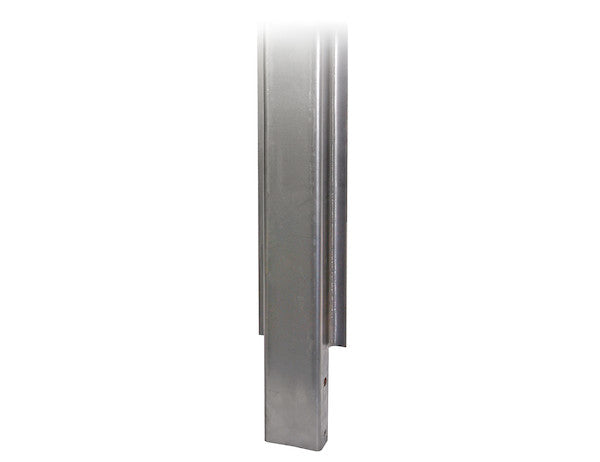
Buyers Products Stake Assembly is constructed from strong 14 Ga steel for a 3 in. by 4-3/4 in. stake pocket. It is commonly used for stake body wall construction on flat beds and trailer stake bodies. Each assembly has two piece stakes with welded reinforcements and is available in multiple lengths.
Specifications
| Finish | Plain |
|---|---|
| Gauge | 14 |
| Length (in.) | 54.00 |
| Material | Carbon Steel |
| Thickness (in.) | 1.44 |
| Width (in.) | 4.50 |
Advanced Technical Overview: Stake Assembly 4.5 x 54 Inch
The Stake Assembly, with its nominal dimensions of 4.5 inches by 54 inches, represents a meticulously engineered component designed for the rigorous demands of commercial vehicle body construction. This product is a testament to the principles of robust structural design, material science, and precision fabrication, specifically tailored for applications such as flatbeds, utility trailers, and other commercial stake body configurations requiring secure and adaptable load containment solutions.
Material Science and Structural Integrity: Carbon Steel 14 Gauge
At the core of this stake assembly's superior performance is its material composition: high-strength carbon steel with a 14-gauge specification. Carbon steel is selected for its advantageous balance of tensile strength, yield strength, and ductility, properties critical for components subjected to dynamic loads and environmental stresses inherent in transportation applications. The 14-gauge thickness, equivalent to approximately 0.0747 inches (1.905 mm), provides an optimal compromise between material weight and structural rigidity. This gauge ensures sufficient resistance to buckling, bending, and shear forces without contributing excessive dead weight to the vehicle, which could negatively impact payload capacity and fuel efficiency. The material's inherent strength allows the stake to effectively transmit and distribute forces from cargo movement to the vehicle's frame, maintaining structural integrity even under adverse conditions. Furthermore, carbon steel offers excellent weldability, a crucial factor given the assembly’s welded reinforcements, ensuring strong, reliable joint integrity throughout its operational lifespan.
Precision Engineering and Design for Specific Applications
The Stake Assembly is dimensioned at 4.5 inches in width and 54 inches in length (or height, when installed vertically). The specification further notes an overall profile thickness (depth) of 1.44 inches. This cross-sectional profile, typically a formed channel or box section, is engineered to maximize the section modulus, thereby enhancing resistance to torsional and bending stresses. A larger section modulus signifies greater rigidity for a given material, which is paramount in preventing deformation and ensuring the stability of the stake walls. The 54-inch length provides a substantial height for securing various types of cargo, from bulk materials to palleted goods, ensuring compliance with common load securement regulations and best practices.
A critical design feature is its compatibility with a 3-inch by 4-3/4-inch stake pocket. This indicates that the base of the stake is specifically formed or dimensioned to interface precisely with a standardized receiving pocket commonly found on flatbed trucks and utility trailers. The difference between the overall stake width (4.5 inches) and the pocket width (3 inches or 4.75 inches, depending on orientation) implies a carefully designed tapered or reduced-profile foot, ensuring a snug fit that minimizes play and maximizes the stability of the erected stake. Proper fitment into the stake pocket is fundamental for distributing lateral loads from the cargo effectively into the vehicle's chassis, preventing premature wear, fatigue, and potential failure.
Two-Piece Construction and Welded Reinforcements
The description highlights a "two-piece stake with welded reinforcements." This construction methodology is a deliberate engineering choice to enhance both strength and manufacturability. By fabricating the stake from two distinct sections, manufacturers can optimize material utilization, potentially incorporate different forming techniques for specific parts, and strategically place reinforcements where stress concentrations are highest. Welded reinforcements are crucial for augmenting the structural integrity of the stake, particularly at stress points such as the transition from the main body to the stake pocket interface, or along the vertical axis to resist buckling. These reinforcements, typically additional steel plates or gussets, are fusion-welded to the primary stake components using controlled welding processes, ensuring metallurgical continuity and robust mechanical bonding. The quality of these welds is paramount, as they determine the ultimate load-bearing capacity and fatigue life of the assembly. Manufacturers typically adhere to industry-standard welding procedures and quality control measures, such as visual inspection, dye penetrant testing, or ultrasonic testing, to guarantee weld integrity.
Finish: Plain and Its Implications
The "Plain" finish indicates that the carbon steel stake assembly is supplied without any primary protective coating, such as paint, powder coat, or galvanization. This offers several strategic advantages and considerations for end-users and vehicle manufacturers:
- Customization Flexibility: A plain finish allows the purchaser to apply a custom finish that matches the vehicle's aesthetic or branding, or to apply a specialized coating system tailored to specific operational environments. This is particularly valuable for fleet operators with distinct color schemes or for applications requiring unique corrosion protection chemistries.
- Cost-Effectiveness: Omitting a factory-applied finish can reduce the initial acquisition cost of the component, allowing for a more economical base unit.
- Optimal Surface for Secondary Processing: The clean, plain steel surface provides an ideal substrate for subsequent surface preparation processes (e.g., sandblasting, chemical etching) and the application of high-performance coatings. It allows for superior adhesion of primers and topcoats, leading to a more durable and longer-lasting protective finish compared to applying coatings over pre-finished surfaces.
- Corrosion Management: While plain carbon steel is susceptible to oxidation and rust when exposed to moisture and oxygen, its susceptibility is a known factor. This necessitates the application of a protective finish by the end-user or vehicle builder, which can be chosen based on the specific corrosive environment (e.g., road salt, industrial chemicals, marine environments).
Applications and Operational Benefits
Stake assemblies are fundamental to the versatility and functionality of numerous commercial vehicles. Their primary application, as indicated, is in stake body wall construction on flatbeds and trailer stake bodies. These applications demand a modular, robust, and easily deployable system for cargo containment.
- Flatbed Trucks: On flatbeds, stakes transform an open platform into a versatile cargo area, capable of securing loose materials, construction debris, agricultural products, and machinery. The ability to quickly install or remove stakes allows the flatbed to adapt between hauling open cargo and contained loads, enhancing vehicle utilization.
- Trailer Stake Bodies: Similar to flatbeds, utility trailers and semi-trailers equipped with stake pockets leverage these assemblies for side and rear wall construction. This is common in agriculture for hauling hay bales or produce, in construction for tools and materials, and in landscaping for debris and equipment.
- Modular Load Containment: The stake assembly system allows for the creation of perimeter walls of varying heights and configurations. This modularity is key for accommodating diverse cargo types and sizes. When not required, the stakes can be removed, allowing for oversized cargo to be loaded and secured directly onto the flat deck.
- Enhanced Safety: By creating a physical barrier, stakes significantly enhance cargo securement, preventing shifting, rolling, or falling of goods during transit. This compliance with cargo securement regulations (e.g., FMCSA in the U.S. or similar international standards) is paramount for operational safety and liability management.
- Load Distribution: When properly installed, stake bodies contribute to the overall structural integrity of the load, distributing forces more evenly across the vehicle's deck and chassis, thereby reducing stress on individual securement points and improving vehicle stability.
System Integration and Maintenance Considerations
The seamless integration of the stake assembly with the vehicle's stake pockets is crucial for optimal performance. The precise dimensions of the stake's base ensure a secure, rattle-free fit, which is essential for minimizing wear and tear on both the stake and the pocket over time. Regular inspection of both the stake assemblies and the stake pockets is recommended to ensure continued structural integrity. Checks should include:
- Weld Integrity: Examination for cracks, corrosion, or signs of fatigue in the welded reinforcements.
- Material Deformation: Inspection for bending, buckling, or other plastic deformation of the steel components.
- Corrosion: Given the plain finish, the applied protective coating should be regularly inspected for damage. Any areas of exposed carbon steel should be promptly treated to prevent progressive corrosion, which can compromise structural strength.
- Pocket Condition: Ensure stake pockets are free from debris, rust, or deformation that could hinder proper stake insertion or securement.
Engineering Standards and Quality Assurance
The design and manufacturing of the Buyers Products Stake Assembly align with industry best practices for heavy-duty commercial vehicle components. Adherence to strict dimensional tolerances ensures interchangeability and consistent fitment across a fleet. Quality control processes typically encompass:
- Material Certification: Verification that incoming steel meets specified mechanical and chemical properties.
- Dimensional Inspection: Post-fabrication measurements to confirm compliance with design specifications for length, width, profile thickness, and pocket interface.
- Weld Quality Inspection: Non-destructive testing (NDT) methods or visual inspection protocols to verify weld integrity and penetration.
- Functional Testing: Though not explicitly stated, manufacturers often conduct or simulate load tests to validate the design's ability to withstand anticipated operational forces.
Economic and Operational Value
Investing in high-quality stake assemblies like the 4.5 x 54 Inch unit from Buyers Products offers significant economic and operational advantages. The durability derived from 14-gauge carbon steel and robust welded construction translates into a longer service life, reducing the frequency of replacement and associated maintenance costs. The inherent modularity enhances vehicle versatility, enabling a single truck or trailer to perform multiple functions, thereby maximizing asset utilization and return on investment. Furthermore, the enhanced cargo securement capabilities contribute directly to improved operational safety, minimizing the risk of cargo damage, accidents, and potential liabilities. For businesses operating in logistics, construction, agriculture, or municipal services, reliable stake assemblies are not merely accessories but essential tools that underpin safe, efficient, and adaptable transportation operations.
Conclusion
The Stake Assembly, 4.5 x 54 Inch, exemplifies a robust and versatile engineering solution for commercial vehicle cargo containment. Its construction from strong 14-gauge carbon steel, coupled with a two-piece design featuring welded reinforcements, ensures superior durability and structural integrity. Engineered for precise integration into standard 3-inch by 4-3/4-inch stake pockets, this assembly facilitates modular wall construction on flatbeds and trailers, offering unparalleled flexibility in managing diverse cargo types. While supplied with a plain finish for customization, its fundamental design and material selection are optimized for longevity and performance under the most challenging operational conditions. This stake assembly is an indispensable component for any commercial operation prioritizing safety, efficiency, and adaptability in its transportation fleet.