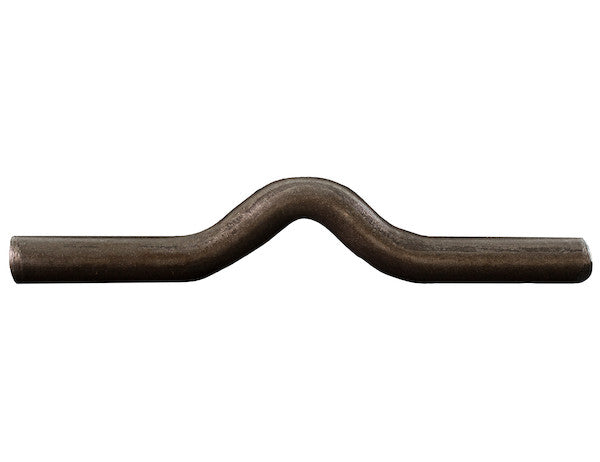
Buyers Products Weld-On Safety Chain Bar welds onto the trailer frame to securely hold a trailer chain in place. Choose from different sizes to accommodate your safety chain diameter.
Specifications
| Accommodates Chain Dia. (in.) | 1/2 |
|---|---|
| Finish | Plain |
| Material | Carbon Steel |
The Buyers Products Weld-On Safety Chain Bar, specifically engineered for a 1/2 Inch Diameter chain, represents a critical component in ensuring the safe and compliant operation of towed vehicles. This robust attachment point is meticulously designed to create a permanent, high-strength anchor on a trailer's structural frame, providing the indispensable secondary connection required by regulatory bodies. Its weld-on methodology ensures maximum integration with the trailer chassis, far surpassing the structural integrity of bolted or clamp-on alternatives for such a vital safety function. The plain finish carbon steel construction underscores its utilitarian purpose and highlights its readiness for integration into diverse trailer configurations, where post-weld finishing can be customized to match specific application requirements.
Technical Overview and Engineering Principles
The fundamental role of a safety chain bar is to serve as an unyielding interface between the trailer's safety chains and the trailer frame itself. The specified 1/2 inch diameter is not merely a dimension; it is a crucial parameter dictating compatibility with a wide array of safety chains designed for various gross vehicle weight ratings (GVWR). Chains rated for trailers requiring a 1/2 inch diameter typically possess significant breaking and working load limits, and the attachment bar must inherently exceed these limits to prevent premature failure at the anchor point. This diameter ensures adequate material cross-section to distribute dynamic loads and stresses effectively during emergency scenarios, such as a primary coupler detachment.
Material Science: Carbon Steel
The selection of carbon steel as the primary material for this safety chain bar is a deliberate engineering choice, offering an optimal balance of strength, ductility, and weldability crucial for its intended application. Carbon steel, broadly defined by its carbon content, exhibits excellent mechanical properties suitable for load-bearing components:
- Tensile Strength: This refers to the maximum stress the material can withstand before breaking. For safety components, high tensile strength is paramount to resist the extreme forces exerted during an emergency decoupling event.
- Yield Strength: This is the stress at which the material begins to deform plastically. A high yield strength ensures that the safety bar will maintain its shape and structural integrity under significant load, preventing permanent deformation that could compromise its effectiveness.
- Ductility: While strength is crucial, ductility (the ability to deform under tensile stress without fracturing) is equally important. In a sudden impact or shock load scenario, a ductile material can absorb energy through deformation, rather than fracturing catastrophically. This "toughness" is a critical safety feature.
- Weldability: As a "weld-on" component, the material's weldability is non-negotiable. Carbon steel is highly amenable to various industrial welding processes, including Shielded Metal Arc Welding (SMAW), Gas Metal Arc Welding (GMAW/MIG), and Gas Tungsten Arc Welding (GTAW/TIG), facilitating strong, metallurgical bonds with the trailer frame.
The "Plain" finish indicates the absence of any protective coating such as paint, powder coat, or galvanization. This is specifically advantageous for welding operations, as it eliminates the need for grinding off coatings prior to welding, simplifying the installation process and ensuring a clean, contaminant-free weld joint. Post-installation, it is standard practice and highly recommended to apply a protective coating, such as an epoxy primer and topcoat, or a rust-inhibiting paint, to prevent corrosion and extend the service life of the component, especially given its exposure to environmental elements.
Installation Methodology and Best Practices
The "weld-on" nature of this safety chain bar is a key differentiator, offering unparalleled structural integration and load-bearing capacity compared to bolt-on or clamp-on alternatives. However, it necessitates adherence to professional welding standards and practices. The integrity of the weld joint is as critical as the strength of the bar itself.
Pre-Welding Procedures:
- Surface Preparation: The welding area on the trailer frame and the surface of the safety chain bar must be meticulously cleaned. This involves removing all grease, oil, rust, scale, paint, or any other contaminants that could compromise weld quality. Grinding to bare metal is often required.
- Positioning: The bar should be positioned strategically on the trailer frame to ensure proper alignment and clearance for the safety chains. Considerations include allowing sufficient chain length for turns, preventing chain drag, and ensuring the chains can be correctly crossed under the coupler (as often mandated).
- Securing: The safety bar must be firmly clamped or tacked in place prior to final welding to prevent movement and maintain proper alignment during the welding process.
Welding Techniques:
Given the safety-critical nature of this component, welding should only be performed by certified or experienced welders following appropriate safety protocols and welding procedures. Common welding processes include:
- GMAW (MIG Welding): Popular for its speed, ease of use, and ability to produce clean welds on carbon steel. Requires careful parameter selection (wire feed speed, voltage) to ensure adequate penetration.
- SMAW (Stick Welding): Highly versatile and effective for outdoor applications or where surface conditions are less than ideal. Offers excellent penetration and strength when performed correctly.
- GTAW (TIG Welding): Produces exceptionally clean and precise welds, often used where aesthetic quality and critical integrity are paramount. Requires a higher skill level.
Regardless of the chosen method, the weld bead must exhibit full penetration, be free of defects such as porosity, undercut, or cracks, and possess adequate throat thickness to withstand the anticipated loads. A multi-pass weld may be necessary depending on the thickness of the trailer frame material and the bar itself to achieve the required strength.
Post-Welding Inspection and Finishing:
- Visual Inspection: After the weld has cooled, a thorough visual inspection is crucial. The weld bead should be uniform, smooth, and free of visible defects.
- Destructive/Non-Destructive Testing (Optional): For critical or high-volume applications, non-destructive testing methods like dye penetrant inspection or magnetic particle inspection may be employed to detect subsurface defects.
- Corrosion Protection: As mentioned, the plain finish necessitates the application of a protective coating immediately after welding and cleaning. This step is vital to prevent rust and ensure the long-term integrity and appearance of the component.
Regulatory Compliance and Safety Imperatives
The Weld-On Safety Chain Bar is more than just a piece of metal; it is an integral part of a trailer's safety system, designed to meet or exceed stringent regulatory requirements. Safety chains are legally mandated in virtually all jurisdictions for trailers exceeding a certain weight threshold, acting as a failsafe mechanism in the event of a primary coupler or hitch failure.
Federal and State Regulations:
- U.S. Department of Transportation (DOT): Federal regulations, specifically outlined in 49 CFR Part 393.70, dictate the requirements for coupling devices and towing methods. While general, these regulations emphasize the need for a secondary attachment system.
- State-Specific Laws: Individual states often have more granular requirements regarding safety chains, including their number (typically two), attachment method, minimum breaking strength relative to the trailer's GVWR, and the practice of crossing chains under the coupler to prevent the tongue from dropping to the ground if disconnected. The safety chain bar's design must accommodate these varied requirements, providing a robust anchor point compliant with such mandates.
The Critical Role in Preventing Runaway Trailers:
The consequences of a trailer detaching from the tow vehicle can be catastrophic, leading to severe accidents, injuries, or fatalities, and significant property damage. The safety chain bar's primary function is to prevent such a runaway trailer scenario. By providing an immovable point of attachment for properly rated safety chains, it ensures that even if the primary hitch fails, the trailer remains connected to the tow vehicle, allowing the operator to safely bring the entire rig to a controlled stop. The 1/2 inch diameter of this bar implies its suitability for trailers where the kinetic energy and inertial forces during a detachment event would be substantial, necessitating a high-strength anchoring solution.
Applications and Operational Environment
The Weld-On Safety Chain Bar is versatile and essential across a broad spectrum of trailer types and operational contexts:
- Utility Trailers: From small single-axle units to larger tandem-axle utility trailers used for landscaping, construction, or personal hauling.
- Cargo Trailers: Enclosed trailers for commercial goods, tools, or recreational vehicles (ATVs, motorcycles).
- Boat Trailers: Providing a secure link for boat trailers, often exposed to corrosive marine environments (hence the importance of post-weld coating).
- RV and Camper Trailers: Ensuring the safety of recreational vehicles on long-distance journeys.
- Heavy-Duty and Commercial Trailers: Flatbeds, equipment trailers, and other commercial applications where the GVWR necessitates robust safety measures.
- Custom Fabrication: Ideal for custom trailer builders or those undertaking extensive trailer repairs and modifications, providing a standardized, high-quality component.
In all these applications, the component is subjected to significant operational stresses, including continuous road vibration, dynamic shock loads during acceleration and braking, and environmental exposure to elements such as moisture, road salt, UV radiation, and temperature fluctuations. The carbon steel construction, when adequately protected post-weld, offers excellent resistance to these factors, contributing to a long and reliable service life.
Quality Assurance and Long-Term Performance
The reputation of Buyers Products for manufacturing durable and reliable truck and trailer hardware is reflected in components like this safety chain bar. While seemingly simple, the design and material selection are critical to its performance. Adherence to manufacturing standards, quality control during the production process, and the selection of appropriate raw materials ensure that each bar meets the necessary mechanical properties for its safety-critical function. However, the ultimate performance and longevity are also contingent upon proper installation and ongoing maintenance.
Maintenance and Inspection:
Regular inspection of the safety chain bar and its weld joint is crucial for continued safety. Operators should periodically check for:
- Corrosion: Any signs of rust, especially if the post-weld coating has been compromised, should be addressed promptly by cleaning and re-coating.
- Deformation: Evidence of bending, cracking, or any other structural deformation. While designed to be robust, extreme overloading or impacts could potentially cause damage.
- Weld Integrity: Cracks or separation in the weld joint, which could indicate a compromised connection to the trailer frame.
Prompt attention to any of these issues ensures that the safety chain bar continues to provide its intended level of protection.
Conclusion
The Weld-On Safety Chain Bar 1/2 Inch Diameter from Buyers Products is an indispensable, high-performance component engineered to meet the stringent demands of trailer safety. Its carbon steel construction, paired with a plain finish optimized for welding, ensures a robust and permanent attachment point for safety chains, thereby safeguarding against the potentially severe consequences of trailer detachment. By adhering to meticulous installation procedures and regular maintenance schedules, this safety chain bar contributes significantly to vehicle safety, regulatory compliance, and operator peace of mind, affirming its role as a fundamental element in responsible towing operations across diverse industries and applications.