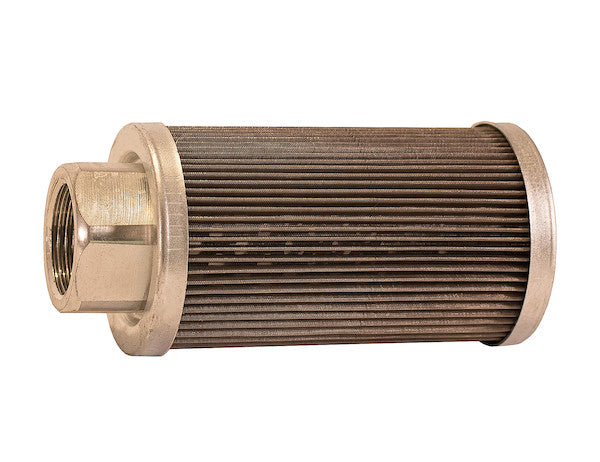
The Single Element Sump Strainer from Buyers Products works inside your fluid reservoir to stop items from being sucked into the system and causing damage. The cleanable strainer can stop items 150 microns or larger, using a pleated element of stainless steel wire cloth (100 mesh). It has an extra large filtering area, allowing a greater flow rate. The strainer installs into the wall of the reservoir and is available in a range of port sizes and flow rates. Choose from a range of NPTF port sizes.
Specifications
| Element Diameter | 2.62 |
|---|---|
| Element Length | 5.34 |
| Filter Material | 304 Stainless Steel |
| Flow (GPM) | 10 |
| Inlet Port Size | 1 NPTF |
| Nominal Rating | 150 |
| Pressure Bypass | 3 |
The 1 Inch NPTF Port Single Element Sump Strainer from Buyers Products is an indispensable component in the fluid conditioning architecture of hydraulic and lubrication systems. Engineered for robust performance and extended operational life, this device serves as the primary line of defense against particulate contamination originating within the fluid reservoir. Its strategic placement at the suction inlet of the hydraulic pump ensures that gross contaminants are captured before they can inflict damage upon sensitive downstream components, thereby safeguarding system integrity and optimizing operational efficiency.
Fundamentally, a sump strainer prevents macroscopic debris—such as manufacturing swarf, rust flakes, seal fragments, and environmental particulate—from entering the pump’s suction port. Without this initial filtration stage, such contaminants lead to abrasive wear in pump gears, vanes, or pistons, induce cavitation, obstruct critical orifices in valves, and accelerate degradation of hydraulic fluid properties. The Buyers Products sump strainer, with its specific technical attributes, is meticulously crafted to mitigate these risks effectively, providing essential primary protection for the entire hydraulic circuit.
Technical Specifications and Material Science
1 Inch NPTF Port: Precision and Sealing Integrity
The "1 Inch NPTF" designation signifies a critical interface for system integration. NPTF, or National Pipe Taper Fuel, is a thread standard engineered to create a mechanical seal without requiring additional sealants, though careful application of thread sealant is often recommended for enhanced reliability in critical hydraulic applications. The tapered design of both male and female threads enables an interference fit that, when tightened, cold-forms the threads to establish a leak-tight connection. A 1-inch NPTF port size dictates the nominal flow capacity and connection dimensions, ensuring compatibility with a wide array of industrial and mobile hydraulic systems. This standard proves particularly advantageous in dynamic environments where vibration and thermal cycling might compromise less robust sealing methods. The selection of a 1-inch port is optimized to accommodate the specified flow rate of 10 GPM with minimal pressure drop, a crucial factor in preventing pump starvation and cavitation.
Filtration Efficacy: 150 Micron Nominal Rating (100 Mesh)
The filtration capability of this sump strainer is defined by its 150-micron nominal rating, corresponding to a 100-mesh stainless steel wire cloth. A micron, one-millionth of a meter, signifies that particles of 150 microns (approximately the diameter of a human hair) are targeted for capture. This rating indicates the strainer is designed to capture approximately 98% of particles 150 microns and larger. While considered coarse filtration compared to finer filters downstream, it is precisely engineered for its role as a primary protective barrier. Particles of this size are particularly detrimental to hydraulic pumps, causing significant abrasive wear and potential mechanical jamming. The 100-mesh specification refers to the number of openings per linear inch of the wire cloth, directly correlating to the aperture size. The precision weave of the 304 stainless steel wire cloth ensures consistent pore size distribution, critical for reliable particle retention.
Advanced Material Construction: 304 Stainless Steel Pleated Wire Cloth
The filter element is constructed from 304-grade stainless steel wire cloth. This material choice is paramount for the strainer's longevity and performance within challenging fluid environments. 304 SS offers exceptional resistance to corrosion from common hydraulic fluids, including petroleum-based oils, synthetic lubricants, and water-glycol solutions, ensuring structural integrity over extended periods. It also exhibits superior mechanical strength and ductility, resisting deformation or collapse under typical system pressures and flow surges. The wire cloth is formed into a pleated configuration, a design choice that dramatically increases the effective surface area of the filter medium within a compact form factor. This expanded surface area (Element Diameter: 2.62 inches, Element Length: 5.34 inches) is directly responsible for the "extra-large filtering area," translating into several operational advantages:
- Reduced Pressure Drop: A larger surface area allows fluid to pass through with less resistance, minimizing pressure drop across the strainer. This is vital for maintaining adequate suction pressure at the pump inlet and preventing cavitation.
- Higher Flow Capacity: The pleated design enables the strainer to handle a robust flow rate of 10 GPM without excessive media velocity, preventing dislodging captured particles.
- Extended Service Intervals: More surface area means the element can accumulate a greater volume of contaminants before reaching its clogging limit, extending time between maintenance cycles.
Integrated Pressure Bypass Valve: Safeguarding Pump Integrity
A crucial safety feature of this sump strainer is its integrated pressure bypass valve, set to activate at 3 PSI. This mechanism is a critical safeguard against pump starvation, which can occur if the strainer element becomes excessively clogged. As the filter media accumulates particles, fluid flow restriction increases, elevating the differential pressure across the element. When this differential pressure reaches 3 PSI, the bypass valve automatically opens, allowing a portion of the fluid to bypass the clogged element and flow directly to the pump. While this temporarily delivers unfiltered fluid, it crucially ensures a continuous supply to the pump, preventing cavitation and severe damage from dry running or fluid starvation. This feature underscores the design's focus on system protection, prioritizing pump survival under extreme clogging conditions. Regular monitoring and scheduled maintenance are essential to ensure the bypass valve rarely engages, maintaining optimal fluid cleanliness.
Flow Rate Optimization: 10 GPM Capacity
The specified flow rate of 10 GPM (gallons per minute) is a key performance parameter, indicating the volume of fluid the strainer can effectively process per unit of time while maintaining optimal filtration and minimal pressure drop. This capacity suits a wide range of mobile and industrial hydraulic systems requiring a steady, moderate fluid flow. Proper system design dictates matching the sump strainer's flow rate capacity to the maximum flow demand of the hydraulic pump. An undersized strainer can lead to excessive pressure drop, cavitation, and premature clogging. The 10 GPM rating, combined with the extra-large pleated filtering area, ensures efficient fluid delivery to the pump even under demanding operational conditions.
Operational Benefits and System Integration
Comprehensive Pump Protection
The primary benefit of deploying the 1 Inch NPTF Port Single Element Sump Strainer is the unparalleled protection it offers to the hydraulic pump. The pump, as the heart of any hydraulic system, has its longevity directly dependent on the cleanliness of the fluid it processes. By preventing large, abrasive particles (150 microns and larger) from reaching the pump's precision components, the strainer significantly reduces wear, extends the pump's operational lifespan, and mitigates the risk of sudden failure. This preemptive protection is especially critical for positive displacement pumps, which are highly susceptible to damage from particulate matter.
Enhanced System Longevity and Reliability
Beyond the pump, the cleanliness achieved by the sump strainer contributes to the overall longevity and reliability of the entire hydraulic system. Downstream components such as directional control valves, proportional valves, servo valves, hydraulic cylinders, and motors are all sensitive to contamination. While finer filtration typically exists downstream, the sump strainer removes the bulk of larger particles that could rapidly overwhelm finer filters or cause immediate blockages and damage to critical orifices and sealing surfaces. This multi-stage filtration approach ensures all components operate within their design parameters, reducing wear, maintaining performance characteristics, and minimizing unexpected downtime.
Cost-Effectiveness Through Cleanability and Reusability
A significant economic advantage of this strainer is its cleanable and reusable design. Unlike disposable filter elements, the 304 stainless steel wire cloth can be thoroughly cleaned and reinstalled, dramatically reducing ongoing consumables costs. Cleaning procedures typically involve flushing with a compatible solvent, backflushing, or ultrasonic cleaning, followed by thorough drying. This reusability not only provides significant cost savings but also aligns with environmental sustainability practices by minimizing waste. The robust construction ensures the element withstands multiple cleaning cycles without degrading filtration performance.
Prevention of Cavitation
Cavitation, the formation and collapse of vapor bubbles within the fluid, is highly destructive for hydraulic pumps, typically occurring when pump inlet pressure drops below the fluid's vapor pressure. A clogged or undersized sump strainer restricts fluid flow, causing a significant pressure drop at the pump suction, inducing cavitation. The Buyers Products sump strainer is engineered with an extra-large filtering area and a thoughtful 10 GPM flow capacity to minimize pressure drop even when partially loaded. Furthermore, the integrated 3 PSI bypass valve acts as a critical fail-safe, ensuring the pump always receives fluid—even if unfiltered—to prevent severe damage associated with cavitation under extreme clogging scenarios.
Maintenance and Best Practices
To maximize the effectiveness and lifespan of the 1 Inch NPTF Port Single Element Sump Strainer, adherence to proper maintenance protocols is essential. Regular inspection and cleaning schedules should be established based on the operating environment, fluid contamination levels, and system duty cycle.
- Inspection Intervals: Initially, inspect the strainer more frequently (e.g., every 50-100 operating hours) to establish a baseline for contamination accumulation. Adjust the interval as needed.
- Cleaning Procedure: When cleaning is required, carefully remove the strainer from the reservoir. Use a compatible cleaning solution or solvent to flush the element, ensuring all trapped particulates are dislodged. Ultrasonic cleaning can be highly effective. Always inspect the element for any signs of damage (tears, holes, deformation) before reinstallation.
- Sealing Integrity: Upon reinstallation, ensure the NPTF connection is properly tightened and sealed to prevent air ingress into the suction line, which can lead to cavitation or fluid aeration.
- Fluid Level: Maintain adequate fluid levels in the reservoir to ensure the strainer remains fully submerged during all operating conditions, preventing air entrainment.
- Bypass Valve Monitoring: While the bypass valve protects the pump, frequent activation indicates a neglected or undersized strainer. It serves as an alert for necessary maintenance rather than a substitute for regular cleaning.
Applications Across Industries
The robust design and critical protective function of the 1 Inch NPTF Port Single Element Sump Strainer make it indispensable across a diverse range of industrial and mobile hydraulic applications.
- Construction Equipment: Excavators, loaders, dozers, and graders rely on clean hydraulic fluid for precise control and heavy lifting.
- Agricultural Machinery: Tractors, harvesters, and sprayers operate in dusty, challenging environments where initial contamination ingress is high.
- Material Handling: Forklifts, cranes, and conveyor systems benefit from reliable hydraulic power and prolonged component life.
- Industrial Power Units: Stationary hydraulic power units used in manufacturing, presses, and automation systems.
- Waste Management Vehicles: Refuse trucks and compactors often experience demanding duty cycles and varied operating conditions.
- Forestry Equipment: Loggers, feller bunchers, and chippers require robust filtration against wood debris and environmental contaminants.
- Marine Applications: Vessels with hydraulic steering, winches, and propulsion systems require corrosion-resistant components.
Conclusion
The Buyers Products 1 Inch NPTF Port Single Element Sump Strainer is a foundational component for ensuring the long-term health and efficiency of any hydraulic or lubrication system. Its meticulously engineered design, featuring a 150-micron nominal rating, durable 304 stainless steel pleated wire cloth, and a critical 3 PSI pressure bypass, provides superior protection against gross contamination. By preventing particulate damage to hydraulic pumps and sensitive downstream components, this cleanable and robust strainer significantly reduces maintenance costs, extends equipment lifespan, and minimizes costly downtime. Investing in such a high-quality sump strainer is a strategic decision that underpins the reliability and performance of capital equipment across a multitude of demanding applications, embodying a proactive approach to fluid power system management.