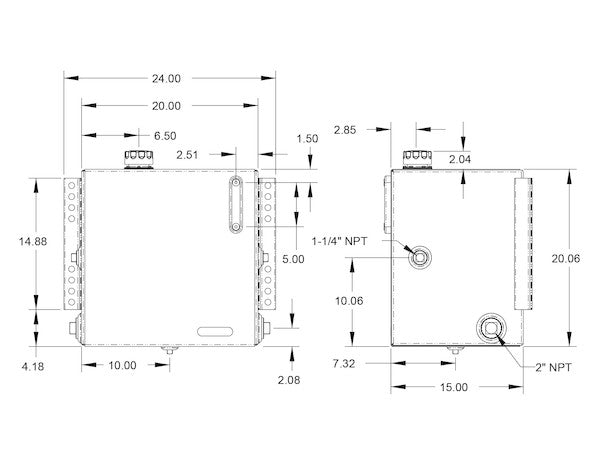
The 25 Gallon Side Mount Steel Reservoir with Micron Filter features tough, durable construction and a system-protective filter for lasting performance. It's ideal for 1 ton trucks and smaller dump, landscaping and similar applications. The reservoir features 13 Ga HRPO steel that has been factory powder-coated for corrosion resistance, and a welded-on bracket for mounting to your truck frame. It comes pre-drilled for an included tank-mounted HFA5S series return filter. Choose from a 10 or 25 micron filter (shipped separately). Other protective features include: - a quarter-turn chrome filler breather with a wire basket strainer - a sight fluid level and temperature gauge - an interior baffle between suction and discharge to aid in fluid cooling - a magnetic drain plug that helps prevent metallic particle contamination
Specifications
| Additional Port Size | 1 1/4 NPT |
|---|---|
| Capacity | 25 |
| Color | Black |
| Depth | 15.04 |
| Filter Head Material_1 | Aluminum |
| Finish | Powder-Coat |
| Hardware and Brackets Included (y/n) | No |
| Height | 20.15 |
| Included Valve (y/n) | No |
| Integral Brackets (y/n) | Yes |
| Integral Level Gauge (y/n) | Yes |
| Magnetic Drain Plug (y/n) | Yes |
| Material | Carbon Steel |
| Material Gauge | 13 |
| Mount Position | Side Mount |
| Mount Style | Side |
| Oil Level Gauge (y/n) | Yes |
| Reservoir Shape | Rectangle |
| Return Line Filter Included (y/n) | Yes |
| Return Line Filter Rating | 25 |
| Style 1 Port Diameter | 2 |
| Style 2 Port Diameter | 1-1/4 |
| Suction Port Size | 2 NPT |
| Temperature Gauge (y/n) | Yes |
| Usable Capacity | 18 |
| Width | 24.00 |
Advanced Technical Overview: The 25 Gallon Side Mount Steel Hydraulic Reservoir with 25 Micron Filter
The 25 Gallon Side Mount Steel Hydraulic Reservoir with a 25 Micron Filter represents a meticulously engineered solution for demanding mobile and stationary hydraulic applications. Designed to optimize the performance and extend the lifespan of hydraulic systems in environments such as 1-ton trucks, smaller dump bodies, and various landscaping equipment, this reservoir integrates robust construction with critical fluid conditioning features. Its comprehensive design addresses the paramount concerns of hydraulic system integrity: fluid cleanliness, temperature management, structural durability, and ease of maintenance.
Precision Engineering and Material Science: The Foundation of Durability
Central to the exceptional durability and longevity of this hydraulic reservoir is its construction from 13 Gauge Hot Rolled Pickled and Oiled (HRPO) steel. HRPO steel undergoes a rigorous manufacturing process that provides superior material properties critical for hydraulic component fabrication. Hot rolling imparts excellent strength and formability, while the pickling process removes scale and impurities from the steel surface, ensuring a clean, uniform base material. The subsequent oiling provides temporary corrosion protection, crucial for storage and handling prior to final finishing.
The selection of 13 Gauge steel (approximately 0.090 inches or 2.28 mm thick) is a deliberate engineering choice, striking an optimal balance between structural rigidity and manageable weight. This gauge provides significant resistance to deformation under dynamic loads, vibration, and minor impacts common in mobile applications. It ensures the reservoir maintains its structural integrity throughout its operational life, preventing leaks and maintaining precise internal component alignment. Furthermore, the material's inherent strength contributes to the safety of the hydraulic system by securely containing high-pressure return flows and preventing inadvertent punctures or damage.
Advanced Corrosion Protection: Factory Powder-Coating
To further enhance its resistance to environmental degradation, the reservoir is factory powder-coated. This advanced finishing technique offers substantial advantages over traditional liquid paint applications. The process involves electrostatically applying a dry powder, typically polyester or epoxy-based, to the thoroughly cleaned HRPO steel surface. The reservoir is then cured in an oven, where the powder melts and flows to form a smooth, uniform, and extremely durable protective layer.
The benefits of powder coating are multifaceted:
- Superior Corrosion Resistance: The thick, continuous polymer layer acts as an impermeable barrier against moisture, road salts, chemicals, and atmospheric pollutants, significantly delaying the onset of rust and galvanic corrosion. This is especially vital for side-mounted applications where exposure to elements is constant.
- Enhanced Durability: Powder coating exhibits excellent resistance to chipping, scratching, fading, and abrasion, outperforming liquid paints in terms of mechanical toughness. This resilience ensures the aesthetic and protective qualities of the reservoir are maintained even in rugged operating conditions.
- Environmental Responsibility: The powder coating process emits minimal Volatile Organic Compounds (VOCs), making it an environmentally friendlier choice compared to solvent-based paints.
- Aesthetic Appeal: The uniform black powder coat provides a professional, clean appearance that resists dirt accumulation and is easy to clean, contributing to the overall presentation of the vehicle or equipment.
Integrated Mounting and Structural Design
The reservoir features robust, welded-on brackets specifically designed for side mounting to a truck frame. This integral design eliminates the need for external, bolt-on mounting kits, reducing potential points of failure and simplifying installation. The welding process creates a high-strength, permanent bond between the brackets and the reservoir body, ensuring secure attachment even under the severe vibration and dynamic stresses characteristic of mobile machinery.
Side mounting offers several practical advantages:
- Space Optimization: For 1-ton trucks and compact equipment, maximizing available space is crucial. Side mounting utilizes often underutilized areas along the frame rails, leaving valuable bed or chassis space free for other components or cargo.
- Accessibility: Positioning the reservoir on the side frame typically improves access for routine maintenance tasks such as fluid level checks, filter changes, and drainage, thereby facilitating efficient servicing.
- Weight Distribution: Proper side mounting contributes to balanced weight distribution on the vehicle chassis, which can positively impact vehicle handling, stability, and tire wear, particularly when the reservoir is filled to capacity.
Advanced Fluid Conditioning: The Heart of System Protection
The longevity and efficiency of any hydraulic system are directly proportional to the cleanliness and condition of its working fluid. This 25-gallon reservoir is engineered with advanced fluid conditioning features that significantly mitigate the primary causes of hydraulic component wear and failure: contamination and thermal degradation.
High-Efficiency Return Line Filtration: The 25 Micron Standard
A cornerstone of this reservoir's protective capabilities is the included HFA5S series return filter, for which the tank comes pre-drilled. The return line is the ideal location for primary system filtration, as it captures contaminants generated within the hydraulic circuit before the fluid returns to the reservoir for recirculation. The standard offering is a 25-micron filter, with an option for a 10-micron filter (shipped separately) for applications demanding higher fluid cleanliness levels.
Understanding the significance of micron ratings is crucial:
- Micron Definition: A micron (µm) is one-millionth of a meter. For reference, a human hair is typically 50-70 microns thick.
- 25 Micron Filtration: A 25-micron filter is highly effective at capturing larger particulate contaminants that are the most damaging to hydraulic pumps, valves, and actuators. These larger particles (often visible to the naked eye or just beyond) contribute significantly to abrasive wear in tight tolerance components, eroding surfaces and accelerating fatigue. While 25 microns might be considered coarser than some sophisticated pressure line filters, it serves as an excellent primary barrier in the return line, preventing a large volume of gross contamination from recirculating. This level of filtration is well-suited for the specified applications where robust particulate removal is paramount for preventing catastrophic failures and maintaining system efficiency.
- 10 Micron Option: For systems requiring an even higher degree of fluid cleanliness, such as those with highly sensitive servo valves or tighter component tolerances, the 10-micron option offers enhanced protection. A 10-micron filter captures finer particulates, contributing to extended component life and better adherence to stricter ISO cleanliness codes. The choice between 10 and 25 microns depends on the specific OEM recommendations for the hydraulic components being protected and the operational environment.
Strategic Fluid Management for Thermal Stability and Contaminant Settling
Beyond particulate filtration, effective reservoir design plays a pivotal role in managing fluid temperature, de-aeration, and the passive settling of contaminants.
An interior baffle, strategically positioned between the suction and discharge ports, is a key design element. This baffle forces the return fluid to travel a longer, circuitous path within the reservoir before it is drawn back into the pump's suction line. This extended dwell time provides several critical benefits:
- Enhanced Heat Dissipation: By increasing the surface area and time the fluid is exposed to the reservoir walls and ambient air, the baffle significantly aids in cooling the hydraulic fluid. Maintaining optimal fluid temperature is crucial, as excessive heat accelerates fluid degradation (oxidation, viscosity breakdown) and can damage seals and other elastomer components, leading to reduced system efficiency and premature failure.
- De-aeration: The slower, less turbulent flow induced by the baffle allows entrained air bubbles to rise to the fluid surface and dissipate into the atmosphere via the breather. Air in hydraulic fluid can lead to cavitation in pumps (a destructive process), spongy control, and reduced hydraulic power.
- Contaminant Settling: The reduced fluid velocity within the baffled compartments encourages heavier particulate contaminants that may bypass the filter (or are too fine to be caught by the primary filter) to settle to the bottom of the reservoir, away from the pump suction line. This passive cleaning mechanism further contributes to overall fluid cleanliness.
Proactive Contamination Control: The Magnetic Drain Plug
The inclusion of a magnetic drain plug represents a critical, yet often overlooked, defense against metallic contamination. As hydraulic components operate, particularly during the break-in period or under normal wear, microscopic ferrous particles are generated. These particles, even if small, can be highly abrasive and accelerate wear throughout the system.
The magnetic drain plug, strategically located at the lowest point of the reservoir, attracts and holds these ferrous wear particles, preventing them from recirculating through the hydraulic system. During routine fluid changes or maintenance checks, the plug can be easily removed and cleaned, allowing for visual inspection of captured particles. The presence and quantity of metallic debris can serve as an early indicator of component wear, facilitating proactive maintenance and preventing more extensive damage. This feature significantly contributes to extending the life of pumps, motors, and valves.
Fluid Monitoring and Accessibility: Sight Gauge and Filler Breather
Effective system operation and maintenance rely heavily on accurate and convenient fluid monitoring. This reservoir is equipped with a clear sight fluid level and temperature gauge.
- Fluid Level Monitoring: The sight glass provides a direct visual indication of the hydraulic fluid level. Maintaining the correct fluid level is paramount to prevent pump cavitation (if too low) and spillage/overfilling (if too high). Regular checks are essential, especially since fluid levels can fluctuate with temperature and system operation.
- Temperature Monitoring: The integrated temperature gauge allows operators to quickly ascertain the fluid's thermal state. Abnormal temperature readings can indicate issues such as inefficient cooling, excessive system load, pump problems, or incorrect fluid viscosity, prompting timely investigation and corrective action.
For fluid filling and reservoir breathing, a quarter-turn chrome filler breather with a wire basket strainer is provided.
- Breather Function: The breather allows air to enter and exit the reservoir as the fluid level fluctuates during system operation and thermal expansion/contraction. This prevents a vacuum or excessive pressure buildup within the tank, which could impede pump function or damage seals. The breather element also filters incoming air, preventing airborne particulate matter from entering the clean hydraulic fluid.
- Chrome Finish: The chrome finish on the filler breather offers excellent corrosion resistance and a durable, aesthetically pleasing surface.
- Wire Basket Strainer: The integrated wire basket strainer serves as a preliminary filter during fluid top-offs or initial fills. It prevents larger debris, such as dirt, lint, or foreign objects, from inadvertently entering the reservoir, ensuring that only pre-filtered or clean fluid is introduced into the system. The quarter-turn mechanism provides quick and secure access.
Optimized Porting for System Integration
The reservoir is equipped with thoughtfully sized and positioned ports to ensure efficient fluid flow and seamless integration into various hydraulic circuits.
- 2 NPT Suction Port: The 2 NPT (National Pipe Taper) suction port is generously sized to minimize pressure drop and ensure an unrestricted flow of hydraulic fluid to the pump. Proper suction line sizing is critical to prevent pump cavitation, which occurs when insufficient fluid supply causes vapor bubbles to form and collapse, leading to severe pump damage and noise. The NPT threading ensures a secure, tapered seal when properly installed with thread sealant.
- 1 1/4 NPT Additional Port / Style 2 Port Diameter: The 1 1/4 NPT port is designated as an additional port or a secondary return port. This versatility allows for multiple return lines from different hydraulic functions or provides an access point for auxiliary equipment, pressure transducers, or other system components. The sizing is optimized to handle return flows without creating excessive back pressure.
- Style 1 Port Diameter (2 inches): While the current specifications list two suction-related ports (2 NPT suction, and Style 1 Port Diameter 2 inches), typically, a reservoir would have one primary suction, one or more returns, and possibly drain/auxiliary ports. Assuming "Style 1 Port Diameter" refers to another large NPT port, this further enhances the reservoir's adaptability, possibly for a secondary suction, drain, or a main return line if distinct from the HFA5S filter return. Clarification from the system designer would confirm its precise intended use; however, its substantial size indicates a high flow capacity, aligning with robust system demands.
Applications and Performance Benefits
This 25-gallon side mount hydraulic reservoir is expertly suited for a range of demanding mobile applications where reliability and continuous operation are paramount.
For 1-ton trucks, which are frequently upfitted with auxiliary hydraulic systems for snowplows, salt spreaders, utility cranes, or lift gates, the reservoir offers a compact yet sufficient fluid capacity. Its side-mount design neatly integrates into the chassis, leaving truck bed space clear. The robust steel construction and powder coat finish withstand the harsh environmental conditions (road salt, debris, temperature extremes) typical of truck operations.
In smaller dump, landscaping, and similar applications (e.g., mini excavators, skid steers, compact utility vehicles, landscape trailers with hydraulic ramps/implements), the reservoir’s features are equally critical. These machines often operate in dusty, dirty environments and experience intermittent, high-load cycles. The integrated 25-micron filter (with a 10-micron option) effectively combats the ingress of airborne and operational contaminants, protecting expensive pumps and cylinders. The baffle-driven cooling and de-aeration capabilities are essential for maintaining fluid integrity during demanding, often continuous operation in varying ambient temperatures. The magnetic drain plug becomes particularly valuable in these applications, providing an early warning system for wear generated by frequently engaged, heavily loaded components.
In essence, this reservoir provides a comprehensive solution for managing the lifeblood of any hydraulic system – the fluid. By rigorously controlling contamination, maintaining optimal temperatures, facilitating de-aeration, and offering robust construction, it contributes directly to:
- Extended Component Life: Minimizing wear on pumps, valves, and cylinders.
- Reduced Downtime: Fewer failures lead to greater operational availability.
- Lower Operating Costs: Less frequent fluid changes, reduced repair expenses.
- Improved System Performance: Consistent fluid quality ensures optimal power transmission and responsiveness.
- Enhanced Safety: Reliable hydraulic function is critical for safe operation of heavy equipment.
Conclusion
The 25 Gallon Side Mount Steel Hydraulic Reservoir with its integrated 25 Micron Filter is more than just a fluid storage tank; it is a critical, purpose-built component designed to be the guardian of your hydraulic system’s health. Its combination of high-grade HRPO steel, advanced powder coating, thoughtful fluid conditioning features (including high-efficiency filtration, temperature/level monitoring, effective baffling, and magnetic particle capture), and practical mounting design makes it an indispensable asset for a wide array of demanding mobile hydraulic applications. Investing in this reservoir is an investment in the long-term reliability, efficiency, and operational uptime of your valuable machinery. Its robust specifications and integrated protective elements ensure that your hydraulic fluid remains clean, cool, and ready to perform under the toughest conditions, safeguarding your equipment and maximizing your productivity.