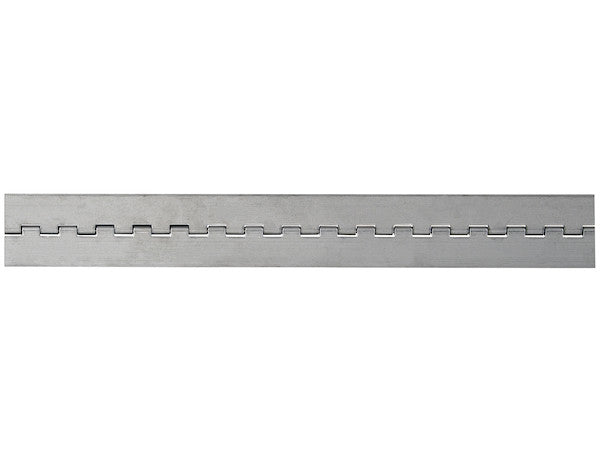
The Stainless Steel Continuous Hinge from Buyers Products is ideal for any application that sees frequent use or more potential for wear and tear. The hinge evenly distributes weight down the length of the lid or door, keeping it in position and minimizing stress. The 302 stainless steel hinge features equal leaves and comes stocked in 72 in. lengths and a variety of widths, thicknesses, and gauges to meet your needs. They can be cut to size as needed. Longer (96 in.) lengths are available by special order. Please contact Customer Service for further information. Stainless steel pins are standard with the hinge.
Specifications
| Gauge | 11 |
|---|---|
| Hinge Length | 72.0 |
| Hinge Width | 2.00 |
| Knuckle Length (in.) | 2.00 |
| Leaf Width | 1.00 |
| Open Width (in.) | 2.00 |
| Pin Diameter (in.) | .375 |
| Thickness (in.) | .120 |
Advanced Engineering and Material Science: The Stainless Steel Continuous Hinge for Demanding Applications
In the realm of mechanical components designed for exceptional durability and operational longevity, the Stainless Continuous Hinge, specified with a .120 inch thickness, 72-inch length, 3/8 inch pin, and 2.0-inch open width, stands as a paramount solution. This product represents a confluence of superior material science, meticulous engineering, and application-driven design, making it an indispensable component for industries where reliability and structural integrity are non-negotiable.
The Foundational Material: 302 Stainless Steel
The selection of 302 stainless steel for this continuous hinge is a critical factor in its high-performance characteristics. Stainless steel, by definition, is a family of iron-based alloys containing a minimum of 10.5% chromium. This chromium content forms a passive, self-repairing oxide layer on the surface, which is responsible for its renowned corrosion resistance. The 302 grade, specifically, is an austenitic stainless steel, belonging to the 300 series, which are characterized by their excellent formability, weldability, and corrosion resistance, particularly in mildly corrosive environments.
Compositionally, 302 stainless steel typically contains 17-19% chromium and 8-10% nickel, along with minor percentages of carbon, manganese, and silicon. The presence of nickel stabilizes the austenitic microstructure, which is face-centered cubic, contributing to the material's excellent ductility and toughness. While 304 stainless steel is more commonly encountered, 302 offers a slightly higher carbon content, which, in certain applications, can enhance its strength properties. For components subjected to frequent dynamic loads and environmental exposure, such as a continuous hinge, the attributes of 302 stainless steel are highly advantageous. Its inherent resistance to oxidation and a broad spectrum of chemical agents ensures that the hinge maintains its structural integrity and aesthetic appeal over an extended service life, even in challenging operational environments. This makes it particularly suitable for outdoor applications, marine settings, and industrial environments where moisture and varying temperatures are prevalent.
Design Superiority: The Continuous Hinge Principle
Unlike traditional butt hinges, which utilize a few discrete pivot points, a continuous hinge, often referred to as a piano hinge, extends along the entire length of the door, lid, or panel it supports. This fundamental design difference confers several significant engineering advantages. The primary benefit lies in the uniform distribution of weight and stress. Instead of concentrating load at localized points, the forces are dispersed evenly across the entire seam. This engineering principle effectively minimizes stress concentrations, which are common failure points in conventional hinge designs, thereby drastically reducing wear and tear on both the hinge and the attached substrate. This uniform load distribution translates directly into enhanced structural rigidity, superior resistance to distortion, and a significantly prolonged operational lifespan for the entire assembly.
The design incorporates "equal leaves," meaning both sides of the hinge that attach to the respective components are of the same width (1.00 inch each, contributing to the 2.0-inch open width). This symmetry simplifies installation and ensures balanced mechanical performance. The knuckles, which interlock along the hinge's length, create a continuous pivot axis. The specified knuckle length of 2.00 inches contributes to the hinge's robust construction, ensuring smooth and consistent rotational movement while preventing unwanted lateral play.
Precision Specifications and Their Impact
The precise dimensions of this continuous hinge are not arbitrary; each specification is carefully chosen to optimize performance for heavy-duty applications:
Thickness (.120 Inch / 11 Gauge)
The material thickness of .120 inches, equivalent to 11 gauge, signifies a heavy-duty construction. In the engineering of hinges, thickness directly correlates with the load-bearing capacity and rigidity. A thicker gauge material provides greater resistance to bending, deformation, and fatigue, making it ideal for supporting heavier doors or lids and withstanding substantial external forces or frequent usage cycles. This robust thickness ensures that the hinge maintains its structural integrity even under demanding conditions, preventing sagging or misalignment of the hinged component over time. This level of thickness is considerably more substantial than light-duty residential hinges, marking it as a truly industrial-grade component.
Length (72 Inches)
A length of 72 inches (6 feet) allows for extensive coverage along the entire edge of the hinged component. This full-length engagement is central to the continuous hinge's ability to distribute load uniformly. While supplied at this standard length, the material's properties and the hinge's design allow it to be cut to size, offering considerable adaptability for custom applications. The availability of longer 96-inch lengths by special order further extends its utility for oversized panels or specialized industrial enclosures, demonstrating the product's versatility in meeting diverse project requirements.
Pin Diameter (.375 Inch / 3/8 Inch)
The hinge pin is the pivotal element around which rotational movement occurs. A pin diameter of .375 inches (3/8 inch) is a critical specification that directly impacts the hinge's strength and operational smoothness. A larger diameter pin offers significantly greater shear strength, making the hinge more resistant to failure under heavy loads or impact. Furthermore, a substantial stainless steel pin ensures minimal deflection and wear within the knuckles over countless cycles of opening and closing, contributing to the overall longevity and consistent performance of the hinge. The use of stainless steel for the pin itself ensures that this critical component shares the same corrosion resistance and durability as the leaves, preventing disparate rates of wear or degradation.
Open Width (2.0 Inches) and Leaf Width (1.0 Inch)
The open width of 2.0 inches defines the total width of the hinge when laid flat, from the outer edge of one leaf to the outer edge of the other. With equal leaves, each leaf measures 1.0 inch. These dimensions are crucial for mounting considerations and the projection of the hinged component. A 1.0-inch leaf provides ample surface area for secure attachment to the door or frame using fasteners such as screws, rivets, or by welding. The compact open width, despite the heavy gauge, facilitates integration into various designs without requiring excessive space.
Manufacturing and Quality Assurance
The production of such a high-performance continuous hinge demands rigorous manufacturing processes and stringent quality control. The fabrication typically involves precision stamping and forming of the 302 stainless steel coils to create the interlocking knuckles and flat leaves. Advanced tooling ensures consistent dimensional accuracy along the entire 72-inch length. Precision drilling or punching of mounting holes (if pre-drilled, though often left undrilled for custom applications) is executed to tight tolerances, ensuring proper alignment and ease of installation. The integration of the 3/8 inch stainless steel pin through the continuous knuckle array is a critical step, ensuring smooth, low-friction operation. Each stage of the manufacturing process is subject to quality checks, from raw material inspection to final product verification, guaranteeing that every hinge meets the specified mechanical properties and dimensional precision.
Versatility Across Applications
The robust construction and material properties of this stainless steel continuous hinge make it exceptionally versatile across a multitude of demanding applications:
- Commercial and Industrial Vehicles: Essential for heavy-duty truck bodies, utility trailers, service vehicle compartment doors, and cargo enclosures where consistent performance under vibration, frequent use, and exposure to harsh weather is required.
- Industrial Enclosures and Machinery Guards: Provides secure and reliable access to sensitive equipment, control panels, and machinery, ensuring long-term operational integrity in factories and industrial facilities.
- Marine Environments: The inherent corrosion resistance of 302 stainless steel is invaluable for boats, docks, marine equipment enclosures, and other applications exposed to saltwater and high humidity, where standard steel would quickly corrode.
- Architectural and Commercial Doors: Offers superior security and longevity for heavy commercial doors, gates, and access panels in high-traffic areas, reducing the likelihood of hinge failure and maintenance.
- Heavy-Duty Storage and Tool Chests: Ideal for reinforcing the lids of large toolboxes, storage lockers, and equipment cases that experience substantial weight and repeated opening/closing cycles.
- OEM and Custom Fabrication: Its cut-to-size capability and robust specifications make it a preferred component for original equipment manufacturers and custom fabrication shops developing specialized solutions requiring exceptional hinge performance.
Installation Considerations and Best Practices
Proper installation is paramount to leveraging the full performance capabilities of this continuous hinge. Given its heavy-duty nature, methods of attachment are crucial:
- Welding: For permanent and highly robust installations, welding the stainless steel hinge to compatible stainless steel or carbon steel structures is often the preferred method, ensuring maximum strength and a seamless integration. Careful consideration of welding techniques for stainless steel (e.g., TIG welding with appropriate filler material) is essential to maintain corrosion resistance and avoid distortion.
- Mechanical Fasteners: For applications requiring disassembly or where welding is not feasible, high-strength mechanical fasteners such as bolts, nuts, screws, or rivets are employed. For stainless steel hinges, using stainless steel fasteners is recommended to prevent galvanic corrosion and ensure consistent corrosion resistance throughout the assembly. The .120 inch thickness provides substantial material for secure fastener engagement. Adequate spacing and quantity of fasteners along the hinge's length are necessary to replicate the load distribution benefits.
- Alignment: Precise alignment of the hinge during installation is critical for smooth operation and to prevent undue stress on the hinge and the attached components. Misalignment can lead to binding, accelerated wear, and premature failure.
- Load Capacity: While the hinge itself is heavy-duty, installers must ensure that the mounting surfaces and fasteners are equally capable of supporting the intended load to prevent system failure.
Long-Term Value and Economic Benefits
Investing in a high-quality stainless steel continuous hinge, such as this .120 x 72 inch model, yields significant long-term value. Its exceptional durability and resistance to wear, tear, and environmental degradation translate into reduced maintenance requirements and lower replacement costs over the product's lifecycle. The enhanced structural integrity it provides minimizes potential damage to the hinged components, protecting valuable assets. Furthermore, the consistent performance and reliability contribute to operational efficiency and safety in various industrial and commercial settings. While the initial investment might be higher than that for a standard carbon steel or lighter-gauge hinge, the total cost of ownership is substantially lower due to its extended service life and minimal need for intervention.
Conclusion
The Stainless Continuous Hinge, meticulously engineered with a .120 inch thickness, 72-inch length, 3/8 inch stainless steel pin, and 2.0-inch open width, represents the pinnacle of hinge technology for demanding applications. Its foundation in 302 stainless steel ensures unparalleled corrosion resistance and mechanical strength, while its continuous design principle guarantees optimal weight distribution and stress reduction. Each specification, from gauge to pin diameter, is chosen to deliver maximum performance, longevity, and reliability in the most challenging environments. For engineers, fabricators, and end-users seeking a robust, durable, and high-performance hinging solution, this product offers an exceptional combination of material science, precision manufacturing, and application versatility, establishing it as an essential component for critical industrial, commercial, and marine endeavors.