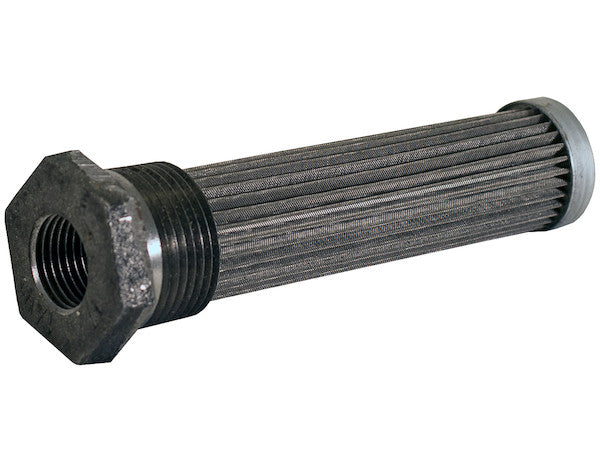
The Thru-Wall Sump Strainer from Buyers Products is designed to stop items from getting back into fluid reservoir and causing damage. The cleanable and reusable strainer can stop items 150 microns or larger at the suction port of your reservoir, using a pleated element of stainless steel wire cloth (100 mesh). It's constructed tough, with bushings and leak-free bonding epoxy. The strainer installs into the wall of the reservoir and is available in a range of port sizes and flow rates.
Specifications
| Element Diameter | 1.38 |
|---|---|
| Element Length | 6.70 |
| Filter Material | 304 Stainless Steel |
| Flow (GPM) | 10 |
| Inlet Port Size | 1 1/4 NPTF |
| Nominal Rating | 150 |
| Outlet Port Size | 3/4 NPTF |
| Pressure Bypass | 3 |
Advanced Technical Overview: Thru-Wall Sump Strainer for Hydraulic System Protection
The Thru-Wall Sump Strainer, with its precise 1-1/4 Inch NPT Male Thread for reservoir installation and a 3/4 Inch NPT Port Thread for suction line connection, represents a critical component in maintaining the operational integrity and longevity of diverse fluid power systems. Engineered by Buyers Products, this specialized filtration device is meticulously designed to intercept and retain particulate contaminants, specifically those measuring 150 microns or larger, directly at the suction inlet of a fluid reservoir. Its robust construction, featuring a zinc-plated bushing and a 304 stainless steel wire cloth pleated element, underscores its suitability for demanding industrial and mobile hydraulic applications where fluid cleanliness is paramount. The strategic placement of this strainer—internally within the reservoir, extending through its wall—ensures that the fluid supplied to the system's pump is pre-filtered, thereby safeguarding sensitive components from abrasive wear and potential catastrophic failure.
The Indispensable Role of Sump Filtration in Hydraulic Systems
In the intricate world of hydraulic and lubrication systems, fluid contamination is recognized as the leading cause of component wear, premature failure, and operational inefficiency. Contaminants can originate from various sources, including initial system assembly (manufacturing debris), ingression from the environment (dust, moisture), internal wear (metal particles, seal degradation), and fluid degradation (oxidation products, sludge). Unfiltered, these particulates can abrade pump internals, jam control valves, erode cylinder surfaces, and degrade fluid properties, leading to reduced system performance, increased energy consumption, and significant downtime for repair or replacement. A sump strainer serves as the first line of defense, acting as a coarse filter to remove larger, more destructive contaminants before they enter the pump and circulate throughout the system. While not designed for achieving high levels of fluid cleanliness (which is typically addressed by return line or pressure line filters), the sump strainer's primary function is to prevent gross contamination from damaging the pump itself and to extend the life of finer downstream filters.
Precision Engineering and Material Science: Key Specifications Explained
The efficacy and durability of the Thru-Wall Sump Strainer are directly attributable to its carefully selected materials and precise manufacturing tolerances. Let us delve into the technical aspects that define this product's superior performance.
Integrated Thru-Wall Design for Optimal Fluid Path
The "Thru-Wall" designation highlights a distinct installation methodology. Unlike traditional in-tank sumps that hang freely or are submerged, this design integrates the strainer directly into the reservoir wall. This configuration offers several advantages:
- Direct Suction Path: It creates a clean, direct fluid path from the reservoir to the pump, minimizing potential pressure drops and cavitation risks associated with long suction lines or multiple fittings.
- Space Optimization: By being an integral part of the wall, it reduces internal reservoir clutter, allowing for more efficient use of tank volume and easier visual inspection of the reservoir interior.
- Simplified Maintenance Access: Depending on the setup, maintenance and cleaning of the element can often be performed with greater ease, sometimes without needing to fully drain the reservoir, provided proper isolation methods are employed.
Thread Specifications: 1-1/4 Inch NPT Male to 3/4 Inch NPT Port
The distinct threading provides critical interfaces:
- 1-1/4 Inch NPT Male Thread: This larger National Pipe Taper Fuel (NPTF) thread is engineered for the secure and leak-proof installation into the reservoir wall. NPTF threads are designed to create a mechanical seal by interference fit between the tapered threads, eliminating the need for additional sealant in some applications, though hydraulic sealant or tape is generally recommended for robust, leak-free connections in fluid power systems. The substantial size ensures adequate structural support for the strainer body within the reservoir.
- 3/4 Inch NPT Port Thread: This smaller NPTF port serves as the connection point for the hydraulic pump's suction line. The reduction in port size from the reservoir connection to the pump suction line is often optimized for flow dynamics and pump inlet requirements, ensuring a consistent and controlled fluid intake to prevent cavitation, which is a common cause of pump damage. The NPTF standard ensures broad compatibility with standard hydraulic fittings and hoses.
Zinc-Plated Bushing: Enhanced Corrosion Resistance and Structural Integrity
The inclusion of a zinc-plated bushing is a testament to the product's design for longevity and reliability in challenging environments. Zinc plating provides a sacrificial layer of protection against corrosion. In the presence of moisture and oxygen, zinc corrodes preferentially to steel, preserving the integrity of the underlying metal component. This is particularly vital in applications where the strainer might be exposed to varying environmental conditions, temperature fluctuations, or corrosive elements within the fluid itself. The bushing further provides mechanical strength and stability for the through-wall installation, ensuring a robust connection that can withstand operational stresses and vibrations inherent in mobile and industrial machinery.
304 Stainless Steel Wire Cloth: The Heart of Filtration
The filtration media, constructed from 304 stainless steel wire cloth, is pivotal to the strainer's performance:
- Material Properties: 304 stainless steel is a widely recognized austenitic stainless steel known for its excellent corrosion resistance across a broad range of atmospheric, chemical, and food processing environments. It exhibits high strength and ductility, crucial for resisting deformation under fluid flow and pressure differentials. Its inert nature ensures compatibility with a vast array of hydraulic fluids, including mineral oils, synthetic fluids, and some water-glycols, without leaching or degrading. The material's thermal stability allows for reliable operation across typical hydraulic system temperature ranges.
- Pleated Element Design: The filter element is pleated, a design choice that significantly enhances its filtration capacity. Pleating increases the effective surface area of the filter media within a compact volume. This larger surface area translates directly to a higher dirt-holding capacity, allowing the strainer to capture more contaminants before requiring cleaning or replacement. It also contributes to lower pressure drops across the element at a given flow rate, which is critical for preventing pump cavitation, especially during cold starts when fluid viscosity is higher.
- 100 Mesh / 150 Micron Nominal Rating: "100 mesh" refers to the number of openings per linear inch in the wire cloth. A 100-mesh screen effectively filters particles down to a nominal rating of 150 microns. A micron (µm) is one-millionth of a meter. To put this in perspective, a human hair is typically 50-70 microns thick. The 150-micron rating ensures that larger, potentially pump-damaging particulates like metal chips, rust flakes, and coarse environmental debris are effectively captured, while allowing the system to maintain adequate fluid flow. This rating is considered a coarse filtration, suitable for primary pump protection.
Cleanable and Reusable Element: Economic and Environmental Advantages
One of the most significant features of this sump strainer is its cleanable and reusable element. This design offers substantial benefits:
- Cost-Effectiveness: The ability to clean and reinstall the filter element reduces recurring operational costs associated with frequent filter replacements. Over the lifespan of a hydraulic system, this can lead to considerable savings.
- Environmental Impact: Reusability minimizes waste generation, contributing to more sustainable industrial practices.
- Maintenance Flexibility: Cleaning can typically be performed using appropriate solvents or detergents, followed by rinsing and air drying. This flexibility allows operators to manage maintenance schedules efficiently.
Leak-Free Bonding Epoxy: Assured Containment
The use of "leak-free bonding epoxy" for element assembly and sealing is a critical detail. This specialized epoxy ensures that the filter media is securely sealed within its housing, preventing fluid bypass and ensuring that all fluid passes through the filtration medium. This epoxy is formulated to be compatible with hydraulic fluids, resistant to chemical degradation, and capable of maintaining its structural integrity under varying temperatures and pressures, thereby guaranteeing the long-term effectiveness of the strainer's filtration function.
Performance Dynamics: Flow, Filtration, and Protection
Understanding the performance specifications is crucial for integrating the Thru-Wall Sump Strainer into a hydraulic system effectively.
Flow Rate (10 GPM)
A flow rate of 10 Gallons Per Minute (GPM) indicates the maximum recommended flow through the strainer while maintaining acceptable pressure drop characteristics. This value is critical for matching the strainer to the hydraulic pump's suction requirements. Undersizing a strainer relative to pump flow can lead to excessive pressure drop, increasing the risk of cavitation at the pump inlet. Cavitation occurs when the absolute pressure in the fluid drops below its vapor pressure, causing vapor bubbles to form and then collapse violently, eroding pump surfaces and generating noise and vibration. The 10 GPM rating makes this particular strainer suitable for a wide array of small to medium-sized hydraulic power units, mobile equipment, and auxiliary systems.
Nominal Rating (150 Microns)
As discussed, the 150-micron nominal rating signifies the filter's ability to capture the majority of particles larger than 150 microns. It's important to differentiate nominal from absolute filtration. An absolute rating specifies the largest pore size and implies that all particles larger than that size will be captured. A nominal rating, conversely, indicates the average pore size and the percentage of particles of a given size that will be captured. For sump strainers, a nominal rating is standard and sufficient for its role as a protective device against gross contamination.
Pressure Bypass (3 PSI)
The integral pressure bypass set at 3 PSI (Pounds per Square Inch) is a crucial safety and operational feature:
- Cavitation Prevention: The primary purpose of a bypass valve in a suction strainer is to prevent pump cavitation. If the filter element becomes excessively clogged with contaminants, or if the fluid viscosity is unusually high (e.g., during cold starts), the pressure drop across the element can increase significantly. Without a bypass, this high pressure drop could starve the pump of fluid, leading to cavitation.
- Continuous Fluid Supply: When the pressure differential across the strainer element exceeds 3 PSI, the bypass valve opens, allowing unfiltered or partially filtered fluid to flow directly to the pump. While this means the pump temporarily receives less-than-optimally filtered fluid, it ensures a continuous supply, preventing pump starvation and the severe damage associated with cavitation.
- System Monitoring: A bypass mechanism can also serve as an indicator for maintenance. If the bypass frequently opens, it signals that the strainer element is likely saturated and requires cleaning.
Installation, Maintenance, and Longevity
Proper installation and routine maintenance are critical to realizing the full benefits of the Thru-Wall Sump Strainer.
Installation Considerations
Installation typically involves preparing an appropriately sized and threaded opening in the reservoir wall. The 1-1/4 inch NPT male thread should be secured using recommended thread sealants or PTFE tape to ensure a leak-proof connection to the reservoir. Care should be taken to avoid over-tightening, which can damage threads or the reservoir wall. The strainer should be positioned to ensure adequate fluid submergence even at low fluid levels, and away from high-turbulence areas or return lines to prevent premature clogging or air entrainment.
Maintenance Procedures
The cleanable nature of the 304 stainless steel element simplifies maintenance. Recommended procedures typically include:
- Scheduled Inspections: Regularly inspect the strainer for signs of clogging, damage, or bypass activation (if applicable indicators are present).
- Cleaning: Remove the strainer from the reservoir. The element can be cleaned by backflushing with a compatible cleaning solvent or detergent, followed by thorough rinsing with clean fluid or water, and then air drying. Ultrasonic cleaning can also be highly effective for removing stubborn particulate matter.
- Replacement: While designed for reusability, the element should be replaced if it shows signs of damage (e.g., torn mesh, deformed pleats) or if repeated cleaning does not restore adequate flow performance. The zinc-plated bushing and robust construction of the strainer body ensure that the overall assembly has a long service life, typically requiring only element cleaning or replacement over time.
Diverse Applications Across Industries
The Thru-Wall Sump Strainer is an essential component across a broad spectrum of industrial and mobile applications, including but not limited to:
- Hydraulic Power Units (HPUs): Integral for stationary industrial machinery requiring clean hydraulic fluid.
- Construction Equipment: Excavators, loaders, dozers, and cranes where exposure to harsh environments makes robust filtration crucial.
- Agricultural Machinery: Tractors, harvesters, and sprayers operating in dusty and debris-laden conditions.
- Material Handling Equipment: Forklifts, conveyors, and lift tables that rely on consistent hydraulic performance.
- Heavy-Duty Trucks and Municipal Vehicles: Dump trucks, refuse vehicles, and utility trucks utilizing hydraulic systems for various functions.
- Industrial Manufacturing: Machine tools, presses, and automation equipment to protect their hydraulic systems.
- Marine Applications: Ensuring clean fluid for steering, winches, and other hydraulic systems in marine vessels.
Conclusion: A Foundation for System Reliability
The Thru-Wall Sump Strainer from Buyers Products, with its meticulously engineered design, premium material selection, and critical performance features, stands as a foundational element in safeguarding hydraulic and lubrication systems. By effectively removing larger particulates at the suction point, it plays a vital role in preventing pump damage, extending the life of downstream filters, and significantly enhancing overall system reliability and longevity. Its cleanable and reusable nature, combined with robust construction, offers a cost-effective and environmentally conscious solution for maintaining fluid cleanliness. For engineers, maintenance professionals, and system designers, selecting this Thru-Wall Sump Strainer ensures a critical layer of protection, contributing directly to reduced operational costs, minimized downtime, and sustained peak performance of valuable hydraulic assets.