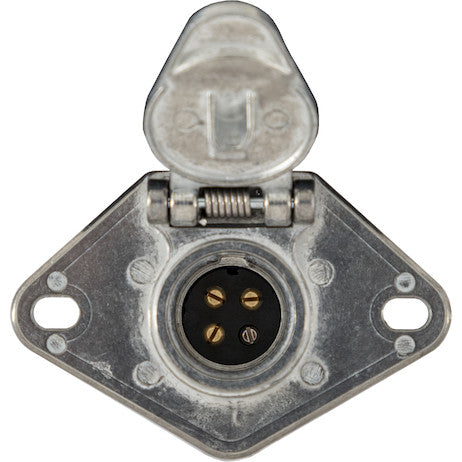
Buyers Products 4-Way Die-Cast Zinc Trailer Connector is a round terminal pin, truck-side connector. It attaches to your vehicle and is commonly used to make a power connection between the vehicle and a utility trailer. It features a durable, die-cast zinc construction with a spring-loaded door to protect the round terminal pins when not in use.
Specifications
| End Way (Number of Pins) | 4 |
|---|---|
| Mounting Type | Bolt-On |
| Pin Style | 4 Round |
| Start Way (Number of Pins) | 4 |
| Truck Side/Trailer Side | Truck Side |
Advanced Technical Overview: Buyers Products 4-Way Die-Cast Metal Trailer Connector - Truck Side
The Buyers Products 4-Way Die-Cast Zinc Trailer Connector represents a critical interface component in the seamless integration of a towing vehicle with its towed utility trailer. Engineered for robust performance and exceptional durability in demanding operational environments, this truck-side connector is a professional-grade solution designed to establish a reliable electrical conduit for essential lighting functions. Its construction from high-quality die-cast zinc, coupled with a meticulously designed spring-loaded protective door and secure bolt-on mounting, positions it as an industry standard for foundational trailer wiring systems.
Material Science and Engineering: Die-Cast Zinc Construction
The selection of die-cast zinc as the primary material for this trailer connector is a testament to its superior mechanical and corrosion-resistant properties. Die casting is a manufacturing process that injects molten metal under high pressure into a mold cavity, yielding components with excellent dimensional accuracy, smooth surface finishes, and high structural integrity. Zinc alloys, particularly those used in die casting, possess several key advantages pertinent to an outdoor electrical connector:
- Exceptional Strength-to-Weight Ratio: Zinc alloys offer a high tensile strength, ensuring the connector can withstand mechanical stresses, repeated insertions, and external impacts without fracturing or deforming. This robustness is paramount in dynamic towing environments where vibration and occasional physical contact are inevitable.
- Superior Corrosion Resistance: Zinc inherently exhibits excellent resistance to various forms of corrosion, including oxidation and galvanic corrosion, especially when exposed to moisture, road salts, and automotive chemicals. This intrinsic property is further enhanced by the dense, non-porous surface achieved through the die-casting process, which minimizes pathways for corrosive agents. The protective spring-loaded door further augments this defense, creating a barrier against environmental ingress when the connector is disengaged.
- High Impact Resistance: Unlike many plastic or lighter-gauge metal alternatives, die-cast zinc provides outstanding impact strength, making the connector resilient against accidental bumps, drops, or abrasive contact that can occur during hitching and unhitching procedures.
- Thermal Stability: The material maintains its structural integrity and performance across a broad spectrum of temperatures, from extreme cold to intense heat, ensuring consistent electrical contact and mechanical function regardless of climatic conditions or vehicle operational heat.
- Dimensional Stability and Precision: Die casting allows for the production of complex geometries with tight tolerances, ensuring that the round terminal pins are precisely aligned and seated within the connector body. This precision is vital for creating a consistently secure and low-resistance electrical connection with the mating trailer-side connector.
- Electrical Conductivity and Grounding: While copper is superior for conductors, zinc provides a reliable, low-resistance path for the connector body and often contributes to the overall grounding integrity of the system, especially when bolted directly to a grounded vehicle frame component.
Functional Design: The 4-Way Round Pin Configuration
The 4-Way round pin configuration is a foundational standard in trailer wiring, specifically designed to facilitate essential lighting functions. Each pin serves a critical, dedicated electrical circuit, ensuring safe and legally compliant operation of a towed trailer. The standard pin assignments for a 4-way system are as follows:
- Ground (White Wire, Pin #1): This is the common return path for all circuits. A robust and low-resistance ground connection is absolutely critical for the proper functioning of all trailer lights. Without an adequate ground, lights may dim, flicker, or fail entirely. The die-cast zinc body often aids in maintaining this critical ground path.
- Tail/Marker Lights (Brown Wire, Pin #2): This circuit powers the rear tail lights, side marker lights, and license plate lights on the trailer, ensuring visibility during night driving or in low-light conditions.
- Right Turn/Brake Light (Green Wire, Pin #3): This circuit controls the right-hand turn signal and the right-hand brake light on the trailer, signaling directional changes and braking actions to following vehicles.
- Left Turn/Brake Light (Yellow Wire, Pin #4): Similarly, this circuit controls the left-hand turn signal and the left-hand brake light on the trailer.
The round terminal pins themselves offer a secure and consistent contact point. Their design typically allows for a greater contact surface area compared to some blade-style connectors, which can lead to lower resistance and improved current flow. The robust nature of these pins, often made from brass or copper alloys for optimal conductivity, ensures longevity and resistance to deformation even with frequent mating cycles. The truck-side designation means this connector is the stationary, permanently mounted component on the towing vehicle, designed to receive the mobile trailer-side plug.
Advanced Features for Enhanced Reliability
Beyond its fundamental electrical function, the Buyers Products connector incorporates design elements that significantly enhance its operational lifespan and reliability:
-
Spring-Loaded Protective Door: This feature is a critical line of defense against environmental degradation. When the trailer is not connected, the spring-loaded door automatically snaps shut, creating a physical barrier that:
- Prevents Moisture Ingress: Shields the internal pins and wiring terminations from rain, snow, and road spray, mitigating the risk of corrosion and short circuits.
- Excludes Debris: Protects against the accumulation of dirt, dust, sand, and road grit, which can interfere with electrical contact or cause abrasion to the pins.
- Reduces UV Exposure: Minimizes direct exposure of internal components and wiring to harmful ultraviolet radiation, which can degrade insulation and plastic components over time.
- Protects Against Mechanical Damage: Guards the delicate pins from incidental contact, bending, or damage during routine vehicle operation or maintenance when no trailer is attached.
-
Bolt-On Mounting: The inclusion of a bolt-on mounting type underscores the product's commitment to secure, permanent installation. Bolt-on connectors offer several advantages over alternative mounting methods:
- Superior Mechanical Stability: A bolted connection provides a significantly more robust physical attachment to the vehicle frame or hitch assembly. This minimizes movement, vibration, and the risk of the connector detaching or rotating under dynamic towing forces.
- Reliable Grounding Path: When bolted directly to a clean, painted-free metal surface of the vehicle frame, a bolt-on connector can often leverage the vehicle's chassis as an integral part of the ground circuit, enhancing the overall system's electrical integrity (though a dedicated ground wire is always recommended).
- Resistance to Pull-Out Forces: The secure nature of a bolted connection ensures that the connector remains firmly in place even under extreme tension or accidental tugging of the trailer harness.
- Ease of Serviceability: While permanent, bolt-on installations allow for straightforward removal and replacement if necessary, using standard hand tools.
Electrical System Integration and Performance
Integrating this 4-way connector into a vehicle's electrical system requires careful consideration of several electrical engineering principles:
- Current Carrying Capacity: The connector and its associated wiring must be appropriately rated to handle the maximum current draw of the trailer's lighting system. While 4-way systems are typically for lower amperage applications (standard incandescent bulbs or LED conversions), ensuring wire gauges and connector components are adequately sized prevents overheating and voltage drop.
- Voltage Drop Management: Longer wire runs and poor connections can lead to voltage drop, resulting in dimmer lights on the trailer. The low-resistance design of the die-cast zinc body and the robust round pins, when properly installed, minimize this effect. Utilizing appropriate wire gauges (e.g., 16-14 AWG for typical trailer lights) is crucial.
- Circuit Protection: The vehicle's trailer wiring harness should always incorporate appropriate fuses or circuit breakers to protect both the vehicle and trailer circuits from overcurrent conditions, such as short circuits. The connector itself, while durable, is an interface and relies on upstream protection.
- Grounding Excellence: As previously mentioned, the ground circuit is paramount. A high-quality ground connection, facilitated by the connector's design and a clean installation point, ensures all other circuits function optimally. Poor grounding is a common cause of trailer lighting malfunctions.
Installation Protocol and Best Practices
Proper installation of the Buyers Products 4-Way Die-Cast Zinc Trailer Connector is paramount to achieving its designed performance and longevity. A professional installation should adhere to the following principles:
- Safety First: Always disconnect the vehicle's battery before commencing any electrical work to prevent accidental short circuits or electrical shock.
- Mounting Location: Select a secure, easily accessible location on the vehicle's rear, typically near the trailer hitch receiver. The bolt-on design necessitates a flat, robust surface for mounting. Drill pilot holes if required and use corrosion-resistant fasteners (e.g., stainless steel bolts, lock washers, and nuts). Ensure the mounting area is free of existing wiring or fuel lines.
- Wire Preparation: Strip wires to the appropriate length, ensuring no stray strands that could cause short circuits. Use professional-grade crimping tools and high-quality electrical connectors (e.g., heat-shrink butt connectors) for all wire splices to the vehicle's harness. Soldering can also be employed for superior conductivity and resistance to vibration, followed by heat-shrink tubing.
- Color Code Adherence: While standard color codes exist (White=Ground, Brown=Tail, Green=Right Turn/Brake, Yellow=Left Turn/Brake), always verify with both the vehicle's and the trailer's specific wiring diagrams as variations can occur.
- Environmental Sealing: After making all electrical connections, it is critical to seal them against moisture and contaminants. Heat-shrink tubing with adhesive lining is highly recommended for all splices. Applying dielectric grease to the internal pins of the connector before initial use can further enhance corrosion protection and improve conductivity.
- Cable Management: Route the wiring harness securely along the vehicle frame, away from exhaust components, moving parts, and sharp edges. Use cable ties, clips, and loom tubing to protect the wiring from abrasion, vibration, and environmental exposure.
- Post-Installation Testing: Before connecting a trailer, thoroughly test each circuit using a multimeter or a specialized trailer light tester. Verify continuity and correct voltage for each pin. Once connected to a trailer, perform a comprehensive functional test of all lighting systems (tail lights, brake lights, turn signals) to ensure proper operation.
Longevity and Maintenance
Even with its durable construction, periodic inspection and maintenance will significantly extend the operational life of the trailer connector:
- Visual Inspection: Regularly check the connector for signs of physical damage, corrosion, bent pins, or compromised wiring insulation. Ensure the spring-loaded door operates freely and closes securely.
- Cleaning: Clean the internal pins and the connector opening with a non-abrasive electrical contact cleaner to remove dirt, grease, and light corrosion.
- Dielectric Grease: Reapply a small amount of marine-grade dielectric grease to the pins periodically, especially before extended periods of non-use or exposure to harsh weather. This grease displaces moisture and inhibits corrosion without interfering with electrical conductivity.
- Wiring Integrity: Check the entire wiring harness for chafing, cuts, or loose connections. Repair any damage immediately to prevent intermittent failures or short circuits.
Applications and Versatility
The 4-way die-cast metal trailer connector is ideally suited for a wide array of light-duty towing applications where basic lighting functions are sufficient. These include:
- Utility Trailers: For hauling lawn equipment, debris, or general cargo.
- Small Boat Trailers: For transporting personal watercraft, canoes, or small fishing boats.
- Motorcycle and ATV Trailers: Ensuring legal visibility for recreational vehicles.
- Tow Dollies: For simple car towing operations.
- Light Agricultural Equipment: For small implements or farm utility trailers.
Its robust construction and dependable performance make it the preferred choice for applications demanding reliability and minimal maintenance, without requiring additional circuits for auxiliary power, electric brakes, or reverse lights typically found in 5-way, 6-way, or 7-way connectors.
Conclusion
The Buyers Products 4-Way Die-Cast Zinc Trailer Connector is more than just a simple electrical component; it is a meticulously engineered interface designed for unwavering reliability in the challenging domain of vehicle-to-trailer electrical connectivity. Its superior die-cast zinc construction provides unparalleled durability and corrosion resistance, while the thoughtful integration of a spring-loaded protective door and secure bolt-on mounting ensures long-term operational integrity and protection against environmental factors. By adhering to established electrical engineering principles and best installation practices, this truck-side connector provides a secure, low-resistance conduit for essential trailer lighting, guaranteeing safety and compliance on the road for countless towing operations. This product embodies a commitment to quality, performance, and durability, making it an indispensable asset for any towing setup requiring a robust 4-way electrical connection.