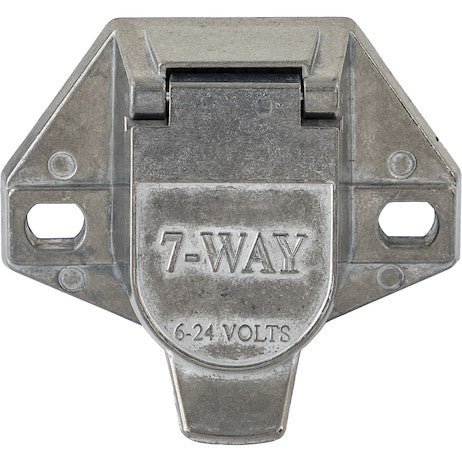
Buyers Products 7-Way Die-Cast Zinc Trailer Connector is a round terminal pin, truck-side connector. It attaches to your vehicle and is commonly used to make a power connection between the vehicle and a utility trailer. It features a durable, die-cast zinc construction with a spring-loaded door to protect the round terminal pins when not in use.
Specifications
| End Way (Number of Pins) | 7 |
|---|---|
| Mounting Type | Bolt-On |
| Pin Style | 7 Round |
| Start Way (Number of Pins) | 7 |
| Truck Side/Trailer Side | Truck Side |
Advanced Technical Overview: Buyers Products 7-Way Die-Cast Metal Trailer Connector - Truck Side
The Buyers Products 7-Way Die-Cast Zinc Trailer Connector represents a critical interface component designed to facilitate robust and reliable electrical communication between a towing vehicle and its utility trailer. Engineered for the demanding environments inherent in commercial and heavy-duty towing applications, this truck-side connector is more than just a simple coupling; it is a meticulously designed system element ensuring operational safety, regulatory compliance, and consistent performance across a multitude of towing scenarios. Its construction, featuring high-grade die-cast zinc and a sophisticated round terminal pin configuration, addresses the common challenges of electrical connectivity in mobile, exposed conditions, providing an unparalleled blend of durability and electrical integrity.
The Significance of 7-Way Connectivity
The 7-way electrical connector standard is prevalent in North America for utility, cargo, and many recreational vehicle (RV) trailers that require more than just basic lighting functions. Unlike simpler 4-way or 5-way connectors, a 7-way system provides dedicated circuits for advanced trailer features, ensuring comprehensive control and safety. Each of the seven round terminal pins serves a specific function, typically adhering to the SAE J2863 standard or similar industry conventions. Understanding the standard pin assignments is crucial for proper installation and system functionality:
- Pin 1 (White, Center): Ground. This is the common return path for all circuits, essential for stable electrical operation and safety. A robust ground connection minimizes voltage drop and electrical noise.
- Pin 2 (Blue): Electric Brake Controller Output. Supplies pulsed DC power to the trailer's electric brakes, modulated by the towing vehicle's brake controller to provide proportional braking.
- Pin 3 (Green): Right Turn Signal & Stop Light. Activates the right-hand turn signal and brake light on the trailer.
- Pin 4 (Red): 12V Battery/Auxiliary Power. Provides constant or ignition-switched 12-volt power for trailer battery charging, interior lights, auxiliary pumps, or other accessories on the trailer. This circuit is often protected by a high-amperage fuse or circuit breaker.
- Pin 5 (Brown): Tail, Running, & License Plate Lights. Powers the essential exterior marker lights, tail lights, and license plate lights, ensuring visibility during night operation.
- Pin 6 (Black): Left Turn Signal & Stop Light. Activates the left-hand turn signal and brake light on the trailer.
- Pin 7 (Yellow): Reverse Lights/Auxiliary. Typically used for trailer reverse lights, but can also be adapted for other auxiliary functions depending on specific trailer requirements or regional variations.
This comprehensive wiring scheme supports the full range of lighting functions required by law, as well as critical safety systems like electric brakes and auxiliary power, making the 7-way connector indispensable for trailers weighing over 1,500 lbs. or those equipped with supplementary electrical features.
Advanced Material Science: Die-Cast Zinc Construction
The selection of die-cast zinc as the primary material for this connector body is a testament to its engineering integrity and focus on long-term reliability. Die-casting is a manufacturing process that involves forcing molten metal under high pressure into a mold cavity. This method yields components with exceptional dimensional accuracy, intricate details, and a superior surface finish, making it ideal for creating complex electrical connector housings.
Properties of Zinc Alloy in Connector Design:
- High Strength and Impact Resistance: Zinc alloys (specifically Zamak alloys, commonly used in die-casting) offer a high strength-to-weight ratio, providing robust protection against physical impact, abrasion, and incidental damage frequently encountered in towing operations. This resilience is critical for a component constantly exposed to external forces.
- Corrosion Resistance: While zinc itself is susceptible to oxidation, die-cast zinc components are often coated or passivated to enhance their inherent corrosion resistance. Zinc provides cathodic protection to ferrous metals, which is beneficial if dissimilar metals are in contact, reducing galvanic corrosion risks. This makes it highly suitable for outdoor applications where exposure to moisture, road salts, and automotive fluids is inevitable.
- Excellent Electrical Shielding: The metallic nature of zinc provides inherent electromagnetic interference (EMI) and radio frequency interference (RFI) shielding properties. This is crucial for protecting the sensitive electrical signals traversing the connector from external electromagnetic noise, ensuring clean and uninterrupted communication between the vehicle and trailer, particularly important for brake controller signals.
- Thermal Conductivity: Zinc alloys possess good thermal conductivity, which can help dissipate any localized heat generated by high current flow through the terminals, contributing to overall system stability and preventing premature material degradation.
- Dimensional Stability and Precision: Die-casting allows for tight tolerances, ensuring that the connector mates perfectly with its trailer-side counterpart. This precision is vital for maintaining consistent electrical contact and preventing water ingress.
The use of die-cast zinc significantly extends the operational lifespan of the connector, reducing the need for frequent replacements and minimizing downtime for fleet operators and individual users alike. It represents a superior choice compared to plastic alternatives in terms of mechanical strength, environmental resilience, and electrical performance.
Optimized Electrical Interface: Round Terminal Pin Design
The choice of a round terminal pin configuration is not arbitrary; it is an engineering decision driven by principles of robust electrical contact and long-term reliability. Each round pin is designed to provide a secure, low-resistance connection when mated with the corresponding socket on the trailer side.
Advantages of Round Terminal Pins:
- Superior Contact Surface Area: The cylindrical geometry of round pins typically allows for a greater contact surface area with the mating socket compared to flat blade designs, leading to lower electrical resistance and enhanced current flow capacity. This reduces heat generation at the contact point and mitigates voltage drop.
- Self-Wiping Action: As round pins are inserted into their sockets, they exhibit a slight self-wiping action, which helps to dislodge minor surface contaminants (like oxidation or dust) from the contact points. This mechanism ensures a cleaner, more reliable electrical pathway with each connection.
- Robust Mechanical Engagement: The inherent design of round pin-and-socket connections offers high mechanical stability, resisting dislodgement due to vibration, shock, or tension during towing. This robust engagement is critical for maintaining continuous electrical signals, especially for safety-critical functions like braking and lighting.
- Environmental Sealing Potential: The circular cross-section simplifies the design of effective environmental seals (e.g., O-rings or molded gaskets around the pins) within the connector body, further protecting the electrical contacts from moisture and contaminants.
- Standardization: The 7-round pin configuration is a widely accepted standard, ensuring broad compatibility with a vast array of trailers equipped with the corresponding trailer-side connector.
This design choice directly translates into a more reliable and efficient electrical system, critical for the demanding nature of trailer towing where intermittent connections can lead to dangerous situations or system malfunctions.
Protective Spring-Loaded Door Mechanism
A key feature enhancing the longevity and performance of this connector is its integrated spring-loaded door. This mechanism provides vital protection for the internal electrical contacts when the connector is not in use or is disconnected from the trailer.
Benefits of the Spring-Loaded Door:
- Environmental Protection: The door effectively shields the sensitive round terminal pins from environmental ingress, including dust, dirt, moisture, road spray, and corrosive elements such as road salts. This is particularly important for truck-side connectors, which are often mounted in exposed locations beneath the vehicle or near the hitch.
- Corrosion Prevention: By preventing direct exposure to oxygen and moisture, the door significantly mitigates the risk of oxidation and corrosion on the terminal pins. Corroded pins can lead to increased electrical resistance, intermittent connections, and ultimately, system failure.
- Physical Damage Protection: The door acts as a physical barrier, protecting the pins from accidental bending, crushing, or abrasion when not connected to a trailer. This preserves the structural integrity of the pins and ensures consistent mating geometry.
- Cleanliness: A clean contact surface is paramount for optimal electrical conductivity. The door helps maintain the cleanliness of the pins, reducing the need for frequent cleaning and ensuring immediate readiness for connection.
This seemingly simple feature plays a significant role in extending the operational life of the connector and maintaining its high performance over time, reducing maintenance requirements and ensuring reliable electrical contact when towing.
Secure and Stable Bolt-On Mounting
The bolt-on mounting type specified for this connector offers a superior level of security and stability compared to alternative mounting methods. This design ensures the connector is rigidly affixed to the vehicle’s chassis or bumper, providing a steadfast point of connection for the trailer's electrical system.
Advantages of Bolt-On Mounting:
- Vibration Resistance: In towing applications, vehicles and trailers are subjected to constant vibration and dynamic loads. A bolt-on mount creates a high-strength mechanical bond that resists loosening or displacement, thereby preventing damage to wiring or the connector itself, and ensuring uninterrupted electrical flow.
- Enhanced Durability: Distributing mounting forces over a larger area, often with multiple fasteners, reduces stress concentration points, making the connector assembly more robust and resistant to fatigue cracking or breakage under continuous stress.
- Optimal Cable Management: A fixed, securely mounted connector allows for proper routing and strain relief of the vehicle's wiring harness, preventing chafing, kinking, or excessive tension on the electrical conductors.
- Improved Grounding Potential: For certain electrical configurations, secure metal-to-metal contact of the connector housing to a properly grounded vehicle frame can enhance the overall grounding scheme, though dedicated ground wires are always recommended for all circuits.
- Ease of Replacement/Service: While secure, the bolt-on nature also simplifies removal and replacement if service is ever required, using standard tools.
Proper installation of the bolt-on connector involves selecting an appropriate mounting location on the vehicle that provides both protection and accessibility, drilling pilot holes if necessary, and using appropriate hardware (e.g., stainless steel bolts, lock washers, and nuts) tightened to the manufacturer's recommended torque specifications to achieve optimal mechanical integrity.
Electrical System Integration and Performance Metrics
Integrating the 7-Way Die-Cast Zinc Trailer Connector into a vehicle's electrical system requires careful consideration of several performance metrics to ensure safety and functionality. This connector is engineered to facilitate reliable power transfer and signal integrity, which are paramount for compliant and safe towing.
Key Performance Considerations:
- Current Carrying Capacity: Each pin and its associated wiring must be rated to safely handle the maximum current draw of its respective circuit. For instance, the 12V auxiliary power pin often carries significant current for battery charging or high-power trailer accessories, necessitating robust terminals and appropriately gauged wiring to prevent overheating.
- Voltage Drop Mitigation: Minimizing voltage drop across the connector and wiring harness is crucial for optimal performance of trailer lights and electric brakes. Excessive voltage drop can lead to dim lights, sluggish brake response, and reduced efficiency of auxiliary systems. The round pin design with its large contact area and low resistance, coupled with proper wire sizing, effectively mitigates this issue.
- Grounding Integrity: A dedicated, low-resistance ground path (Pin 1) is fundamental for the stable operation of all trailer electrical systems. The connector's robust construction ensures a stable connection for the ground wire, preventing ground loops or resistance issues that can manifest as flickering lights or unreliable brake performance.
- Dielectric Strength: The insulation materials within the connector and the air gap between pins are designed to withstand the operational voltages (typically 12V DC) without dielectric breakdown, preventing short circuits even under minor surge conditions.
Environmental Resilience and Longevity
The operational lifespan of a trailer connector is heavily influenced by its ability to withstand diverse and often harsh environmental conditions. The Die-Cast Zinc Trailer Connector is specifically engineered for maximum resilience.
- Temperature Extremes: The materials used, including the zinc alloy and internal insulating plastics, are selected to perform reliably across a broad range of temperatures, from sub-zero winter conditions to intense summer heat, without degrading mechanical or electrical properties.
- Chemical Resistance: Exposure to common automotive fluids (oil, grease, brake fluid), cleaning agents, and especially corrosive road salts and de-icing chemicals, is a fact of life for vehicle-mounted components. The die-cast zinc housing and specialized coatings offer enhanced resistance to chemical attack, preserving the connector's structural integrity and appearance.
- UV Stability: While often shielded, portions of the connector may be exposed to ultraviolet (UV) radiation from sunlight. The materials are chosen to resist UV degradation, preventing embrittlement, discoloration, or cracking over time.
- Vibration and Shock Absorption: Beyond the secure bolt-on mount, the inherent properties of die-cast zinc and the overall connector design allow it to absorb and dissipate mechanical stresses from road vibrations and occasional impacts, preventing internal component damage or loosening of electrical contacts.
Installation Best Practices and Maintenance
To fully realize the benefits of the Buyers Products 7-Way Die-Cast Zinc Trailer Connector, adherence to best practices during installation and routine maintenance is essential.
Installation Guidelines:
- Pre-Installation Inspection: Verify the vehicle's towing package wiring harness, ensuring it is compatible with a 7-way connector and has all necessary circuits.
- Mounting Location: Select a location that is protected yet accessible, typically near the trailer hitch receiver. Ensure sufficient clearance for proper cable routing and mating with the trailer connector.
- Wiring Preparation: Strip wires to the appropriate length. Use high-quality crimp terminals (e.g., heat-shrink butt connectors) or solder connections for maximum reliability. Ensure correct wire gauge for each circuit according to electrical load requirements.
- Pin Assignment: Carefully connect each vehicle wire to the correct terminal pin within the connector housing, following the standard wiring schematic (e.g., SAE J2863). Double-check all connections.
- Secure Mounting: Use corrosion-resistant hardware (e.g., stainless steel bolts, lock washers, self-locking nuts) and torque fasteners to manufacturer specifications to ensure a robust, vibration-resistant attachment to the vehicle frame or bumper.
- Cable Management: Route the vehicle's wiring harness neatly, using cable ties and conduit where necessary, to prevent chafing, pinching, or snagging. Leave adequate slack to prevent strain during vehicle articulation.
- Testing: After installation, use a multimeter or a dedicated trailer connector tester to verify continuity, correct voltage output for each pin, and proper function of all circuits (lights, brakes, auxiliary power) before connecting a trailer.
Maintenance Recommendations:
- Regular Inspection: Periodically inspect the connector for signs of wear, damage, corrosion, or loose connections. Pay attention to the condition of the spring-loaded door and the integrity of the housing.
- Cleaning: Keep the interior of the connector and the pins clean and free of dirt, debris, and corrosion. A soft brush and electrical contact cleaner can be used.
- Dielectric Grease: Applying a thin layer of high-quality dielectric grease to the terminal pins and within the connector body can provide an additional layer of protection against moisture and corrosion, improving long-term electrical conductivity.
- Wiring Integrity: Check the entire wiring harness leading to the connector for any signs of abrasion, cuts, or deterioration of insulation.
Versatile Applications and Compliance
The Buyers Products 7-Way Die-Cast Zinc Trailer Connector is a versatile component essential for a wide range of towing applications, extending its utility beyond simple recreational use.
- Utility Trailers: Essential for standard utility trailers carrying equipment, landscaping materials, or general cargo, ensuring all legal lighting and potentially electric brakes are operational.
- Cargo Trailers: Crucial for enclosed cargo trailers, providing power for interior lights, and often electric brakes, ensuring safe transport of goods.
- Boat Trailers: While smaller boat trailers might use 4-way, larger boat trailers with hydraulic surge brakes or requiring auxiliary power for winches often utilize 7-way connectors.
- Agricultural Equipment: Used on farm vehicles to tow various implements that require lighting and potentially power for auxiliary functions.
- Commercial Fleets: Indispensable for commercial towing operations, where reliability and compliance with Department of Transportation (DOT) regulations are paramount for heavy-duty trailers.
This connector adheres to stringent industry standards, such as those set by the Society of Automotive Engineers (SAE), particularly SAE J560 and J2863 for commercial vehicle towed equipment electrical connections. Adherence to these standards ensures interoperability, safety, and consistent performance across different vehicle and trailer manufacturers, reinforcing its status as a professional-grade component.
Conclusion
The Buyers Products 7-Way Die-Cast Zinc Trailer Connector - Truck Side is engineered with a deep understanding of the challenges and requirements of modern towing. Its robust die-cast zinc construction, combined with precision-engineered round terminal pins, a protective spring-loaded door, and secure bolt-on mounting, establishes it as a superior choice for reliable electrical connectivity. This connector ensures not only the effective operation of essential lighting and braking systems but also supports auxiliary power needs, all while providing exceptional durability and resistance to the harsh elements. For professionals and serious users who demand unwavering performance, safety, and longevity from their towing equipment, this 7-way connector stands as a testament to advanced design and material science, delivering a critical link for countless towing ventures.