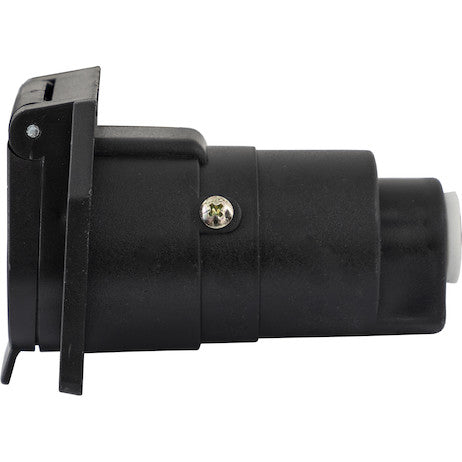
Buyers Products 7-Way Plastic Trailer Connector is a flat blade, truck-side connector. It features a splice-in connection and its 7-way RV blade design is commonly used to make a power connection between your vehicle and a utility or travel trailer. The trailer connector features durable, nylon plastic construction with a spring-loaded door to protect the flat terminal pins when not in use.
Specifications
| End Way (Number of Pins) | 7 |
|---|---|
| Pin Style | RV Flat |
| Start Way (Number of Pins) | 7 |
| Truck Side/Trailer Side | Truck Side |
The Buyers Products 7-Way Plastic Trailer Connector represents a critical component in ensuring reliable and comprehensive electrical communication between a towing vehicle and its towed utility or travel trailer. Designed as a truck-side, flat blade connector, this device adheres to the industry-standard 7-way RV blade configuration, facilitating a robust splice-in connection. Its construction from durable nylon plastic, coupled with a meticulously engineered spring-loaded door, underscores its suitability for demanding applications where environmental exposure and sustained electrical integrity are paramount.
Advanced Engineering and Electrical Interfacing of the 7-Way Trailer Connector
The Significance of the 7-Way RV Blade Standard
The 7-way RV blade connector standard is widely adopted across North America for light-duty and medium-duty towing applications. This configuration surpasses simpler 4-way or 5-way connectors by providing dedicated circuits for essential trailer functions beyond basic lighting, including electric brakes, auxiliary power, and reverse lights. This comprehensive electrical interface is fundamental for the safe and regulated operation of modern utility, cargo, and travel trailers, particularly those equipped with active braking systems and onboard battery charging capabilities. The flat blade design within this standard offers a larger contact surface area compared to traditional round pins, translating to lower electrical resistance, reduced heat generation, and enhanced current carrying capacity. This design attribute directly contributes to the reliability and longevity of the electrical connection, minimizing voltage drop and ensuring consistent power delivery to all connected trailer systems.
Pin Configuration and Functional Allocation
The 7-way RV blade connector adheres to a specific wiring convention, ensuring universal compatibility and predictable functionality across diverse towing setups. The Buyers Products 7-Way Plastic Trailer Connector is engineered to seamlessly integrate into this established standard. A detailed breakdown of each pin's function is as follows:
- Pin 1 (White - Ground): This circuit serves as the common return path for all other electrical circuits in the trailer system. A robust and low-resistance ground connection is absolutely critical for the proper functioning and safety of all trailer lights, brakes, and auxiliary systems. Any compromise in the ground circuit can manifest as intermittent electrical issues, dimming lights, or malfunctioning brakes.
- Pin 2 (Blue - Electric Brakes): Dedicated to the trailer's electric braking system, this pin carries the modulated voltage from the vehicle's brake controller to the trailer's brake magnets. The precise control over this circuit is essential for safe deceleration and stopping, especially with heavier trailers. The current demand for electric brakes can be significant, emphasizing the need for a high-quality connection.
- Pin 3 (Green - Tail/Running Lights): This circuit provides power to the trailer's tail lights, running lights, and often the license plate light. These lights are active whenever the towing vehicle's headlights or parking lights are engaged, ensuring the trailer is visible from the rear and sides during nighttime or low-visibility conditions.
- Pin 4 (Black - 12V Battery/Auxiliary Power): Also known as the auxiliary power or charge line, this pin delivers constant 12-volt power from the towing vehicle's battery to the trailer. This circuit is vital for charging the trailer's onboard battery, operating interior lights, refrigeration units, or other auxiliary accessories even when the vehicle is not running, depending on the vehicle's wiring configuration.
- Pin 5 (Red - Right Turn/Brake): This pin activates the right-side turn signal and brake light on the trailer. It receives signals from the towing vehicle's corresponding circuits, ensuring accurate communication of driver intentions to following traffic.
- Pin 6 (Brown - Left Turn/Brake): Similarly, this pin activates the left-side turn signal and brake light on the trailer, mirroring the vehicle's left-side signaling.
- Pin 7 (Yellow - Reverse Lights/Auxiliary): Typically, this circuit is used for the trailer's reverse lights, illuminating the area behind the trailer when the towing vehicle is in reverse gear. In some less common configurations, it might be allocated for additional auxiliary functions.
Truck-Side Orientation and Interoperability
As a specifically designated "Truck Side" connector, this product is designed to be wired into the towing vehicle's electrical harness. This ensures it provides the necessary power and control signals to the mating "Trailer Side" connector, which is typically mounted on the trailer's tongue or frame. The precise dimensional tolerances and pin geometry of the 7-way RV blade standard guarantee proper mechanical mating and electrical contact, preventing accidental disconnections and ensuring signal integrity. The robust design of the Buyers Products connector, even on the truck side, anticipates environmental exposure and mechanical stresses inherent in towing operations.
Material Science and Durability: The Role of Nylon Plastic
Advanced Polymer Construction
The selection of nylon plastic (polyamide) for the construction of this trailer connector is a deliberate engineering choice driven by a confluence of material properties critical for the application. Nylon is a semi-crystalline thermoplastic known for its exceptional balance of mechanical strength, toughness, and chemical resistance. Specifically:
- Mechanical Robustness: Nylon exhibits high tensile strength and stiffness, allowing the connector body to withstand significant physical impact, abrasion, and the stresses associated with frequent connection and disconnection cycles. This inherent toughness prevents cracking or deformation under typical operating conditions.
- Impact Resistance: Even at varying temperatures, nylon maintains excellent impact resistance, which is crucial for a component exposed to road debris, incidental contact, and environmental factors during vehicle operation.
- Chemical and Environmental Resistance: The material demonstrates superior resistance to a wide range of common automotive fluids, including oils, greases, gasoline, and road salts. Furthermore, it possesses good resistance to UV radiation, which is essential for preventing material degradation, discoloration, and embrittlement when exposed to prolonged sunlight. This ensures the structural integrity and aesthetic appearance are maintained over time.
- Temperature Stability: Nylon can operate effectively across a broad temperature range, from sub-zero winter conditions to the elevated temperatures encountered under the vehicle chassis or during summer operation. This thermal stability prevents material creep or loss of mechanical properties under thermal cycling.
- Dielectric Strength: As an electrical connector, the insulating properties of the housing material are paramount. Nylon possesses excellent dielectric strength, effectively insulating the individual flat terminal pins and preventing current leakage or short circuits, even in the presence of moisture.
This sophisticated material choice ensures that the Buyers Products 7-Way Plastic Trailer Connector maintains its functional and structural integrity through years of rigorous service, minimizing the potential for electrical faults arising from material failure.
Protective Mechanisms: The Spring-Loaded Door
A distinctive feature of this connector is its spring-loaded door, a seemingly simple yet critically important design element. This door provides a crucial layer of protection for the flat terminal pins when the connector is not in use. Its primary functions include:
- Contaminant Exclusion: The door effectively seals the contact area, preventing the ingress of dirt, dust, moisture, and road grime. These contaminants can lead to corrosion, increased electrical resistance, and potential short circuits, significantly degrading the connector's performance and lifespan.
- Corrosion Prevention: By limiting exposure to atmospheric oxygen and moisture, the spring-loaded door helps mitigate the oxidation and galvanic corrosion of the metallic terminal pins. Corrosion is a leading cause of electrical connection failure in automotive and trailer applications.
- Physical Damage Protection: The door safeguards the delicate flat terminal pins from accidental bending, breakage, or deformation due to impacts from tools, debris, or other environmental factors. Maintaining the precise geometry of these pins is essential for a secure and reliable electrical connection.
- Maintaining Electrical Integrity: By ensuring the pins remain clean, dry, and undamaged, the door helps maintain optimal electrical contact characteristics, ensuring minimal voltage drop and consistent signal transmission between the vehicle and trailer.
The robust spring mechanism ensures the door remains securely closed when disconnected, yet opens smoothly to allow easy mating with the trailer connector, balancing protection with user-friendliness.
Connection Methodology: The Splice-In Advantage
Technical Aspects of Splice-In Connections
The "splice-in" connection method signifies that this connector is designed for direct integration into the vehicle's existing wiring harness. This typically involves cutting the vehicle's trailer wiring, stripping the insulation from the individual wires, and then securely joining them to the corresponding wires of the 7-way connector using appropriate crimping or soldering techniques. This method offers several technical advantages:
- Customization and Flexibility: Splice-in connectors provide the ultimate flexibility for installation. They allow for precise wire length management, custom routing, and integration into non-standard or modified vehicle wiring configurations. This is particularly useful for aftermarket installations or when replacing damaged connectors on existing wiring.
- Robust Electrical Contact: When executed correctly, a splice-in connection, particularly one utilizing high-quality crimp terminals or soldered joints, can yield an extremely low-resistance electrical pathway. Proper crimping with the correct tools ensures maximum surface area contact between the wire strands and the terminal, minimizing voltage drop and heat generation. Soldering offers an even more permanent and low-resistance connection, though it requires specific skills and tools.
- Durability of Connection: A well-executed splice-in connection, properly insulated and strain-relieved, is highly resistant to vibration, environmental degradation, and mechanical stress, surpassing the reliability of some quick-connect or plug-and-play solutions in demanding environments.
- Wire Gauge Matching: The splice-in method allows the installer to match the gauge of the connector's wires precisely to the vehicle's wiring, ensuring optimal current carrying capacity for each circuit without creating bottlenecks or overheating risks.
Best Practices for Splice-In Installation
To maximize the performance and longevity of a splice-in connector, adherence to professional installation practices is critical:
- Wire Stripping: Use a precision wire stripper to remove insulation without nicking or damaging the wire strands.
- Crimping/Soldering: Employ high-quality, insulated crimp connectors (e.g., heat shrink crimps) and a proper crimping tool to ensure a gas-tight, low-resistance connection. Alternatively, use lead-free solder for a permanent joint, ensuring proper heat application to avoid damaging wire insulation.
- Insulation and Sealing: After crimping or soldering, insulate all connections thoroughly with heat shrink tubing (preferably marine-grade with adhesive lining for moisture protection) or high-quality electrical tape. This prevents short circuits and protects against corrosion.
- Strain Relief: Secure the wiring harness near the connector using cable ties or clamps to prevent tension on the splice points, which could lead to wire fatigue and failure.
- Proper Routing: Route the wiring away from sharp edges, hot exhaust components, and moving parts to prevent abrasion and damage.
- Testing: Always test all circuits with a multimeter or a trailer wiring tester after installation to confirm correct functionality of all lights, brakes, and auxiliary power.
Applications and Performance Reliability
The Buyers Products 7-Way Plastic Trailer Connector is engineered for a broad spectrum of towing applications where consistent electrical functionality is non-negotiable. Its robust design makes it ideal for:
- Utility Trailers: Providing essential power for lights (tail, brake, turn), and potentially auxiliary power for hydraulic pumps or winches.
- Cargo Trailers: Ensuring full lighting functionality and often supplying 12V power for interior lighting or refrigeration units.
- Travel Trailers and RVs: Crucial for the complete integration of braking systems, all exterior and interior lighting, and the charging of the trailer's onboard battery, enhancing comfort and safety during extended travel.
- Boat Trailers: While requiring additional sealing for marine environments, the core functionality for lights and surge brake systems is met.
- Horse Trailers: Supporting full lighting and electric brake systems, vital for the safe transport of livestock.
The performance reliability of this connector is a direct consequence of its thoughtful design and material selection. The durable nylon housing protects internal components from mechanical shock and environmental ingress, while the flat blade terminals ensure optimal electrical contact. The spring-loaded door acts as a continuous protective barrier, extending the operational life of the pins and maintaining low resistance connections over time. This holistic approach to design minimizes the likelihood of common towing electrical issues such as intermittent lights, brake controller errors, or battery drain, thereby enhancing the overall safety and convenience of towing operations.
Safety and Regulatory Considerations
Electrical connectors for towing applications are subject to various safety considerations and, in some regions, regulatory standards. The 7-way RV blade standard itself is a de facto industry standard, often aligning with performance requirements set by organizations like the Society of Automotive Engineers (SAE), specifically documents such as SAE J2863 for trailer wiring systems. While this specific product is a component, its design contributes significantly to overall system safety:
- Short Circuit Protection: The robust insulation provided by the nylon housing and proper installation with sealed connections minimizes the risk of short circuits, protecting both the towing vehicle's electrical system and the trailer's.
- Overload Prevention: While the connector itself doesn't prevent overloads, its proper wire gauge compatibility and low resistance ensure that current flows efficiently without generating excessive heat within the connector, a critical factor in preventing thermal runaway under heavy loads (e.g., electric brakes).
- Secure Connection: The flat blade design and precise fit minimize the risk of accidental disconnection during transit, which could lead to loss of trailer lights or brakes, posing a significant safety hazard.
- Visibility: Ensuring all trailer lights function correctly via a reliable connector directly contributes to the trailer's visibility on the road, reducing the risk of accidents, especially in adverse weather or low light conditions.
Users are always advised to ensure their complete trailer wiring system, including all components and installation practices, complies with local and national road safety regulations.
Conclusion
The Buyers Products 7-Way Plastic Trailer Connector – Truck Side is an exemplary product engineered for superior performance and longevity in demanding towing applications. Its adherence to the established 7-way RV blade standard, combined with its durable nylon plastic construction and protective spring-loaded door, ensures a reliable, secure, and comprehensive electrical interface between a towing vehicle and its trailer. The splice-in connection method offers unparalleled flexibility and robustness when installed correctly, making it a preferred choice for professionals and discerning owners seeking optimal electrical integrity. This connector is not merely a conduit for power and signals; it is a meticulously designed component that underpins the safety, functionality, and compliance of modern trailer systems, providing peace of mind through consistent and uninterrupted electrical communication.