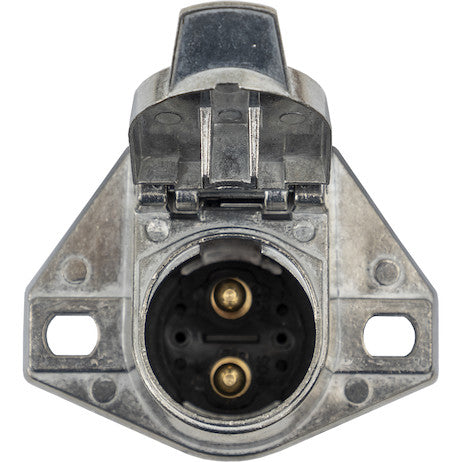
The 2 Way Trailer Connector from Buyers Products provides a secure electrical connection between your truck and your trailer. It's a round-pin connector ideal for a powering an electric tarp. The connector is available for either truck or trailer-side, in a vertical or horizontal pin arrangement. It features sturdy, die cast zinc construction. The trailer-side connector has a spring to protect wiring.
Specifications
| End Way (Number of Pins) | 2 |
|---|---|
| Mounting Type | Bolt-On |
| Pin Style | 2 Round Vertical |
| Start Way (Number of Pins) | 2 |
| Truck Side/Trailer Side | Truck Side |
Advanced Engineering for Vehicular Electrical Interconnection: The 2-Way Die-Cast Zinc Trailer Connector (Truck Side, Vertical Pin Arrangement)
This comprehensive technical overview delves into the design, material science, and application specific advantages of the 2-Way Die-Cast Zinc Trailer Connector, meticulously engineered for truck-side integration with a vertical pin arrangement. This product represents a pinnacle of robust electrical connectivity solutions, specifically optimized for the demanding environments encountered in heavy-duty commercial and industrial vehicle operations. Its design addresses the critical need for unwavering electrical integrity, mechanical durability, and environmental resilience in systems where failure is not an option.
Die-Cast Zinc Construction: A Foundation of Unrivaled Durability and Performance
The selection of die-cast zinc as the primary construction material for this trailer connector is a deliberate engineering choice, offering a superior balance of mechanical strength, corrosion resistance, and thermal conductivity essential for vehicular applications. Zinc alloys, particularly those employed in die-casting, possess exceptional tensile strength and impact resistance, allowing the connector housing to withstand significant physical stressors, including accidental impacts, road debris, and the constant vibration inherent to truck operation. This intrinsic robustness far exceeds that of common plastic alternatives, which can become brittle over time due to UV exposure, temperature cycling, and chemical degradation.
Furthermore, die-cast zinc exhibits excellent inherent corrosion resistance. In environments exposed to moisture, road salts, chemicals, and industrial pollutants, zinc forms a tenacious, passive oxide layer that acts as a protective barrier, preventing the underlying metal from degrading. This sacrificial corrosion protection property also means that if the surface is scratched, the zinc will preferentially corrode before any steel components it might be protecting, safeguarding the structural integrity of the assembly. The die-casting manufacturing process itself contributes significantly to the product's quality. This high-pressure casting method enables the production of complex, intricate geometries with exceptional dimensional accuracy and a fine, consistent surface finish. This precision is crucial for ensuring tight tolerances for pin alignment, secure mating with the trailer-side connector, and effective sealing against environmental ingress. The consistent wall thickness and absence of porosity typical of die-cast components further enhance the connector's structural integrity and longevity.
Thermal management is another key aspect where die-cast zinc excels. Its relatively high thermal conductivity facilitates efficient dissipation of heat generated during current flow, especially important when powering high-amperage devices like electric tarp motors. By preventing localized hotspots, the material contributes to the stability of electrical contacts, minimizing voltage drop and extending the lifespan of both the connector and the connected electrical components. This robust material choice, therefore, underpins the connector's ability to maintain optimal performance across a wide range of operational temperatures and environmental conditions.
Electrical Configuration: The 2-Way Round Vertical Pin System
The electrical interface of this connector is defined by its 2-way, round, vertical pin arrangement, a configuration specifically chosen for its efficacy in delivering focused power for critical auxiliary functions. The 2-way design is optimally suited for applications requiring a dedicated power and ground circuit, providing a straightforward and reliable connection. This simplicity minimizes potential points of failure and is perfectly aligned with the power requirements of devices such as electric tarp motors, where a direct, high-current path is paramount.
The adoption of round pins, as opposed to blade-style or flat terminals, offers distinct advantages in heavy-duty, high-vibration environments. Round pins provide a inherently robust male-to-female contact mechanism. When mated, the cylindrical surfaces establish a high-pressure, multi-point contact area that is less susceptible to intermittent connection issues caused by dynamic forces. This geometry ensures superior electrical continuity even under significant vibration or minor misalignments that could compromise the integrity of other pin types. Furthermore, round pins possess a degree of self-wiping action during connection and disconnection, which helps to clear minor surface contaminants, further enhancing contact reliability over time. Their substantial cross-section also makes them inherently more resistant to bending, fracturing, or fatigue, extending the connector's operational lifespan in rugged conditions.
The vertical pin arrangement is a critical design feature dictating the orientation of the connector and its mating counterpart. This specific configuration ensures that the cable entry and overall footprint align optimally with designated mounting locations on the truck chassis, particularly where spatial constraints or specific cable routing requirements exist. A vertical orientation can simplify wire harness routing, minimize strain on cables, and contribute to a cleaner, more organized installation. It also ensures consistent and repeatable engagement with the trailer-side connector, which is vital for maintaining electrical integrity and preventing accidental disconnections during vehicle operation.
Truck-Side Integration and Bolt-On Mounting Security
This connector is specifically engineered for truck-side installation, a distinction that implies a design optimized for permanent and secure integration with the vehicle's electrical infrastructure. Positioned on the truck, it serves as the primary interface to power various trailer-mounted accessories. The design takes into account the typical challenges of truck mounting, including exposure to the elements, vibration from the engine and road, and potential for physical impact. The robust nature of this connector is paramount for consistent operation in such a dynamic environment.
The bolt-on mounting type is a non-negotiable feature for applications demanding maximum security and stability. Unlike snap-in or friction-fit mounting methods, a bolt-on connection physically anchors the connector to the truck's chassis or a dedicated mounting bracket. This mechanical fastening mechanism provides unparalleled resistance to vibrational loosening, accidental dislodgement, and theft. In environments where components are subjected to constant jarring, acceleration, and braking forces, a bolted connection ensures that the electrical interface remains precisely aligned and securely coupled, preventing intermittent power delivery or complete disconnection. The distributed load provided by multiple bolt points also mitigates localized stress concentrations, enhancing the overall structural integrity of the mounting assembly.
Proper installation of the bolt-on mechanism is critical. This involves selecting appropriate fasteners (e.g., grade 8 bolts for heavy-duty applications), applying the correct torque specifications, and potentially utilizing thread-locking compounds or self-locking nuts to counteract vibration-induced loosening. A clean, flat mounting surface is also essential to ensure a flush fit and optimal load distribution. This meticulous attention to mounting security directly translates to reduced downtime, enhanced operational safety, and a significantly longer service life for the electrical connection, making it a cornerstone of reliable trailer-truck communication and power transfer.
Optimized for Electric Tarp Systems: A Core Application Focus
The description highlights that this 2-Way Trailer Connector is "ideal for powering an electric tarp." This statement underscores a specific design focus on meeting the unique demands of electric tarp systems, which are prevalent on dump trucks, transfer trailers, and other bulk material haulers. Electric tarp motors require a reliable source of high-current DC power to operate efficiently and consistently. These motors typically draw substantial amperage (often ranging from 20 to 50 amps, and sometimes higher for larger systems) during their intermittent duty cycles, necessitating a connector capable of handling such loads without excessive voltage drop or thermal stress.
The robust die-cast zinc construction, coupled with the heavy-duty round pins, ensures that the connector can safely and efficiently transmit these significant current levels. Overheating at the contact points, a common failure mode in lesser quality connectors, is mitigated by the excellent thermal properties of zinc and the large, stable contact surface of the round pins. This prevents premature wear, degradation of insulation, and potential fire hazards. Furthermore, electric tarp systems operate in some of the most challenging conditions imaginable: constant exposure to weather elements (rain, snow, ice, extreme UV radiation), abrasive dust, mud, corrosive road salts, and high-frequency vibrations from the truck and its cargo. The connector's design explicitly addresses these environmental challenges. Its secure mating and robust housing are engineered to resist ingress of moisture and particulate matter, which are primary contributors to corrosion and short-circuiting in electrical systems.
The inherent durability of the die-cast zinc construction and the secure bolt-on mounting mechanism provide superior resistance to the constant physical abuse and vibration experienced in these applications. This ensures that the electrical connection remains stable and functional, preventing costly downtime associated with unreliable tarp operation. While this specific connector is truck-side, the comprehensive system design considers the entire connection. The mention of a spring on the trailer-side connector to protect wiring indicates a holistic approach to system reliability, where both ends of the connection are engineered for longevity and performance in tandem.
Electrical Performance Characteristics and Reliability
The performance of any electrical connector is fundamentally evaluated by its ability to maintain electrical continuity and insulation integrity under operational and environmental stresses. This 2-Way Die-Cast Zinc Trailer Connector excels in these metrics, ensuring highly reliable power delivery. The low contact resistance between the precisely machined round pins is a critical parameter, minimizing voltage drop across the connection. In high-current applications like electric tarps, even a small voltage drop can significantly impact motor performance, reducing torque or speed. The design's optimization for low resistance ensures that maximum power is efficiently transferred to the load.
Insulation resistance is another vital characteristic, ensuring that there is no unwanted leakage current between the two pins or from the pins to the conductive housing. This prevents parasitic draws on the vehicle's electrical system and safeguards against electrical hazards. The dielectric strength, or the connector's ability to withstand a specified voltage without electrical breakdown, confirms its safety and reliability even under potential voltage spikes common in vehicular electrical systems. While an explicit Ingress Protection (IP) rating may not be provided, the design principles of the die-cast zinc housing, secure pin mating, and potential for sealing elements (such as gaskets or dielectric grease at installation points) contribute to a high level of environmental sealing. This protects internal electrical contacts from moisture, dust, and other contaminants that can lead to corrosion, short circuits, and intermittent operation.
The operational temperature range is broad, reflecting the connector's suitability for diverse climates and operating conditions, from sub-zero temperatures to extreme heat. The materials and construction are chosen to maintain mechanical and electrical stability without degradation or deformation across these extremes. The overall design emphasizes a long operational lifespan, minimizing the need for frequent inspection, repair, or replacement, thereby reducing maintenance costs and improving total cost of ownership for fleet operators.
Installation Best Practices and System Integration
Optimal performance of the 2-Way Die-Cast Zinc Trailer Connector is greatly enhanced by adherence to best practices during installation and integration into the truck's electrical system. The proper selection of wire gauge, matching the current demands of the electric tarp motor and the length of the cable run, is paramount to prevent excessive voltage drop and overheating. High-quality crimp terminals, securely attached to the appropriate wire gauge, ensure a low-resistance connection at the wire-to-pin interface. Insulation stripping should be performed accurately to prevent wire damage or exposed conductors.
Effective cable management, including the use of strain relief mechanisms, proper routing away from sharp edges or hot components, and secure fastening, prevents physical damage to the wiring over time. At the wire entry points into the connector housing, appropriate sealing methods such as heat-shrink tubing, rubber grommets, or silicone sealant should be employed to further enhance protection against moisture and contaminants. During the bolt-on mounting process, it is essential to use the specified torque values for fasteners to ensure a secure, vibration-resistant attachment without over-stressing the mounting points. Regular inspection of the connector, particularly in harsh environments, for signs of wear, corrosion, or damage, can significantly extend its service life and prevent unexpected failures. By following these guidelines, the inherent reliability and durability of the connector can be fully realized, contributing to the seamless operation of the entire truck-trailer system.
Conclusion: Uncompromising Performance for Demanding Applications
The 2-Way Die-Cast Zinc Trailer Connector, with its truck-side, vertical pin arrangement, stands as a testament to engineering excellence in vehicular electrical components. Its robust die-cast zinc construction, combined with a precise 2-way round pin configuration and secure bolt-on mounting, delivers an uncompromising solution for reliable power transmission, particularly for high-demand applications such as electric tarp systems. This connector is not merely a component; it is a critical investment in the operational efficiency, safety, and longevity of heavy-duty vehicle fleets.