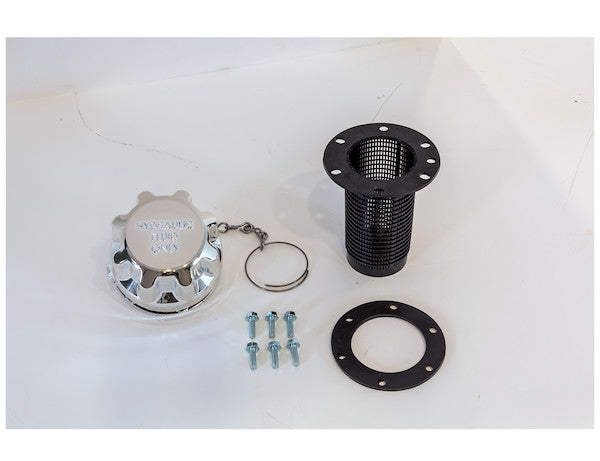
The tough Polymer Filler-Strainer Breather Cap Assembly from Buyers Products keeps contaminants out as you fill your oil reservoir, while acting as a fresh air ventilator to allow the tank to "breathe." It prevents a vacuum from building up in the tank. It's made of rust-resistant, high impact technopolymer and is able to handle temperatures from -22?? F to 240?? F. It contains a quarter-turn filler/breather cap that will filter out contaminants as small as 40 microns. You can order it with a 30 mesh/500 micron strainer basket. All mounting hardware is included. "Hydraulic Fluid Only" is stamped on the cap to prevent damage caused by using the wrong fluid.
Specifications
| Cap Type | Filler-Strainer Breather |
|---|---|
| Filter Rating | 40 |
| For Use With | Hydraulic reservoirs |
| Material | Nylon |
| Maximum Temperature | 180 |
| Thread Size | - |
Advanced Hydraulic System Protection: The Chrome-Plated Polymer Filler-Strainer Breather Cap Assembly
In the demanding world of hydraulic systems, the integrity of the hydraulic fluid is paramount to operational efficiency, component longevity, and overall system reliability. The Chrome-Plated Polymer Filler-Strainer Breather Cap Assembly represents a critical component in safeguarding hydraulic reservoirs from external contamination while simultaneously ensuring optimal internal pressure regulation. This integrated solution, meticulously engineered by Buyers Products, combines three essential functions—fluid filling, particulate straining, and air breathing—into a single, robust, and user-friendly unit.
Comprehensive Contamination Control: A Multi-Tiered Defense
Contamination is the leading cause of hydraulic system failure, accounting for an estimated 70-80% of all malfunctions. Particulate matter, water, and air can significantly degrade hydraulic fluid properties, leading to abrasive wear, corrosive damage, and premature component failure. The Filler-Strainer Breather Cap Assembly provides a sophisticated, multi-tiered defense against these pervasive threats.
Primary Filtration: The 40-Micron Breather Filter
At the core of its protective capabilities is the integrated breather filter, designed to prevent airborne contaminants from entering the hydraulic reservoir as the fluid level fluctuates. While the current description indicates a 40-micron filter rating, it's essential to understand the implications of this specification. A micron (µm) is one-millionth of a meter, and particulate matter at the 40-micron level, though invisible to the naked eye, can cause significant damage to precision hydraulic components. Airborne dust, dirt, and debris are consistently drawn into the reservoir as the fluid level drops (e.g., when cylinders extend or actuators operate), creating a vacuum. Without proper filtration, these contaminants would freely enter the system, leading to:
- Abrasive Wear: Hard particles, even those seemingly small, act like sandpaper within pumps, valves, and cylinders, eroding critical surfaces and increasing internal leakage.
- Reduced Fluid Life: Contaminants accelerate fluid degradation through oxidation and hydrolysis, necessitating more frequent fluid changes.
- Component Seizure: Fine particles can wedge into tight tolerances, causing sticking or outright seizure of moving parts.
- System Inefficiency: Increased friction and compromised component performance lead to higher energy consumption and reduced output.
The 40-micron breather filter acts as the primary barrier, capturing a significant percentage of harmful airborne particulates before they can reach the hydraulic fluid. This level of filtration is a foundational requirement for maintaining a reasonable level of fluid cleanliness in many industrial and mobile hydraulic applications. While finer filtration (e.g., 3-10 microns) may be employed within the hydraulic circuit, the breather cap's role is crucial in preventing gross contamination from the outset.
Secondary Filtration: The Optional 30 Mesh/500 Micron Strainer Basket
Beyond airborne ingress, a significant source of contamination occurs during the refilling process. The introduction of new fluid, even from supposedly "clean" containers, can introduce substantial particulate matter. Furthermore, during maintenance, larger debris can inadvertently fall into the reservoir opening. This assembly addresses this critical vulnerability with an optional 30 mesh/500 micron strainer basket. This robust basket serves several vital functions:
- Pre-Filtration During Filling: As hydraulic fluid is poured into the reservoir, the strainer basket physically intercepts larger particulates (e.g., metal shavings, dirt clumps, sealant fragments) that might otherwise enter the system. A 30 mesh screen corresponds to openings approximately 500 microns in size, effectively trapping macroscopic contaminants.
- Prevention of Gross Contamination: This coarse filtration layer prevents immediate damage to pumps and other sensitive components that could be caused by larger debris. It acts as a safety net, ensuring that even if the fluid source is compromised or accidents occur during filling, the system receives a preliminary level of protection.
- Ease of Cleaning: The basket design allows for easy removal and cleaning, facilitating routine maintenance and ensuring its continued effectiveness.
The combination of the 40-micron breather filter and the optional 500-micron strainer basket establishes a powerful two-stage defense, dramatically reducing the ingress of both airborne and fluid-borne contaminants into the hydraulic reservoir.
Dynamic Pressure Management: The Breather Function
Hydraulic reservoirs are not static containers; they are dynamic components of an active fluid power system. As cylinders extend and retract, or as fluid temperature changes, the fluid level within the reservoir fluctuates, leading to corresponding changes in the volume of air above the fluid. This necessitates a "breathing" function, allowing air to enter or exit the reservoir to equalize pressure. The Filler-Strainer Breather Cap Assembly performs this crucial role as a fresh air ventilator, preventing two detrimental conditions:
- Vacuum Build-up: As fluid is drawn from the reservoir into the hydraulic circuit (e.g., during cylinder extension), the air volume above the fluid increases, creating a partial vacuum. A significant vacuum can lead to cavitation in the pump, causing damage, noise, and reduced efficiency. Cavitation occurs when localized low-pressure zones cause fluid to vaporize and then collapse, sending shockwaves that erode pump components. The breather function ensures that filtered air can freely enter the reservoir, preventing vacuum formation and protecting the pump.
- Positive Pressure Build-up: Conversely, when fluid returns to the reservoir (e.g., during cylinder retraction) or as fluid temperature rises (causing expansion), the air volume above the fluid decreases, potentially creating positive pressure. While less damaging than a vacuum, excessive positive pressure can strain seals, lead to leakage, and potentially deform the reservoir itself. The breather cap allows excess air to exit the reservoir, maintaining atmospheric pressure and protecting the system.
By continuously regulating the internal pressure, the breather cap assembly ensures stable system operation, extends the life of seals and gaskets, and prevents costly repairs associated with pressure imbalances.
Material Science and Durability: The Chrome-Plated Technopolymer Advantage
The selection of materials for hydraulic components is critical, especially for those exposed to harsh operating environments. The Chrome-Plated Polymer Filler-Strainer Breather Cap Assembly leverages advanced material science to deliver exceptional performance and longevity.
High-Impact Technopolymer Construction
The core of this assembly is constructed from a "high-impact technopolymer," specified as Nylon in the technical table. Technopolymers, also known as engineering plastics, are polymers specifically designed to withstand demanding mechanical, thermal, and chemical stresses beyond what general-purpose plastics can endure. Nylon (polyamide) is an excellent example of such a material, widely recognized for its:
- Exceptional Strength and Toughness: Nylon exhibits high tensile strength, rigidity, and impact resistance, making it suitable for applications where mechanical stress is common. This ensures the cap assembly can withstand accidental impacts or vibrations without cracking or breaking.
- Rust and Corrosion Resistance: Unlike metallic components that are susceptible to rust in the presence of moisture, Nylon is inherently rust-resistant. This is a significant advantage in outdoor applications, marine environments, or anywhere condensation is a concern, preventing corrosive byproducts from entering the hydraulic fluid.
- Chemical Compatibility: Nylon offers good resistance to a wide range of chemicals, including many hydraulic fluids, oils, and greases. This ensures the material integrity is maintained over time, preventing degradation that could compromise the cap's sealing or structural properties.
- Lightweight: Polymer construction results in a lighter component compared to an equivalent metal assembly, contributing to overall system weight reduction without sacrificing performance.
Chrome-Plating for Enhanced Aesthetics and Protection
The "Chrome-Plated" aspect of the assembly title refers to a metallic chromium coating applied to the polymer substrate. While polymer itself is highly resistant to many forms of degradation, chrome plating offers additional benefits:
- Superior Surface Hardness: Chromium provides an exceptionally hard surface layer, increasing resistance to abrasion, scratching, and general wear and tear, further extending the product's aesthetic appeal and functional life.
- Enhanced Corrosion Protection: Although the polymer base is rust-resistant, the chrome layer adds an extra barrier against certain chemicals or environmental factors, especially in applications where the cap might be exposed to aggressive cleaning agents or atmospheric pollutants.
- Aesthetic Appeal: Chrome plating imparts a highly polished, reflective finish, providing a professional and premium appearance that aligns with high-quality industrial or mobile equipment. This also aids in easy cleaning, as the smooth, non-porous surface resists dirt adhesion.
This synergistic combination of a high-performance technopolymer base with a durable, aesthetically pleasing chrome finish ensures the cap assembly maintains its structural integrity, protective functions, and visual quality throughout its operational lifespan.
Operating Temperature Range: Robust Performance in Extreme Conditions
Hydraulic systems often operate in diverse and challenging environments, from freezing cold to scorching heat. The specified temperature handling capabilities of the cap assembly are critical for reliable performance:
- Low Temperature Resilience (-22° F): At extremely low temperatures, many plastics become brittle and prone to cracking. The technopolymer used in this assembly is engineered to retain its toughness and structural integrity down to -22° F (-30° C). This ensures that seals remain pliable and the cap assembly functions correctly in arctic conditions, cold storage facilities, or during winter operation of mobile equipment, preventing leaks or mechanical failure due to material embrittlement.
- High Temperature Endurance (Up to 240° F): Conversely, hydraulic systems can generate significant heat. While the general maximum operating temperature is listed as 180° F (82° C) in the specifications, the material's capability to withstand up to 240° F (116° C) indicates a substantial safety margin. This high heat deflection temperature ensures that the cap assembly will not deform, degrade, or lose its sealing properties even when exposed to elevated ambient temperatures or radiant heat from nearby engine compartments or hydraulic lines. This robust thermal stability is crucial for long-term reliability in demanding industrial or off-highway applications.
The ability to perform reliably across such a broad temperature spectrum underscores the product's suitability for a global market and a vast array of application environments.
User-Centric Design and Installation
Ease of use and installation are key factors in component selection for system integrators and maintenance personnel.
Quarter-Turn Filler/Breather Cap
The quarter-turn design of the cap offers several practical advantages:
- Rapid Access: Facilitates quick and efficient reservoir filling and fluid level checks, minimizing downtime during maintenance.
- Secure Sealing: Ensures a positive, leak-proof seal with minimal effort, preventing fluid splash-out and contaminant ingress.
- Ergonomics: Simple operation reduces the risk of incorrect sealing or damage during routine handling.
Integrated Mounting Hardware
The inclusion of all necessary mounting hardware simplifies installation, ensuring that the assembly can be readily integrated into new or existing hydraulic reservoirs without the need for sourcing additional components. This streamlined approach saves time and reduces potential installation errors.
Safety and Application-Specific Indication: "Hydraulic Fluid Only"
The stamping of "Hydraulic Fluid Only" directly on the cap is a vital safety and operational feature. In multi-fluid environments, accidental cross-contamination or the introduction of incorrect fluids (e.g., engine oil, coolant, water) into a hydraulic reservoir can lead to catastrophic system failure, including:
- Seal Degradation: Incompatible fluids can attack and degrade hydraulic seals, causing leaks and loss of pressure.
- Component Damage: Incorrect viscosity or chemical composition can damage pumps, valves, and actuators.
- System Malfunction: Altered fluid properties can lead to erratic operation, reduced power, or complete system shutdown.
This clear, indelible marking serves as a persistent visual reminder to maintenance personnel, significantly reducing the risk of costly and dangerous fluid mix-ups. It underscores a commitment to operational safety and the preservation of hydraulic system integrity.
Applications and Economic Benefits
The Chrome-Plated Polymer Filler-Strainer Breather Cap Assembly is ideally suited for a wide range of hydraulic applications, including:
- Mobile hydraulic equipment (e.g., construction machinery, agricultural vehicles, utility trucks)
- Industrial hydraulic power units
- Material handling equipment
- Marine hydraulics
- Forestry equipment
By providing superior contamination control and pressure management, this assembly delivers significant economic benefits:
- Extended Component Lifespan: Reduced wear and tear on pumps, valves, cylinders, and motors translates directly into longer operational life and fewer premature failures.
- Reduced Maintenance Costs: Fewer component replacements, less frequent fluid changes (due to cleaner fluid), and minimized unscheduled downtime.
- Improved System Efficiency: Optimal fluid cleanliness and pressure balance contribute to consistent system performance and lower energy consumption.
- Enhanced Safety: Reliable operation and clear fluid identification reduce the risk of accidents and operational errors.
In conclusion, the Chrome-Plated Polymer Filler-Strainer Breather Cap Assembly from Buyers Products is more than just a cap; it is a meticulously engineered, multi-functional component critical to the long-term health, efficiency, and safety of any hydraulic system. Its advanced polymer construction, comprehensive filtration capabilities, dynamic pressure management, and user-friendly design make it an indispensable investment for ensuring peak hydraulic performance and extending asset life in demanding operational environments.