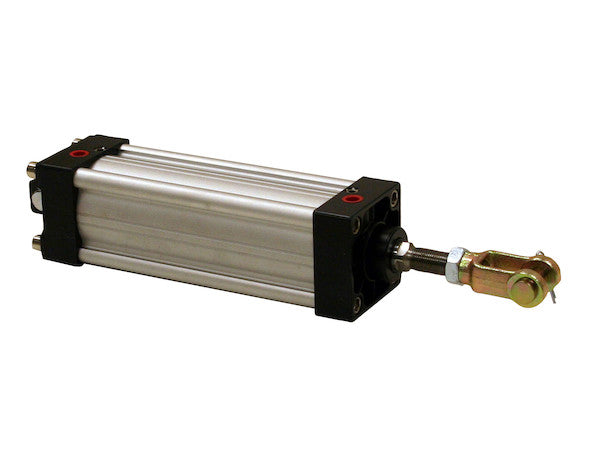
Keep your tailgate operating smoothly with Buyers Products Tie Rod Cylinders. Each cylinder houses and protects an enclosed tie rod in a durable extruded aluminum body. The cylinders are ideal for dump truck operators to engage and disengage tailgate latches from inside their vehicle without having to leave the cab.
Specifications
| Bore | 2.5 |
|---|---|
| Dim A | 15.25 |
| Dim B | 23.25 |
| Features | V |
| Mount | Clevis |
| Rod Dia | .750 |
| Stroke | 8 |
Advanced Technical Overview: Buyers Products Tie Rod Tailgate Cylinder
The Buyers Products Tie Rod Tailgate Cylinder, featuring a 2.5 Inch Bore and an 8 Inch Stroke with 1/4 Inch Ports, represents a robust and precisely engineered hydraulic solution designed for demanding industrial applications, specifically tailored for the automated operation of dump truck tailgates. This hydraulic cylinder embodies a fusion of advanced material science, meticulous design principles, and rigorous manufacturing standards to deliver unparalleled performance, reliability, and operational efficiency in challenging environments. Its core function is to provide the necessary linear force and controlled motion to engage and disengage tailgate latches, thereby significantly enhancing operator safety and productivity.
Fundamentals of Tie Rod Cylinder Design and Operation
Hydraulic cylinders are fundamental components in fluid power systems, converting hydraulic pressure into linear mechanical force and motion. The tie rod cylinder, in particular, is distinguished by its construction, where end caps are secured to the cylinder barrel by means of threaded steel rods (tie rods) that extend the full length of the cylinder. These tie rods pass through holes in the end caps and are tightened with nuts, compressing the assembly and ensuring a robust, leak-free connection. This design provides exceptional structural integrity, making tie rod cylinders highly suitable for applications requiring high operating pressures and substantial forces, while also facilitating maintenance and repair.
The operating principle of this double-acting cylinder involves the controlled introduction of hydraulic fluid into either side of the piston. When fluid is directed to the cap end, it exerts pressure on the larger surface area of the piston, forcing the rod to extend. Conversely, when fluid is directed to the rod end, it pushes the piston and retracts the rod. The difference in effective area between the cap and rod ends results in differential forces and speeds during extension and retraction, a characteristic inherent to double-acting cylinders.
Detailed Analysis of Key Specifications
2.5 Inch Bore Diameter: Force Generation and Pressure Considerations
The bore diameter, measuring 2.5 inches (approximately 63.5 mm), is a critical parameter that directly influences the cylinder's force output. According to Pascal's Principle, the force exerted by a hydraulic cylinder is the product of the hydraulic pressure and the effective piston area. For a 2.5-inch bore, the area (π * (Bore/2)²) is approximately 4.91 square inches. Therefore, at an exemplary hydraulic system pressure of 2000 PSI, this cylinder is capable of generating an extension force of approximately 9,820 pounds (44.5 kN). This substantial force capability is essential for reliably engaging and disengaging heavy dump truck tailgates, which can be subject to significant mechanical resistance due to material buildup, wear, or adverse environmental conditions.
The bore size is also proportional to the volume of hydraulic fluid required per unit of stroke. A larger bore necessitates more fluid for the same stroke length, potentially impacting the speed of operation if the hydraulic pump's flow rate is constant. However, for tailgate applications, a balanced approach between force and speed is typically preferred, ensuring smooth and controlled motion rather than instantaneous high-speed actuation.
8 Inch Stroke Length: Range of Motion and Application Precision
The 8-inch (approximately 203.2 mm) stroke length defines the maximum linear travel of the piston rod. This dimension is specifically engineered to provide the precise range of motion required for the complete and secure engagement or disengagement of dump truck tailgate latches. An optimally chosen stroke length ensures that the latch mechanism can fully cycle without excessive or insufficient travel, preventing partial engagement which could compromise safety or cause premature wear on the latch components. For tailgate applications, the stroke must be sufficient to clear any mechanical interferences during opening and provide a firm, positive lock during closure.
The accuracy of the stroke length is paramount for synchronized operations in multi-cylinder systems, although this particular cylinder typically operates independently for a single tailgate function. The consistent and repeatable stroke ensures that the tailgate operates predictably, contributing to the overall efficiency and safety of material handling operations.
1/4 Inch Ports: Hydraulic Flow Dynamics and Connection Standards
The inclusion of 1/4 inch (NPT - National Pipe Taper, typically implied for industrial hydraulic fittings) ports dictates the interface for hydraulic fluid connection. While seemingly small, these port sizes are carefully selected to balance flow velocity, pressure drop, and connection integrity for this specific cylinder size and application. For a 2.5-inch bore and 8-inch stroke cylinder used in tailgate actuation, 1/4 inch ports are generally sufficient to allow adequate fluid flow for smooth and timely operation without introducing excessive pressure drops that would diminish system efficiency or generate undue heat.
The NPT standard ensures a robust, tapered thread connection that provides a mechanical seal when properly assembled, crucial for preventing hydraulic fluid leaks under high pressure. The port size also influences the speed at which the cylinder can extend or retract; larger ports allow higher flow rates and thus faster actuation, but for a tailgate application, precise control and moderate speed are often prioritized over maximum velocity.
Robust Tie Rod Construction and Durability
The fundamental advantage of the tie rod cylinder design lies in its inherent strength and serviceability. The tie rods, typically high-tensile steel, are designed to withstand significant tensile stresses generated by internal hydraulic pressures, ensuring the integrity of the cylinder assembly under extreme operating conditions. This construction method allows for the relatively straightforward replacement of individual components such as seals, bearings, or even the rod itself, extending the cylinder's service life and reducing long-term maintenance costs compared to welded body designs.
Furthermore, the even distribution of clamping force across the end caps prevents distortion and ensures optimal alignment of internal components, which is critical for smooth piston movement and seal longevity. This modularity also simplifies manufacturing and assembly, contributing to consistent product quality.
Extruded Aluminum Body: Material Science and Performance Benefits
The cylinder body is constructed from durable extruded aluminum. Extrusion is a manufacturing process that forces a metal through a die, creating a uniform cross-sectional profile. This method yields a very dense and homogeneous material structure, free from the porosity and inconsistencies sometimes found in castings. The benefits of using extruded aluminum for the cylinder body are manifold:
- Lightweight: Aluminum's low density significantly reduces the overall weight of the cylinder, which is advantageous in applications where payload capacity or overall vehicle weight is a concern, such as dump trucks.
- Corrosion Resistance: Aluminum naturally forms a passive oxide layer, providing excellent resistance to corrosion, especially beneficial in outdoor, often harsh, operational environments where exposure to moisture, road salts, and chemicals is common.
- Heat Dissipation: Aluminum has good thermal conductivity, allowing it to dissipate heat generated during continuous operation more effectively than steel, contributing to cooler operation and prolonged seal life.
- Precision and Surface Finish: The extrusion process allows for tight dimensional tolerances and a smooth internal bore finish, which is crucial for minimizing friction, enhancing seal performance, and extending the life of the piston and seals.
- Strength-to-Weight Ratio: Despite being lightweight, extruded aluminum offers an excellent strength-to-weight ratio, ensuring the cylinder can withstand the operational stresses without compromising structural integrity.
Clevis Mounting: Versatility and Dynamic Load Handling
The clevis mount is a highly versatile and widely adopted mounting style for hydraulic cylinders. It consists of a U-shaped bracket with a pin that articulates into a corresponding bracket on the equipment. This type of mounting provides several key advantages:
- Articulation: Clevis mounts allow for angular movement of the cylinder relative to its mounting point, accommodating slight misalignments or dynamic changes in angle during the operating cycle. This is particularly beneficial for tailgate mechanisms where the point of force application may shift slightly during opening and closing.
- Robustness: The pin connection provides a strong, reliable pivot point capable of handling both tensile and compressive loads effectively.
- Ease of Installation: Clevis mounts are relatively simple to install and connect, requiring only a compatible mounting bracket on the machine and a connecting pin.
- Compact Design: This mounting style is often compact, which can be advantageous in space-constrained applications within vehicle chassis.
Rod Diameter 0.750 Inch: Strength, Stability, and Surface Integrity
The rod diameter of 0.750 inches (3/4 inch or approximately 19.05 mm) is a critical design factor influencing the cylinder's structural integrity, particularly its resistance to buckling and bending under compressive loads. For a 2.5-inch bore and 8-inch stroke, a 0.750-inch rod provides a robust balance, ensuring sufficient strength to withstand the forces generated by the cylinder, as well as external forces encountered during tailgate operation.
Typically, hydraulic cylinder rods are manufactured from high-strength steel and are precision-ground, polished, and hard chrome-plated. The hard chrome plating significantly enhances surface hardness, providing superior resistance to wear, corrosion, and pitting from external environmental factors. This polished, low-friction surface is also essential for maximizing the life of the rod seals and wiper seals, preventing ingress of contaminants into the hydraulic system and ensuring smooth, consistent operation.
Dimensions (Dim A: 15.25", Dim B: 23.25"): Installation and Operational Envelope
The dimensions provided are crucial for proper mechanical integration. Dim A (15.25 inches) typically refers to the retracted pin-to-pin or mount-to-mount length of the cylinder, while Dim B (23.25 inches) represents the extended pin-to-pin length. These measurements are absolutely vital for design engineers and installers to ensure the cylinder fits within the available space on the dump truck chassis and that it provides the correct mechanical advantage and travel for the tailgate mechanism without interfering with other components.
The difference between Dim B and Dim A (23.25 - 15.25 = 8 inches) directly corresponds to the stated stroke length, confirming the consistency of the specifications. Precise dimensional data minimizes installation errors, ensures optimal functional alignment, and prevents potential structural conflicts or limitations within the vehicle's operational envelope.
Features (V): Advanced Sealing and Internal Components
While the specific interpretation of "V" for features is not detailed, in a technical context for hydraulic cylinders, it often implies specific sealing materials (e.g., Viton for high temperature/chemical resistance), valving (e.g., integrated velocity fuses), or other design enhancements. General advanced features in a quality hydraulic cylinder like this would include:
- High-Performance Sealing Systems: Utilizing advanced piston seals (e.g., U-cups, composite seals) for effective pressure containment and minimal internal bypass, and rod seals (e.g., U-cups, compact seals with secondary lips) for preventing external leakage.
- Wiper Seals: Essential for protecting the internal hydraulic system from contaminants (dust, dirt, moisture) that could enter along the rod, significantly extending seal and component life.
- Rod Bearings/Bushings: Low-friction, wear-resistant bearings typically made of bronze or polymer composites, supporting the piston rod and ensuring smooth operation while preventing metal-to-metal contact.
- Precision Machining: All internal surfaces are machined to tight tolerances and fine finishes to optimize seal performance, reduce friction, and enhance overall efficiency.
- Temperature Range Compatibility: Designed to operate reliably across a broad range of ambient and fluid temperatures, crucial for heavy-duty outdoor machinery.
Application-Specific Advantages for Tailgate Operations
Enhanced Safety and Ergonomics for Operators
The primary benefit of integrating this hydraulic tailgate cylinder into dump truck operations is the significant improvement in operator safety and ergonomics. Manual engagement and disengagement of heavy tailgate latches expose operators to risks of pinch injuries, strains, and falls, particularly on uneven terrain or in adverse weather conditions. The remote operation enabled by this cylinder allows the operator to control the tailgate from the safety and comfort of the cab, mitigating these risks entirely. This adheres to modern industrial safety standards and best practices, reducing potential liabilities and improving working conditions.
Operational Efficiency and Productivity Gains
Automated tailgate operation translates directly into increased productivity. The ability to quickly and reliably open and close the tailgate without leaving the vehicle reduces cycle times for dumping operations. This efficiency is particularly critical in high-volume construction, mining, or waste management applications where every minute saved contributes to higher throughput and profitability. Consistent and smooth operation also minimizes wear and tear on the tailgate mechanism itself, leading to reduced maintenance and downtime.
Robustness in Environmental Extremes
Dump trucks operate in some of the harshest environments imaginable, exposed to extreme temperatures, moisture, abrasive materials, and corrosive agents. The robust design of this Buyers Products cylinder, with its corrosion-resistant extruded aluminum body, hard chrome-plated rod, and high-performance seals, ensures reliable operation under these challenging conditions. It is engineered to resist the ingress of contaminants, maintain sealing integrity, and function effectively without degradation in performance, thereby maximizing uptime and operational continuity.
Hydraulic System Integration and Performance Considerations
Successful deployment of this tailgate cylinder requires proper integration into the vehicle's existing hydraulic system. Key considerations include:
- Hydraulic Fluid Compatibility: Ensuring the hydraulic fluid used in the dump truck system is compatible with the cylinder's seals and materials to prevent degradation and leakage.
- System Pressure: The cylinder must be matched to the vehicle's hydraulic system pressure to achieve the desired force output and avoid over-pressurization.
- Pump Flow Rate: The hydraulic pump's flow rate will determine the speed of cylinder actuation. Proper sizing ensures timely tailgate operation.
- Control Valves: Appropriate directional control valves (e.g., solenoid-operated spool valves) are necessary to control the extension and retraction of the cylinder from the cab.
Manufacturing Excellence and Quality Assurance
Buyers Products is renowned for its commitment to manufacturing excellence. This tie rod cylinder is a testament to that commitment, produced using precision engineering techniques, stringent material selection, and rigorous quality control processes. Each component is meticulously inspected to ensure compliance with design specifications and performance benchmarks. From the uniformity of the extruded aluminum barrel to the precision of the piston and rod assembly, every detail contributes to the overall reliability and longevity of the product. Thorough testing, often including pressure cycle testing and leak detection, ensures that the cylinder meets or exceeds the demands of its intended application.
Conclusion
The Buyers Products Tie Rod Tailgate Cylinder with its 2.5-inch bore, 8-inch stroke, and 1/4-inch ports represents a superior hydraulic actuation solution for dump truck tailgate applications. Its advanced tie rod construction, lightweight yet durable extruded aluminum body, robust rod design, and precisely matched specifications collectively deliver unparalleled safety, efficiency, and reliability. By enabling remote, powerful, and consistent operation of tailgate latches, this cylinder not only enhances the productivity of material handling operations but also significantly elevates the safety profile for vehicle operators in demanding industrial environments. It is an investment in durable engineering and operational excellence, ensuring long-term performance and minimal maintenance in the harshest conditions.