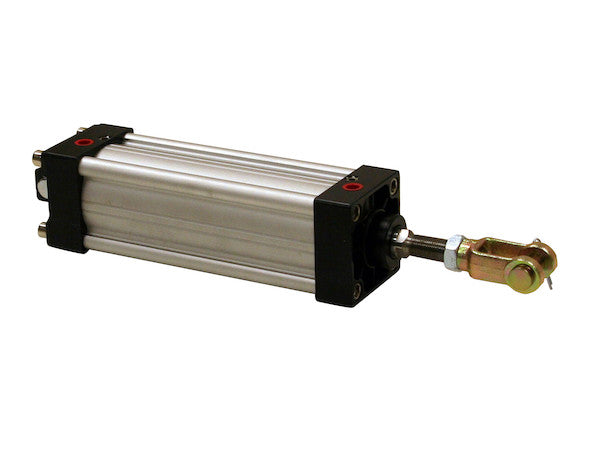
Keep your tailgate operating smoothly with Buyers Products Tie Rod Cylinders. Each cylinder houses and protects an enclosed tie rod in a durable extruded aluminum body. The cylinders are ideal for dump truck operators to engage and disengage tailgate latches from inside their vehicle without having to leave the cab.
Specifications
| Bore | 2.5 |
|---|---|
| Dim A | 15.25 |
| Dim B | 23.25 |
| Features | V |
| Mount | Clevis |
| Rod Dia | .750 |
| Stroke | 8 |
Advanced Engineering and Performance: The Buyers Products Tie Rod Style Cylinder
This detailed description provides a comprehensive technical overview of the Buyers Products Tie Rod Style Cylinder, specifically focusing on the Clevis Mount configuration with a 0.75-inch rod diameter and an 8-inch stroke. Designed for demanding applications, this hydraulic actuator exemplifies robust construction, precision engineering, and reliable performance, making it an indispensable component in various mobile and industrial hydraulic systems.
Fundamentals of Tie Rod Cylinder Design and Operation
A tie rod cylinder is a type of hydraulic cylinder characterized by its construction, where the cylinder barrel, end caps (head and cap ends), and piston assembly are held together by external tie rods. Unlike welded cylinders, which are permanently sealed, tie rod cylinders are designed for easier disassembly, maintenance, and repair, offering significant long-term operational advantages. The specific model under review features an extruded aluminum body, providing an excellent balance of strength, weight reduction, and corrosion resistance.
The core principle of hydraulic cylinder operation involves converting hydraulic fluid pressure into linear mechanical force and motion. Pressurized hydraulic fluid is directed into one side of the cylinder (either the bore side or the rod side), pushing the piston and extending or retracting the piston rod. For this single-acting cylinder variant, the "push" force is generated when fluid enters the bore side, while retraction is often achieved by external forces or spring return, although double-acting versions are also common where fluid pressure can act on both sides. In the context of tailgate operation, a single-acting cylinder might be used to latch, with gravity or a spring unlatching, or a double-acting variant might provide powered control in both directions.
Key Components and Their Functionality:
- Cylinder Barrel: The extruded aluminum body forms the primary pressure vessel and guides the piston. The extrusion process ensures uniform wall thickness, excellent surface finish for reduced seal friction, and inherent resistance to corrosion due to the material's properties. This material choice significantly reduces the overall weight of the assembly compared to steel, which is crucial for mobile applications.
- Piston: A precision-machined component that separates the two pressure chambers within the cylinder. It is fitted with seals (piston seals) to prevent internal fluid bypass, ensuring efficient force transmission.
- Piston Rod: A high-strength, precision-ground and polished steel rod that extends and retracts, transmitting the force generated by the hydraulic pressure to the external load. Its surface finish is critical for seal longevity and minimizing friction. For this model, the 0.75-inch diameter rod offers an optimal balance of strength and space efficiency.
- End Caps (Head and Cap Ends): These seal the ends of the cylinder barrel. The head end (gland) typically houses the rod seal, wiper, and rod bearing, while the cap end provides a solid mounting point. In a tie rod design, these caps are securely clamped to the barrel by the tie rods.
- Tie Rods: High-strength steel rods that run parallel to the cylinder barrel, passing through the end caps. They are threaded at both ends and secured with nuts, creating a robust, pre-stressed assembly that can withstand high internal pressures and external forces. Their design facilitates straightforward disassembly for maintenance.
- Sealing System: Comprising piston seals, rod seals, static seals (O-rings), and rod wipers. The integrity of the sealing system is paramount for preventing leaks, maintaining pressure, and extending the operational life of the cylinder. Modern hydraulic cylinders often utilize advanced polymer compounds for seals, selected for their resistance to hydraulic fluids, temperature variations, and wear. The "V" in the features specification likely indicates a high-performance seal material, such as Viton (FKM), known for its excellent chemical and temperature resistance, or possibly a specific proprietary sealing package.
Technical Specifications and Performance Metrics
The provided specifications are critical for understanding the operational envelope and capabilities of this hydraulic cylinder:
- Bore: 2.5 inches (63.5 mm): The bore diameter dictates the effective area upon which hydraulic pressure acts to generate force. For a 2.5-inch bore, the area (A) is calculated as π * (Bore/2)^2 = π * (1.25)^2 ≈ 4.9087 square inches. This area, when multiplied by the operating pressure, determines the theoretical push force of the cylinder. For example, at an operating pressure of 2,000 psi, the theoretical push force would be approximately 9,817 pounds (4,9087 in² * 2,000 psi).
- Rod Dia: 0.75 inches (19.05 mm): The rod diameter is crucial for the structural integrity of the piston rod, particularly its resistance to buckling under compressive loads and its shear strength. A 0.75-inch rod is well-suited for the 2.5-inch bore, providing sufficient rigidity for an 8-inch stroke. The rod's surface is typically hard chrome plated to enhance corrosion resistance, wear resistance, and provide a low-friction surface for the rod seals, extending their lifespan.
- Stroke: 8 inches (203.2 mm): The stroke defines the maximum linear travel distance of the piston rod. An 8-inch stroke is ideal for applications requiring a precise, moderate range of motion, such as actuating tailgate latches, opening and closing gates, or other material handling functions. This specific stroke length is engineered to provide adequate displacement for the intended application, ensuring full engagement or disengagement of the mechanism.
- Dim A: 15.25 inches (387.35 mm): This typically refers to the retracted length (pin-to-pin or center-to-center) of the cylinder, also known as the closed length. It is a critical dimension for installation planning, ensuring the cylinder fits within the available space when fully retracted.
- Dim B: 23.25 inches (590.55 mm): This represents the extended length (pin-to-pin or center-to-center) of the cylinder. The difference between Dim B and Dim A (23.25 - 15.25 = 8 inches) precisely matches the stated stroke length, confirming these dimensions.
- Mount: Clevis: The clevis mounting style offers significant advantages in applications requiring angular movement or compensation for slight misalignment. This mounting type will be elaborated upon further.
- Features: V: As noted previously, this "V" may denote a specific feature set or material. Common interpretations include Viton® seals (for enhanced chemical and temperature resistance), a specialized valve configuration, or perhaps a unique surface treatment. Assuming Viton, it indicates suitability for a broader range of hydraulic fluids and higher operating temperatures compared to standard nitrile seals.
Clevis Mounting System: Advantages and Applications
The clevis mount is a highly versatile and robust mounting configuration for hydraulic cylinders, offering significant operational benefits:
- Articulation and Angular Movement: A clevis mount allows the cylinder to pivot freely around a single axis, accommodating changes in angular alignment during the stroke. This is essential for applications where the load or the cylinder's connection point undergoes rotational movement, such as the opening and closing of a tailgate or the articulation of an implement on agricultural machinery.
- Ease of Installation: The simple pin connection of a clevis mount facilitates quick and straightforward installation and removal. This reduces downtime for maintenance or replacement, a crucial factor in demanding operational environments.
- Robustness for Shock Loads: Clevis mounts are inherently strong and can effectively distribute forces, making them suitable for applications involving moderate shock loads or vibrations. The solid clevis end acts as a sturdy anchor point.
- Misalignment Compensation: While the clevis provides angular flexibility, it can also tolerate minor lateral misalignments, reducing stress on the cylinder and its mounting pins.
In the context of the tailgate operation, the clevis mount allows the cylinder to effectively engage and disengage the latch mechanism, accommodating the slight arc traced by the tailgate as it moves. Beyond dump truck tailgates, clevis mount cylinders are widely utilized in:
- Agricultural equipment (e.g., controlling plows, loaders, spray booms).
- Construction machinery (e.g., auxiliary functions on excavators, small lift arms).
- Material handling equipment (e.g., conveyor gate controls, clamping mechanisms).
- Industrial automation (e.g., pushing, pulling, or lifting applications with varying load angles).
Material Science and Manufacturing Excellence
The selection of materials and manufacturing processes are paramount to the longevity and performance of hydraulic cylinders. Buyers Products employs advanced techniques and high-grade materials to ensure superior product quality:
- Extruded Aluminum Body: The use of extruded aluminum for the cylinder barrel offers several advantages. Aluminum is lightweight, contributing to fuel efficiency and reduced overall vehicle weight in mobile applications. Its inherent corrosion resistance makes it suitable for outdoor and harsh environments, particularly when compared to untreated steel. The extrusion process yields a dense, uniform material structure with excellent mechanical properties and a smooth internal bore surface that minimizes friction and enhances seal life.
- High-Strength Piston Rod: The 0.75-inch piston rod is typically manufactured from high-tensile steel, providing exceptional strength and rigidity. The precision grinding and polishing of the rod surface, followed by hard chrome plating, are critical steps. Hard chrome plating significantly increases surface hardness (typically 60-70 HRC), enhancing wear resistance, resisting pitting and corrosion from environmental exposure or hydraulic fluid contaminants, and providing a low-friction interface for the rod seals. This extends the lifespan of both the rod and the seals.
- Advanced Sealing Technology: The sealing system is engineered to prevent leakage and ensure efficient operation across a range of temperatures and pressures. This includes dynamic seals for the piston and rod, and static seals for the end caps. The "V" feature likely signifies the use of high-performance elastomers such as Viton (Fluoroelastomer), which offers superior resistance to heat, chemicals, and abrasion compared to standard nitrile (Buna-N) seals. This choice ensures reliable performance even with aggressive hydraulic fluids or in elevated temperature conditions.
- High-Tensile Tie Rods: The tie rods themselves are constructed from high-strength alloy steel, precisely machined and threaded. They are often pre-stressed during assembly, creating a compressive force on the cylinder barrel and end caps. This pre-load enhances the cylinder's fatigue resistance, allowing it to withstand repeated pressure cycles without structural degradation.
Hydraulic System Integration and Fluid Compatibility
Proper integration of the cylinder into a hydraulic system is crucial for optimal performance. This involves selecting appropriate hydraulic fluid, ensuring correct plumbing, and maintaining the system's cleanliness.
- Hydraulic Fluid: The choice of hydraulic fluid directly impacts cylinder performance and lifespan. Key properties include viscosity, viscosity index, lubricity, thermal stability, and anti-wear additives. Given the "V" feature (potentially Viton seals), this cylinder is likely compatible with a wide range of petroleum-based hydraulic oils, and potentially some synthetic fluids, offering flexibility in system design. It is imperative to always consult the manufacturer's fluid compatibility guidelines.
- Operating Pressure: The cylinder is designed to operate within specific pressure ranges. Exceeding these limits can lead to premature wear, seal failure, or even catastrophic structural damage. The 2.5-inch bore and 0.75-inch rod configuration is typically designed for medium to high-pressure applications common in mobile equipment (e.g., 2000-3000 psi).
- Filtration: Maintaining hydraulic fluid cleanliness is paramount. Contaminants can cause abrasive wear on internal components, damage seals, and lead to system inefficiencies. Implementing robust filtration systems (both pressure and return line filters) significantly extends the life of the cylinder and the overall hydraulic system.
- Temperature Management: Operating temperature affects fluid viscosity and seal material properties. The extruded aluminum body aids in heat dissipation, helping to maintain optimal operating temperatures. However, external factors and continuous high-load cycles can generate heat, necessitating adequate cooling in the hydraulic power unit.
Reliability, Durability, and Maintenance
Buyers Products hydraulic cylinders are engineered for maximum reliability and durability, even in the most challenging environments. The tie rod construction significantly contributes to ease of maintenance and extended service life.
- Field Serviceability: Unlike welded cylinders that often require specialized welding equipment for repair, tie rod cylinders can typically be disassembled and reassembled using standard tools. This allows for convenient replacement of seals, bearings, or even the piston rod in the field, drastically reducing repair time and costs. This feature is particularly valuable for fleet operators like dump truck companies, minimizing vehicle downtime.
- Fatigue Resistance: Through careful design, material selection, and manufacturing processes, including pre-stressing the tie rods, these cylinders exhibit excellent fatigue resistance, capable of enduring millions of operational cycles under rated loads.
- Environmental Resilience: The combination of corrosion-resistant aluminum, hard chrome-plated steel, and high-performance seals ensures the cylinder can withstand exposure to moisture, road salt, dirt, and varying temperatures, making it ideal for outdoor mobile applications.
- Preventative Maintenance: Regular inspection for leaks, rod damage, and proper mounting pin lubrication can significantly extend the cylinder's operational life. Monitoring hydraulic fluid quality and adhering to fluid change schedules are also critical.
Diverse Applications Beyond Tailgate Latches
While specifically highlighted for dump truck tailgate operations, the robust design and versatile clevis mount of this tie rod cylinder make it suitable for a multitude of other applications requiring precise linear force and motion:
- Agricultural Implements: Actuation of steering mechanisms, lift assistance for planter markers, or control of small accessory functions on tractors and attachments.
- Waste Management: Compactor mechanisms, chute controls, or bin lifting auxiliary functions on refuse vehicles.
- Industrial Automation: Clamping, pushing, pulling, or lifting operations in manufacturing plants, such as actuating gates on conveyor lines, controlling press tooling, or operating material transfer systems.
- Construction Equipment: Small bucket tilt, boom articulation on mini-excavators, or stabilization leg deployment on utility vehicles.
- Custom Machinery: Integration into custom-built machines requiring a reliable, serviceable hydraulic actuator with a moderate stroke and robust mounting.
Conclusion
The Buyers Products Tie Rod Style Cylinder with a Clevis Mount, 0.75-inch rod, and 8-inch stroke represents a sophisticated piece of hydraulic engineering. Its construction, featuring a durable extruded aluminum body and robust tie rod assembly, coupled with precision-machined components and advanced sealing technology, ensures exceptional performance and longevity. From enabling remote tailgate operation in dump trucks to serving as a critical actuator in diverse industrial and mobile applications, this cylinder delivers reliable, controlled linear motion. Its design emphasizes not only immediate operational efficiency but also long-term serviceability, making it a cost-effective and dependable choice for professionals seeking high-quality hydraulic solutions. By understanding its technical specifications and adhering to proper hydraulic system practices, users can maximize the performance and extend the life of this superior hydraulic component.