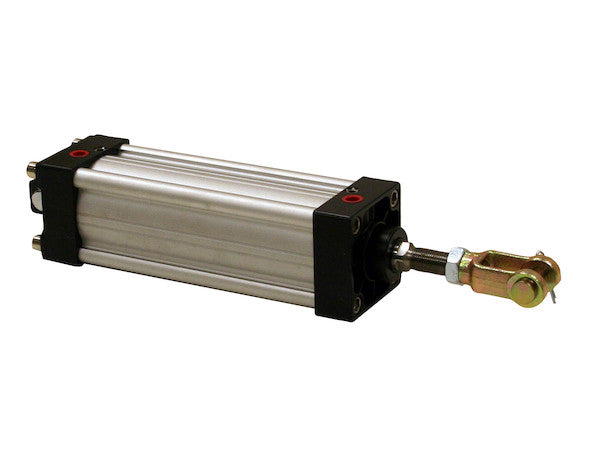
Keep your tailgate operating smoothly with Buyers Products Tie Rod Cylinders. Each cylinder houses and protects an enclosed tie rod in a durable extruded aluminum body. The cylinders are ideal for dump truck operators to engage and disengage tailgate latches from inside their vehicle without having to leave the cab.
Specifications
| Bore | 3.25 |
|---|---|
| Dim A | 17.00 |
| Dim B | 25.00 |
| Features | HM, KSA |
| Mount | Hinge |
| Rod Dia | 1 |
| Stroke | 8 |
Advanced Engineering and Operational Excellence: The Buyers Products Tie Rod Style Hinge Mount Cylinder with Electric Solenoid
The Buyers Products Tie Rod Style Cylinder, specified with a Hinge Mount configuration, a 1.0-inch rod diameter, an 8-inch stroke, and integrated electric solenoid control, represents a pinnacle of hydraulic actuation technology tailored for rigorous industrial applications. This product is meticulously engineered to deliver reliable, precise, and remotely controlled linear motion, particularly excelling in critical functions such as the automated engagement and disengagement of tailgate latches on dump trucks. Its robust construction, featuring an enclosed tie rod design within a durable extruded aluminum body, underscores a commitment to longevity and performance in challenging operational environments.
Core Principles of Tie Rod Cylinder Design and Construction
Tie rod cylinders are a fundamental component in numerous hydraulic and pneumatic systems, recognized for their robust construction, ease of maintenance, and adaptability across a wide spectrum of industrial tasks. The design principle revolves around a cylinder barrel enclosed by two end caps, secured together by external tie rods that run the length of the cylinder. In the case of the Buyers Products offering, the crucial innovation lies in the "enclosed tie rod" system. This design choice provides significant advantages:
- Enhanced Protection: By enclosing the tie rods within the extruded aluminum body, they are shielded from external contaminants, physical damage, and corrosive elements prevalent in outdoor and industrial settings. This significantly extends the lifespan of the cylinder by protecting its structural integrity.
- Sleeker Profile: The enclosed design often results in a more compact and aesthetically integrated unit, which can be advantageous in applications where space is at a premium or where external protrusions might pose snagging hazards.
- Durable Extruded Aluminum Body: The choice of an extruded aluminum body is strategic. Aluminum offers an exceptional strength-to-weight ratio, contributing to a lighter overall assembly without compromising structural integrity. Its inherent corrosion resistance is crucial for applications exposed to moisture, chemicals, and varying weather conditions. Furthermore, aluminum's excellent thermal conductivity aids in dissipating heat generated during operation, helping to maintain optimal fluid temperatures and extending seal life. The extrusion process itself allows for precise internal geometries, ensuring consistent bore diameter and smooth piston travel, which are critical for efficiency and predictable performance.
Beyond the innovative tie rod enclosure, a hydraulic cylinder comprises several critical internal components, each designed for specific functions:
- Cylinder Barrel: The heart of the cylinder, precisely honed to minimize friction and ensure a tight seal for the piston, facilitating efficient force generation.
- Piston: A precisely machined component that travels within the barrel, translating hydraulic pressure into linear mechanical force. It typically features seals to prevent fluid bypass.
- Piston Rod: The connecting element that transmits the force generated by the piston to the external load. Its surface finish and material properties are crucial for seal integrity and resistance to wear and corrosion.
- End Caps: These seal the ends of the cylinder barrel, housing the fluid ports and often the mounting points or rod seals.
- Sealing System: A sophisticated array of static and dynamic seals (e.g., U-cup seals, O-rings, rod wipers) are employed to prevent internal and external fluid leakage, ensuring maximum efficiency and preventing contamination. The integrity of these seals is paramount for sustained performance.
The Hinge Mount Advantage: Versatility and Robustness
The "Hinge Mount" (HM) specified for this cylinder signifies a mounting configuration designed for applications requiring angular movement and flexibility at the attachment points. This type of mount, often utilizing clevis pins or spherical bearings, allows the cylinder to pivot freely as it extends and retracts, accommodating the arc of motion inherent in mechanisms like tailgate latches. The key advantages of a hinge mount include:
- Dynamic Alignment: It inherently compensates for slight misalignments or changes in the load's geometry during its operational cycle, reducing stress on the cylinder and mounting structure.
- Load Distribution: Hinge mounts effectively distribute forces over a wider area, making them highly resilient to shock loads and vibrations, which are common in heavy-duty mobile equipment.
- Ease of Installation: While requiring precise initial positioning, hinge mounts often simplify the connection to complex mechanical linkages by providing a natural pivot point.
The specification "Features: HM, KSA" indicates not only the hinge mount but also an additional feature denoted by 'KSA'. While the exact definition of KSA can vary by manufacturer, in the context of robust cylinder mounting and heavy-duty applications, it often implies a "Keyed Slot Attachment" or a "Keeper Style Accessory" for enhancing the security, alignment, or maintainability of the hinge mount. This typically points to a design that facilitates secure pin retention, prevents rotation, or simplifies removal/installation, further solidifying the cylinder’s integration into demanding operational frameworks.
Precision Engineering: Rod Diameter and Stroke Length
The dimensions of the piston rod and the stroke length are critical parameters that define the cylinder's operational envelope and performance characteristics:
- 1.0-Inch Rod Diameter: The 1.0-inch rod diameter (Rod Dia: 1) is a testament to the cylinder's robust design. A larger rod diameter contributes significantly to the cylinder's structural integrity, providing increased resistance against buckling under compressive loads. This is particularly important when the cylinder is fully extended and subjected to high forces, as can occur when actuating heavy mechanisms or operating in environments with side loads. The rod material itself is typically high-strength, precision-ground, and hard chrome-plated steel, offering superior wear resistance, corrosion protection, and a low-friction surface for seals, thereby extending the life of both the rod and the sealing system.
- 8-Inch Stroke Length: An 8-inch stroke (Stroke: 8) defines the maximum linear distance the piston rod can travel from its fully retracted to its fully extended position. This specific stroke length is optimized for the intended application of engaging and disengaging tailgate latches. It ensures sufficient throw to reliably operate the latch mechanism without over-extension or under-actuation. Selecting the correct stroke length is crucial for efficient system design, preventing unnecessary energy consumption and mechanical stress.
Force Generation and Pressure Considerations: The 3.25-Inch Bore
The cylinder's bore diameter (Bore: 3.25) is the primary determinant of its force-generating capacity. In a hydraulic cylinder, the force exerted is a direct product of the hydraulic pressure applied to the piston's surface area. For a bore of 3.25 inches:
- The piston area (A) can be calculated using the formula A = π * (D/2)2, where D is the bore diameter.
- Area = π * (3.25/2)2 ≈ π * (1.625)2 ≈ 3.14159 * 2.640625 ≈ 8.295 square inches.
- Considering typical hydraulic system pressures for heavy-duty applications, which often range from 2,000 to 3,000 PSI:
- At 2,000 PSI (Push Force): Force = 2,000 PSI * 8.295 sq in ≈ 16,590 pounds.
- At 3,000 PSI (Push Force): Force = 3,000 PSI * 8.295 sq in ≈ 24,885 pounds.
These calculations demonstrate the substantial force capacity of this cylinder, making it exceptionally well-suited for heavy-duty tasks such as securely locking and unlocking robust tailgate mechanisms, often under the dynamic conditions of a dump truck operation. It's also important to consider the pull force (retraction force), which is typically less than the push force due to the area occupied by the piston rod on the retraction side (annulus area).
Integrated Control: The Electric Solenoid
The inclusion of an "Electric Solenoid" in this product fundamentally transforms its operational capabilities, transitioning from a purely mechanical hydraulic component to an electromechanical system. The solenoid serves as the actuator for a directional control valve (DCV) which, in turn, directs hydraulic fluid to either side of the cylinder piston, causing it to extend or retract.
- Principle of Operation: An electric solenoid consists of an electromagnetically inductive coil wound around a movable or fixed ferromagnetic core. When an electric current is passed through the coil, it generates a magnetic field that attracts a plunger (armature). This mechanical motion of the plunger is then used to shift the spool of an associated hydraulic valve.
-
Remote and Automated Control: The primary benefit of solenoid control is the ability to operate the cylinder remotely. For dump truck operators, this translates directly to increased safety and efficiency:
- Enhanced Safety: Operators can engage and disengage tailgate latches from within the safety of their cab, eliminating the need to physically interact with heavy, potentially hazardous equipment in inclement weather or on uneven terrain. This significantly reduces the risk of accidents and injuries.
- Improved Efficiency: Remote operation saves time and effort, allowing for quicker cycle times in material handling. The ability to integrate the cylinder's operation into a larger control system also opens avenues for automation, further boosting productivity.
- Precision and Repeatability: Solenoid valves offer precise control over fluid flow, leading to highly repeatable and predictable cylinder movements.
- Electrical Interface: The solenoid requires a specific voltage (e.g., 12VDC or 24VDC for mobile applications) and current supply. Robust electrical connections and adequate environmental protection for the solenoid coil are essential to ensure reliable long-term operation in demanding conditions. The electrical interface is typically designed for easy integration with a vehicle's existing electrical system, requiring straightforward wiring and switch mechanisms.
Dimensional Specifications and Fitment
The provided "Dim A" (17.00 inches) and "Dim B" (25.00 inches) are crucial for proper installation and represent the retracted and extended lengths of the cylinder, respectively. These dimensions typically refer to the pin-to-pin or center-to-center distance of the hinge mounts. Precise knowledge of these dimensions ensures that the cylinder will fit within the available space and provide the correct range of motion for the application. Proper fitment prevents mechanical binding, excessive stress on mounting points, and ensures the cylinder operates within its design limits.
- Dim A (17.00 inches): This is the minimum center-to-center distance when the cylinder is fully retracted. It defines the clearance required for installation and the start position of the actuated mechanism.
- Dim B (25.00 inches): This is the maximum center-to-center distance when the cylinder is fully extended. It confirms the stroke length (25.00 - 17.00 = 8.00 inches) and defines the endpoint of the actuated mechanism's travel.
Understanding and verifying these dimensions against the specific application's requirements is a critical step in the installation process, preventing costly modifications or operational inefficiencies.
Applications and Operational Benefits
While primarily highlighted for dump truck tailgate operations, the inherent qualities of this Tie Rod Style Hinge Mount Cylinder make it versatile for a range of demanding industrial and mobile applications:
- Dump Truck Tailgate Actuation: This is the quintessential application. The cylinder's ability to remotely engage and disengage heavy tailgate latches provides unparalleled operational convenience and safety. It ensures secure closure during transport and swift, controlled opening for discharge, directly enhancing productivity and operator well-being.
- Material Handling Equipment: Used in conveyors, lift tables, or indexing systems where robust linear motion and angular adaptability are required.
- Construction Equipment: Actuation of various implements, outriggers, or locking mechanisms on excavators, loaders, and other heavy machinery.
- Agricultural Machinery: For controlling various attachments, steering mechanisms, or gate operations where reliability in harsh outdoor conditions is paramount.
- General Industrial Automation: Wherever heavy loads need to be moved, clamped, or positioned with high force and remote control, this cylinder provides a dependable solution.
The comprehensive benefits derived from deploying this advanced hydraulic cylinder include:
- Unmatched Reliability: Engineered with high-quality materials and manufacturing processes to withstand continuous operation in harsh environments.
- Enhanced Safety: Remote operation minimizes human exposure to operational hazards, directly contributing to a safer work environment.
- Increased Efficiency: Faster cycle times, reduced manual labor, and seamless integration into automated systems lead to significant productivity gains.
- Exceptional Durability: The enclosed tie rod design, robust aluminum body, and high-strength rod contribute to a long operational lifespan and reduced maintenance frequency.
- Precise Control: The electric solenoid enables accurate and repeatable positioning, crucial for intricate tasks and system synchronization.
Installation, Maintenance, and Longevity
To maximize the lifespan and ensure optimal performance of the Buyers Products Tie Rod Style Hinge Mount Cylinder, adherence to proper installation and maintenance protocols is essential:
-
Installation:
- Alignment: Critical to ensure the cylinder is correctly aligned with the load. Misalignment can lead to side loading, accelerated wear on seals and bearings, and potential rod buckling. The hinge mount aids in accommodating minor angular variations, but gross misalignment must be avoided.
- Secure Mounting: All mounting hardware must be torqued to manufacturer specifications. Loose mounts can cause vibration, fatigue, and eventual failure.
- Hydraulic Connections: Use appropriate hydraulic hoses and fittings, ensuring they are clean, properly routed to avoid kinks or abrasion, and securely tightened to prevent leaks.
- Electrical Wiring: The electric solenoid must be wired correctly according to the specified voltage and current. Wiring should be protected from physical damage, heat, and moisture, with appropriate fuse protection.
- System Integration: Ensure the hydraulic power unit (HPU) and control system are compatible with the cylinder's pressure and flow requirements.
-
Preventative Maintenance:
- Regular Inspection: Periodically inspect the cylinder for signs of external leakage, rod damage (scratches, pitting, chrome flaking), loose mounts, and abnormal noises.
- Fluid Quality: Maintain clean hydraulic fluid at the correct level and viscosity. Contaminated fluid is a leading cause of seal and component wear.
- Seal Replacement: While designed for longevity, seals are wear items. Timely replacement based on service intervals or signs of leakage is crucial.
- Rod Surface Care: Keep the piston rod clean and protected from nicks or scratches, which can damage rod seals. Rod boots or covers can be used in highly abrasive environments.
- Solenoid Check: Verify the electrical connections to the solenoid are secure and free from corrosion.
The robust construction, particularly the enclosed tie rod design and durable aluminum body, inherently contributes to a longer service life, reducing downtime and total cost of ownership. The ability to perform maintenance and inspections readily also supports sustained peak performance.
Conclusion
The Buyers Products Tie Rod Style Cylinder with Hinge Mount, 1.0-inch rod, 8-inch stroke, and electric solenoid represents a meticulously engineered solution for demanding linear actuation requirements. Its innovative enclosed tie rod design within a durable extruded aluminum body, combined with the versatility of a hinge mount and the precision of an electric solenoid, positions it as an indispensable component for optimizing operational safety, efficiency, and reliability in critical applications such as dump truck tailgate actuation. By leveraging advanced materials, precise manufacturing, and integrated control technology, this cylinder not only meets but exceeds the rigorous demands of modern industrial and mobile equipment, offering a superior blend of performance, durability, and sophisticated control.