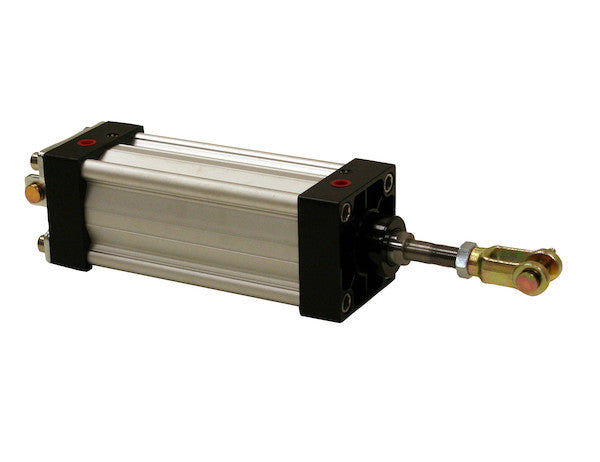
Keep your tailgate operating smoothly with Buyers Products Tie Rod Cylinders. Each cylinder houses and protects an enclosed tie rod in a durable extruded aluminum body. The cylinders are ideal for dump truck operators to engage and disengage tailgate latches from inside their vehicle without having to leave the cab.
Specifications
| Bore | 3.25 |
|---|---|
| Dim A | 17.00 |
| Dim B | 25.00 |
| Features | V |
| Mount | Clevis |
| Rod Dia | 1 |
| Stroke | 8 |
The Tie Rod Style Cylinder with Clevis Mount, featuring a 1.0-inch rod diameter and an 8-inch stroke, from Buyers Products represents a pinnacle of hydraulic actuator engineering, specifically designed for demanding mobile and industrial applications. This product is meticulously crafted to deliver reliable, precise, and powerful linear motion, serving critical functions such as the automated operation of tailgate latches in dump trucks, thereby enhancing operational safety and efficiency for operators. The integration of an enclosed tie rod within a durable extruded aluminum body signifies a commitment to superior protection, longevity, and performance in harsh operating environments.
Core Principles of Hydraulic Cylinder Operation
At its foundation, a hydraulic cylinder converts hydraulic fluid pressure into a linear mechanical force and motion. This process is governed by Pascal's Principle, which states that pressure applied to an enclosed fluid is transmitted undiminished to every portion of the fluid and the walls of its container. In the context of a cylinder, pressurized hydraulic fluid acts upon the surface area of a piston, generating a force that causes the piston and its attached rod to extend or retract. The magnitude of this force is directly proportional to the fluid pressure and the effective surface area of the piston (Force = Pressure × Area).
For this specific model, with a bore diameter of 3.25 inches, the effective area for extension is significantly larger than the effective area for retraction due to the presence of the 1.0-inch diameter rod on one side of the piston. This differential area results in a greater force during extension than retraction, a common characteristic of single-rod hydraulic cylinders. The 8-inch stroke defines the maximum linear travel achievable by the piston rod, dictating the operational range for the actuated mechanism. Precision engineering ensures that the fluid dynamics within the cylinder are optimized for smooth, controlled motion, even under varying load conditions.
The Advanced Tie Rod Cylinder Construction
The nomenclature "Tie Rod Style Cylinder" refers to a construction method where the cylinder barrel, end caps (head and cap), and often the internal components are held together by external tie rods that run parallel to the cylinder barrel, secured with nuts at each end. This design is renowned for its robust nature, ease of maintenance, and ability to withstand high operating pressures. However, the Buyers Products offering elevates this traditional design by incorporating an "enclosed tie rod in a durable extruded aluminum body." This innovative approach provides several distinct advantages:
- Enhanced Protection: By enclosing the tie rod within the extruded aluminum body, the critical structural components are shielded from direct exposure to environmental contaminants such as dirt, dust, moisture, and corrosive agents. This significantly reduces the risk of tie rod damage, wear, and subsequent failure, thereby extending the cylinder's service life and reducing maintenance requirements.
- Corrosion Resistance: The use of an extruded aluminum body inherently provides superior corrosion resistance compared to traditional steel bodies, especially in applications where the cylinder is exposed to road salt, chemicals, or maritime environments. Aluminum's natural oxide layer offers a passive protective barrier, making it ideal for outdoor and vehicle-mounted applications.
- Reduced Weight: Aluminum is substantially lighter than steel, contributing to an overall weight reduction of the hydraulic system and the host vehicle. For dump trucks and other mobile equipment, reduced weight translates into improved fuel efficiency and increased payload capacity, offering significant operational cost savings.
- Streamlined Aesthetics and Design: The extruded aluminum body creates a clean, integrated profile, eliminating the visible external tie rods that can sometimes detract from the aesthetic or present snagging points. This modern design not only looks professional but also simplifies cleaning and inspection.
- Precision Manufacturing: Extrusion allows for the production of complex cross-sectional profiles with high dimensional accuracy and excellent surface finish. This manufacturing precision contributes to tighter tolerances, better seal performance, and overall higher quality of the cylinder.
The combination of these features results in a cylinder that not only meets but often exceeds the performance and durability expectations for demanding applications, providing a reliable and long-lasting solution.
The Strategic Advantage of Clevis Mounting
The "Clevis Mount" configuration is a pivotal design choice for applications requiring significant angular articulation. A clevis mount, typically located at one or both ends of the cylinder, consists of a U-shaped bracket with holes that align to accept a pin. This pin then connects the cylinder to a corresponding mounting bracket on the machine frame or actuated component. Key benefits of the clevis mounting style include:
- Exceptional Articulation: Clevis mounts allow for a wide range of angular movement between the cylinder and its mounting point. This is crucial in applications where the cylinder's path of motion is not perfectly linear, or where the load undergoes rotational changes during its operation, such as the opening and closing of a tailgate. The inherent flexibility minimizes side loading on the cylinder rod and piston, thereby extending seal and bearing life.
- Robust and Reliable Connection: The pin connection characteristic of clevis mounts provides a strong, positive link between the cylinder and its load. This robust interface is capable of transferring significant forces without compromising integrity, ensuring secure operation even under dynamic and heavy-duty conditions.
- Ease of Installation and Maintenance: Clevis mounts simplify the installation process. The cylinder can be quickly pinned into place, reducing assembly time. For maintenance, disconnecting the cylinder involves simply removing the pin, allowing for efficient servicing or replacement.
- Compact Design: While allowing articulation, the clevis mount is also a relatively compact mounting solution, which is beneficial in applications where space is limited. The integrated design minimizes protrusion, contributing to the overall streamlined profile of the cylinder.
For dump truck tailgate mechanisms, the clevis mount facilitates the smooth, unrestricted movement required to engage and disengage latches effectively, accommodating the geometry changes as the tailgate pivots.
Rod Diameter and Stroke: Functional Determinants
The specifications of the 1.0-inch rod diameter and 8-inch stroke are crucial for understanding the cylinder's operational envelope and suitability for specific tasks.
1.0-Inch Rod Diameter: Strength and Stability
The piston rod is the primary component transmitting force from the hydraulic system to the external load. Its diameter is critical for several reasons:
- Column Strength (Buckling Resistance): A larger rod diameter provides increased column strength, making the rod more resistant to buckling under compressive loads (when the cylinder is retracting or pushing against a load). This is especially important for long-stroke cylinders or those operating under high forces. While an 8-inch stroke is moderate, a 1.0-inch rod ensures ample rigidity for typical tailgate operations.
- Tensile Strength: When the cylinder is extending and pulling a load, the rod is under tension. The cross-sectional area of the rod dictates its tensile strength, ensuring it can withstand the pulling forces without yielding or fracturing.
- Differential Area: As previously mentioned, the rod's diameter directly impacts the differential area of the piston, influencing the force output and speed characteristics during retraction. A smaller rod diameter leads to a larger effective area for retraction, potentially allowing faster retraction speeds if flow is constant, but also a slightly lower retraction force compared to extension.
The rod itself is typically precision-ground, polished, and hard chrome-plated to provide a smooth, low-friction surface that resists wear, corrosion, and impacts, crucial for long seal life and consistent performance.
8-Inch Stroke: Precision in Motion
The 8-inch stroke defines the maximum linear travel of the piston rod. This specific stroke length is engineered to provide the precise amount of movement required for the cylinder's intended application. For tailgate latching mechanisms, an 8-inch stroke is typically sufficient to fully engage or disengage the latching pins or hooks, ensuring complete and secure operation. The choice of stroke length is a fundamental aspect of cylinder design, directly related to the required travel distance of the actuated component. Engineers must carefully consider the mechanical linkage and the necessary travel to achieve the desired functional outcome, selecting a cylinder with an appropriate stroke to avoid over-extension or under-extension issues.
Materials, Seals, and Durability Engineering
The construction materials and sealing technologies employed in the Buyers Products Tie Rod Style Cylinder are paramount to its long-term durability and performance in demanding environments.
- Extruded Aluminum Body: Beyond its protective and aesthetic qualities, the extruded aluminum body is selected for its high strength-to-weight ratio and excellent thermal conductivity, which aids in dissipating heat generated during operation, thus maintaining optimal fluid temperatures.
- Precision-Machined Components: Internal components such as the piston, rod, and end caps are precision-machined from high-grade materials to ensure accurate fit, minimize internal leakage, and maximize efficiency. The piston, often made of ductile iron or aluminum, features grooves for piston seals and wear rings.
- Rod Material and Finish: The 1.0-inch rod is typically manufactured from high-strength steel, often induction-hardened for improved wear resistance. It then undergoes a rigorous surface treatment process, commonly hard chrome plating, which provides a highly durable, corrosion-resistant, and low-friction surface crucial for smooth operation and extending the life of the rod seals.
-
Advanced Sealing Systems: The cylinder incorporates a sophisticated multi-component sealing system designed to prevent internal and external fluid leakage, minimize friction, and withstand a wide range of temperatures and pressures. This system typically includes:
- Piston Seals: Designed to prevent fluid bypass across the piston, ensuring efficient force transmission. Materials such as polyurethane, Buna-N, or Viton are selected based on fluid compatibility, temperature range, and pressure requirements.
- Rod Seals: Crucial for preventing external leakage of fluid along the piston rod and for keeping contaminants out of the cylinder. These are often backed by secondary exclusion seals (wipers) that scrape contaminants off the rod surface before they can enter the cylinder.
- Static Seals (O-rings, Gaskets): Used to seal between stationary components, such as the cylinder barrel and the end caps, preventing external leakage.
- Bearings and Wear Rings: To support the piston rod and piston, the cylinder includes high-quality bearings and wear rings. Rod bearings (often made of bronze or composite materials) support the rod and minimize side loading, while piston wear rings prevent metal-to-metal contact between the piston and the cylinder barrel, reducing friction and extending the life of both components.
Performance Metrics and Operating Environment Considerations
The robust design of this Tie Rod Style Cylinder ensures reliable performance across a broad spectrum of operating conditions. Key performance metrics include:
- Operating Pressure: Designed to operate efficiently within specified pressure ranges, ensuring consistent force output for the 3.25-inch bore. Exceeding these pressures can lead to premature wear or failure.
- Fluid Compatibility: Engineered for use with standard hydraulic fluids, but critical to ensure compatibility with specialized fluids if required by the application.
- Temperature Range: The choice of materials, particularly seals, dictates the operational temperature limits. This cylinder is built to withstand the typical temperature fluctuations encountered in outdoor mobile equipment, from extreme cold to high ambient temperatures.
- Cycle Life: The durable construction, superior sealing, and wear-resistant surfaces contribute to an extended cycle life, meaning the cylinder can perform numerous extension and retraction cycles before requiring maintenance or replacement. This translates into lower total cost of ownership.
For dump truck tailgate operation, these cylinders are exposed to constant vibration, shock loads, and environmental factors such as dirt, water, and temperature extremes. The enclosed tie rod design and robust aluminum body directly address these challenges, providing a solution that minimizes downtime and maximizes productivity.
Integration into Hydraulic Systems and Maintenance Best Practices
Effective integration of this cylinder into a broader hydraulic system is crucial for optimal performance. This involves careful consideration of:
- Pump and Valve Selection: The hydraulic pump must provide sufficient flow and pressure to achieve desired cylinder speed and force. Control valves must be appropriately sized and configured to manage cylinder movement, direction, and speed precisely.
- Hose and Fitting Specification: Hoses and fittings must be rated for the system's operating pressure and fluid type, and properly routed to prevent damage or interference.
- Fluid Cleanliness: Maintaining the cleanliness of the hydraulic fluid is paramount. Contaminants are the leading cause of hydraulic component failure. Proper filtration, regular fluid analysis, and scheduled fluid changes are essential to protect the cylinder's internal components, especially the seals and polished rod surface.
- Mounting Alignment: While the clevis mount offers excellent articulation, proper alignment during installation is still critical to prevent undue side loading, which can lead to premature wear of rod bearings and seals.
Routine inspection of the cylinder, particularly the rod surface for damage, the seals for signs of leakage, and the mounting pins for wear, will ensure continued smooth operation and help proactively address any potential issues. The Buyers Products design, with its focus on durability and protection, inherently reduces the frequency of these interventions compared to less robust alternatives.
Applications Beyond Tailgate Operation
While ideally suited for dump truck tailgate latches, the versatile design of the Buyers Products Tie Rod Style Cylinder, with its 3.25-inch bore, 1.0-inch rod, 8-inch stroke, and clevis mount, makes it adaptable to a wide array of other applications. These could include:
- Agricultural Equipment: Actuating small implements, gates, or components on compact tractors.
- Construction Machinery: Operating locking mechanisms, small blade adjustments, or support legs on utility vehicles.
- Material Handling: Movement of conveyors, sorters, or lifting platforms in warehouses or distribution centers.
- Specialty Vehicles: Actuating various functions on municipal, service, or custom-built vehicles where precise linear motion and robust construction are required.
- Industrial Automation: For fixtures, clamps, or push-pull operations in manufacturing environments that require a compact yet powerful hydraulic actuator.
The combination of a protected tie rod design, lightweight aluminum body, and flexible clevis mounting ensures that this cylinder can reliably perform in diverse scenarios where durability, strength, and adaptability are key requirements.
Quality Assurance and Engineering Excellence
Buyers Products maintains a rigorous commitment to quality assurance throughout the design, manufacturing, and testing phases of their hydraulic cylinders. Each component is subjected to stringent quality checks, and the final assembled product undergoes performance testing to ensure it meets published specifications for pressure, force, and seal integrity. This dedication to engineering excellence ensures that every Tie Rod Style Cylinder delivered to the customer is a reliable, high-performing asset designed for longevity and demanding operational conditions. The "V" feature in the specifications, while concise, can be interpreted as a hallmark of value, signifying that the product embodies a combination of advanced features and robust construction designed to provide superior utility and return on investment for the end-user.
Conclusion
The Buyers Products Tie Rod Style Cylinder, with its Clevis Mount, 1.0-inch rod, and 8-inch stroke, is more than just a hydraulic component; it is an engineered solution for critical linear motion requirements. Its innovative enclosed tie rod design within a durable extruded aluminum body sets it apart, offering unparalleled protection, corrosion resistance, and weight savings. Coupled with the flexibility and strength of a clevis mount, and precise hydraulic performance characteristics tailored by its bore, rod, and stroke dimensions, this cylinder delivers consistent, powerful, and reliable operation. For professionals in industries such as transportation, agriculture, and construction, who demand robust, efficient, and low-maintenance hydraulic actuators, this cylinder represents an intelligent investment in operational excellence, safety, and long-term durability. It exemplifies the blend of advanced material science, precision manufacturing, and application-specific design that defines leading-edge hydraulic technology.