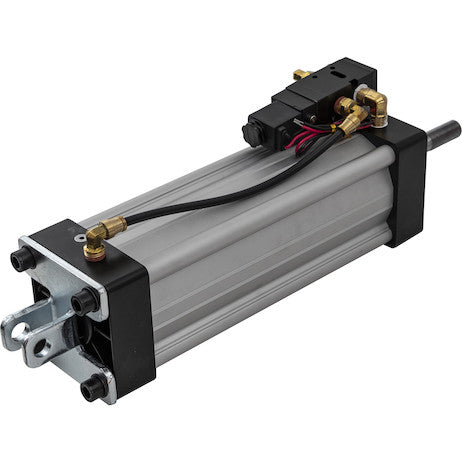
Keep your tailgate operating smoothly with Buyers Products Tie Rod Cylinders. Each cylinder houses and protects an enclosed tie rod in a durable extruded aluminum body. The cylinders are ideal for dump truck operators to engage and disengage tailgate latches from inside their vehicle without having to leave the cab.
Specifications
| Bore | 3.25 |
|---|---|
| Dim A | 17.00 |
| Dim B | 25.00 |
| Features | V, KSA |
| Mount | Clevis |
| Rod Dia | 1 |
| Stroke | 8 |
Advanced Technical Overview: Tie Rod Style Hydraulic Cylinder with Integrated Electric Solenoid
This document provides an in-depth technical analysis of the Buyers Products Tie Rod Style Hydraulic Cylinder, specifically configured with a Clevis Mount, a 1.0-inch rod diameter, an 8-inch stroke, and an integrated electric solenoid for remote actuation. Designed for demanding applications such as the automated engagement and disengagement of dump truck tailgate latches, this cylinder embodies precision engineering, robust material selection, and sophisticated control integration to enhance operational safety, efficiency, and longevity in commercial and industrial environments.
Core Principles of Tie Rod Cylinder Design
Tie rod cylinders are a foundational component in modern hydraulic systems, renowned for their robust construction and ease of maintenance. Unlike welded cylinders, tie rod cylinders utilize high-strength steel rods that extend through the cylinder body, connecting the end caps. These rods are typically threaded at both ends, allowing the end caps to be securely fastened with nuts. This design offers several significant advantages:
- Structural Integrity: The tie rods distribute the stress of internal hydraulic pressure evenly across the cylinder body and end caps, contributing to exceptional structural integrity and resistance to fatigue, especially under high-pressure cycling.
- Serviceability: The modular nature of tie rod cylinders allows for straightforward disassembly and reassembly, simplifying maintenance procedures such as seal replacement or piston inspection. This reduces downtime and extends the overall service life of the unit.
- Versatility: The design accommodates various mounting options, port configurations, and rod end styles, making them highly adaptable to diverse application requirements.
In this particular model, the tie rod is internally housed and protected within a durable extruded aluminum body. This internal enclosure shields the tie rod from external contaminants, physical damage, and corrosive elements prevalent in outdoor and mobile equipment environments, thereby maximizing reliability and minimizing the need for external protective measures.
Material Science: The Extruded Aluminum Body
The selection of an extruded aluminum body for this hydraulic cylinder is a critical design choice that offers a compelling balance of performance attributes. Aluminum, particularly high-strength alloys, provides several benefits pertinent to mobile hydraulic applications:
- Exceptional Strength-to-Weight Ratio: Aluminum is significantly lighter than steel, which is crucial for reducing the overall weight of vehicle-mounted equipment without compromising structural integrity. This contributes to improved fuel efficiency and increased payload capacity for the host vehicle.
- Corrosion Resistance: Aluminum naturally forms a passive oxide layer that provides excellent resistance to corrosion, especially in environments exposed to moisture, road salts, and mild chemicals. This inherent resistance is further enhanced through extrusion processes and potential surface treatments, ensuring long-term aesthetic and functional integrity in harsh operating conditions.
- Thermal Conductivity: Aluminum possesses superior thermal conductivity compared to steel, facilitating more efficient heat dissipation from the hydraulic fluid. While hydraulic cylinders themselves are not primary heat exchangers, this property contributes to the overall thermal management of the hydraulic system, helping to maintain optimal fluid temperatures and prevent premature seal degradation.
- Manufacturing Precision: Extrusion allows for the creation of complex cross-sectional profiles with tight tolerances, leading to highly consistent cylinder barrels. This precision is vital for the smooth operation of the piston and the effectiveness of the sealing system, contributing to leak-free and efficient performance. The extruded profile also often incorporates features like internal grooves for sealing or mounting, further streamlining manufacturing and enhancing performance.
The durability provided by this extruded aluminum body, combined with the protected internal tie rod, forms a highly resilient actuator capable of withstanding the rigorous demands of continuous duty cycles in challenging operational settings.
Mounting Configuration: The Clevis Mount
This cylinder features a Clevis Mount, a highly prevalent and robust mounting style for hydraulic cylinders, particularly in applications requiring pivotal motion or connection to linkage systems. The clevis mount, typically located at one or both ends of the cylinder, comprises a U-shaped bracket with a pin passing through holes in the cylinder rod eye or base end and a corresponding mounting bracket on the machine frame. Key advantages of the clevis mount include:
- Pivoting Capability: The clevis allows the cylinder to pivot freely about the pin axis as the rod extends and retracts, accommodating changes in angular alignment during the machinery's operation. This is essential for applications where the load path is not strictly linear, such as tailgate mechanisms, suspension systems, or articulated joints.
- Robust Connection: The pin connection provides a secure and strong link, capable of transmitting significant tensile and compressive forces between the cylinder and the application.
- Ease of Installation: Clevis mounts are relatively simple to install and disconnect, facilitating maintenance or replacement.
In the context of a dump truck tailgate latch, the clevis mount enables the cylinder to articulate smoothly as it engages and disengages the latch mechanism, absorbing any minor misalignments or dynamic movements of the tailgate without inducing undue stress on the cylinder itself. This flexibility is critical for reliable and long-lasting operation in dynamic environments.
Precision Actuation: 1.0-Inch Rod and 8-Inch Stroke
The specified dimensions of this cylinder—a 1.0-inch rod diameter and an 8-inch stroke—are tailored for precise and controlled linear actuation in specific applications. The interplay of these dimensions with the cylinder bore (3.25 inches) dictates the cylinder's force output, speed, and overall physical envelope.
- 1.0-Inch Rod Diameter: The rod diameter is a critical parameter influencing the cylinder's structural integrity and its ability to withstand buckling and tensile loads. A 1.0-inch rod, paired with a 3.25-inch bore, provides a robust piston rod capable of handling significant loads generated by the hydraulic pressure acting on the piston area. Furthermore, the rod’s surface finish and material properties are crucial for minimizing friction against the rod seals and resisting wear from abrasive contaminants. Typically, piston rods are precision-ground, polished, and hard-chrome plated or nitrocarburized to enhance surface hardness, corrosion resistance, and seal compatibility, contributing to extended seal life and overall cylinder durability.
- 8-Inch Stroke: The 8-inch stroke defines the maximum linear travel of the piston rod. This specific stroke length is indicative of an application requiring a relatively short but precise range of motion. For tailgate latching mechanisms, an 8-inch stroke provides ample travel to fully engage and disengage the latch components, ensuring secure closure and complete release. The consistency and repeatability of this stroke length are vital for reliable automated operation. The stroke length also directly influences the volume of hydraulic fluid required for extension and retraction, which in turn affects the operational speed based on the system's pump flow rate.
The precise control afforded by these dimensions ensures that the cylinder performs its designated task with accuracy, preventing partial engagement or over-extension that could lead to mechanical wear or system failure.
Integrated Control: Electric Solenoid Actuation
The integration of an electric solenoid is a distinguishing feature that elevates this hydraulic cylinder from a purely mechanical actuator to a remotely controllable electro-hydraulic system. The electric solenoid acts as the interface between the vehicle's electrical control system and the hydraulic circuit, allowing for automated and remote operation of the cylinder. This is particularly advantageous for:
- Remote Operation and Safety: The primary benefit for dump truck operators, as highlighted, is the ability to engage and disengage tailgate latches from inside the cab. This eliminates the need for manual intervention, significantly enhancing operator safety by removing them from potentially hazardous areas near moving equipment or falling debris. It also protects against exposure to inclement weather or environmental contaminants.
- Automation and Efficiency: Solenoid-controlled hydraulics enable seamless integration into automated work cycles. For example, a dump truck could be programmed to automatically unlatch the tailgate upon reaching a designated dump site, followed by a hydraulic lift of the dump bed. This automation reduces cycle times and operator fatigue, leading to increased productivity.
- Precision and Responsiveness: Electric solenoids provide rapid and precise control over hydraulic fluid direction. When activated, the solenoid quickly shifts a spool or poppet valve within a directional control valve, directing hydraulic fluid to either the extend or retract port of the cylinder. This quick response time is crucial for efficient and reliable operation of the latching mechanism.
- System Simplification: Integrating the solenoid directly into the control mechanism reduces the complexity of external plumbing and wiring compared to systems relying on separate, externally mounted control valves. This leads to a more compact, tidy, and potentially more robust installation with fewer potential leak points or electrical connection issues.
The solenoid-operated valve mechanism typically consists of an electromagnetic coil, a plunger (armature), and a spring. When electrical current flows through the coil, it generates a magnetic field that pulls the plunger, overcoming the spring force and shifting the valve element to open or close fluid paths. Deactivating the current allows the spring to return the plunger, shifting the valve back to its original position (e.g., closed-center, open-center, or tandem-center depending on the valve type and application requirements).
Hydraulic System Parameters and Performance
Understanding the interplay of bore, rod diameter, stroke, and the hydraulic system’s characteristics is essential for appreciating this cylinder's performance envelope.
- Bore (3.25 inches): The cylinder bore dictates the effective piston area, which, in conjunction with the system pressure, determines the force output. For extension, the force is calculated as (System Pressure) x (Area of Bore). For retraction, the force is calculated as (System Pressure) x (Area of Bore - Area of Rod). A larger bore generates more force at a given pressure. With a 3.25-inch bore, this cylinder is capable of generating significant force for robust latch engagement and disengagement. For example, at a common system pressure of 2,000 psi, the extension force would be approximately 16,770 lbs (2000 psi * pi * (3.25/2)^2), while the retraction force would be approximately 15,200 lbs.
- Hydraulic Fluid and Pressure: The cylinder is designed for operation with standard hydraulic fluids (e.g., mineral oil-based, synthetic) suitable for mobile equipment. The maximum operating pressure rating is critical, ensuring the cylinder's structural integrity under peak loads. The seals and internal components are selected to withstand this pressure range and associated temperature fluctuations.
- Sealing Technology (Features V, KSA): The "V" in the features list often denotes Viton® (FKM) seals. Viton is a high-performance fluoroelastomer known for its excellent resistance to high temperatures, aggressive hydraulic fluids, and a wide range of chemicals. Its superior sealing properties contribute significantly to the cylinder's leak-free operation and extended service life in demanding environments. "KSA" could refer to a proprietary sealing package, a specific rod surface treatment, or bearing material designed for enhanced wear resistance and reduced friction, further contributing to durability and efficiency. Modern hydraulic cylinders employ advanced sealing systems, typically including primary piston seals (e.g., lip seals, compact seals), rod seals, wipers (scrapers), and static seals for the end caps. The selection of these seals is crucial for maintaining pressure, preventing external leakage, and keeping contaminants out of the hydraulic system.
Detailed Dimensions and Installation Considerations
The provided dimensions, Dim A (Retracted Length) and Dim B (Extended Length), are crucial for proper installation and integration into the host machinery.
- Dim A (17.00 inches): This represents the center-to-center dimension of the mounting points when the cylinder is fully retracted. This value is critical for determining the minimum space required for the cylinder within the machine’s kinematic envelope and for verifying that the latch mechanism is fully closed or disengaged at its resting position.
- Dim B (25.00 inches): This represents the center-to-center dimension of the mounting points when the cylinder is fully extended. Given an 8-inch stroke, Dim B is exactly Dim A + Stroke (17.00 + 8.00 = 25.00), confirming the consistency of the provided specifications. This dimension is vital for ensuring that the cylinder provides the necessary travel to fully engage or disengage the tailgate latch and that there is no mechanical interference at full extension.
When installing, careful consideration of these dimensions, along with the clevis mount geometry, is essential to ensure that the cylinder operates within its specified range without binding or exceeding its mechanical limits. Proper alignment of mounting points prevents side loading on the piston rod, which can lead to premature wear of rod seals, bearings, and even rod bending.
Applications Beyond Tailgate Latching
While specifically highlighted for dump truck tailgate operations, the inherent design robustness, technical specifications, and solenoid control of this cylinder render it suitable for a broader spectrum of heavy-duty mobile and industrial applications requiring precise, remotely controlled linear motion:
- Construction Equipment: Actuation of auxiliary attachments, locking pins on excavators, or adjustment mechanisms on bulldozers.
- Agricultural Machinery: Control of implement linkages, spreader gates, or bale ejectors where remote operation enhances safety and efficiency.
- Utility Vehicles: Actuation of tool storage compartments, access platforms, or specialized equipment on service trucks.
- Material Handling: Operation of clamping mechanisms, diverters, or positioning units in industrial conveyor systems or automated warehouses, particularly where human access is limited or hazardous.
- Specialized Industrial Machines: Any application requiring a robust, compact, and remotely controlled hydraulic linear actuator with a moderate stroke and significant force capability.
Installation, Maintenance, and Longevity
Proper installation and routine maintenance are paramount to achieving the extended service life and reliable performance engineered into this hydraulic cylinder.
- Installation: Ensure that mounting surfaces are flat and parallel to prevent bending stresses. Use appropriate-grade mounting hardware for the clevis pin connections. Hydraulic lines should be sized correctly to minimize pressure drop and heat generation and routed to prevent chafing or kinking. Electrical connections for the solenoid must be secure, weather-resistant, and comply with vehicle voltage specifications.
- System Fluid Management: Use clean, recommended hydraulic fluid. Regular fluid analysis and filtration are crucial for preventing contamination-induced wear of seals, valves, and pump components.
- Seal and Rod Inspection: Periodically inspect the piston rod for damage, pitting, or corrosion. Check rod seals and wiper seals for signs of leakage or wear. Early detection of seal degradation can prevent catastrophic fluid loss and system failure.
- Solenoid Check: Verify the electrical connections to the solenoid for integrity. Test solenoid actuation periodically to ensure prompt and reliable shifting.
- Preventive Maintenance: Adhere to manufacturer-recommended maintenance schedules, including torque checks for tie rod nuts and mounting hardware, and lubrication of pivot points if applicable.
By integrating high-quality materials, precision manufacturing, and an intelligent control interface, this Tie Rod Style Cylinder with Clevis Mount and Electric Solenoid offers a robust, efficient, and safe solution for critical actuation tasks in demanding environments. Its design reflects a comprehensive understanding of operational requirements for heavy-duty mobile equipment, ensuring optimal performance and a significant return on investment through enhanced productivity and reduced operational costs.