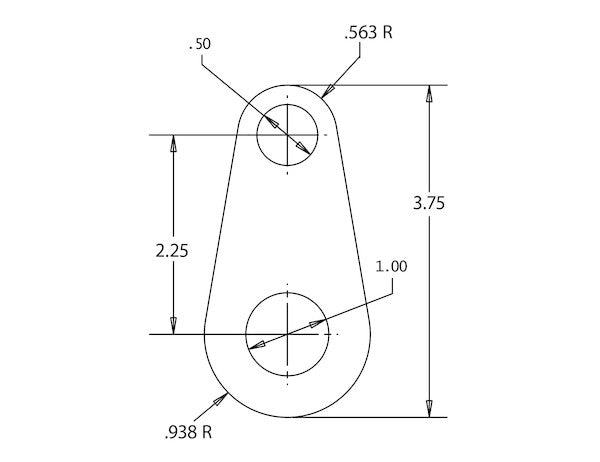
Buyers Products Tailgate Linkage Connecting Plate welds to the dump body tailgate and helps connect the tailgate release lever to the lower tailgate hinge. It is stamped from a 1/2 in. steel plate and available in several sizes.
Specifications
| A | 1/2 |
|---|---|
| B | 1.00 |
| Material | Carbon Steel |
| Mounting Holes Ctr to Ctr (in.) | 2-1/4 |
| Overall Length (in.) | 3-3/4 |
| Plate Thickness | 1/2 |
| Use With | Tailgate Latch Assembly |
The Tailgate Linkage Connecting Plate, featuring precisely engineered 1/2-inch and 1-inch diameter holes, represents a critical component in the mechanical architecture of heavy-duty dump bodies and similar industrial vehicles requiring robust tailgate operational mechanisms. This component is specifically designed to bridge the mechanical interface between the tailgate release lever and the lower tailgate hinge, facilitating the controlled opening and closing of the tailgate. Its foundational role ensures both operational efficiency and safety in material handling operations, making its design, material science, and manufacturing process paramount for long-term reliability in demanding environments.
Crafted with meticulous attention to structural integrity, this connecting plate is stamped from a formidable 1/2-inch (approximately 12.7 mm) thick carbon steel plate. The selection of carbon steel as the primary material is a deliberate engineering choice, prioritizing a combination of high tensile strength, excellent yield strength, and superior weldability. Carbon steel, particularly in the structural grades commonly employed for such components, offers inherent robustness against dynamic loads, abrasive wear, and cyclical fatigue, which are pervasive challenges in applications involving bulk material transport and discharge. The material's ability to be readily welded ensures a permanent, high-strength bond to the dump body tailgate, integrating the plate seamlessly into the vehicle's structural framework without reliance on mechanical fasteners that could loosen under vibration or stress over time. This monolithic integration is crucial for maintaining the integrity of the tailgate release system under the severe operational stresses encountered during loading, transit, and dumping cycles.
The manufacturing process of stamping from a 1/2-inch steel plate is chosen for its ability to produce components with consistent dimensions, excellent material utilization, and a favorable cost-to-strength ratio. Stamping ensures that each connecting plate adheres to tight dimensional tolerances, which is vital for proper alignment and frictionless operation within the tailgate linkage assembly. The process also imparts specific metallurgical characteristics, potentially enhancing the material's grain structure and surface hardness in critical areas, further contributing to the plate's overall durability and resistance to deformation. The substantial plate thickness of 1/2 inch is a direct response to the significant forces that this component must withstand. During dumping operations, the tailgate, often laden with residual material, exerts considerable leverage and impact forces on its hinge points and release mechanisms. A thinner plate would be susceptible to bending, cracking, or premature failure, leading to operational downtime, safety hazards, and costly repairs. The 1/2-inch thickness provides the necessary rigidity and shear strength to reliably manage these forces throughout the component's operational lifespan.
The specification of two distinct hole diameters, designated 'A' at 1/2 inch and 'B' at 1.00 inch, is central to the plate's functionality and compatibility within diverse tailgate linkage systems. The 1/2-inch diameter hole typically serves as the attachment point for a smaller diameter pin or rod that connects to the tailgate release lever. This lever-actuated mechanism often involves transmitting relatively lower, but precisely controlled, forces to initiate the unlatching sequence. The 1.00-inch (1-inch) diameter hole, conversely, is designed to accommodate a more substantial pin or shaft, commonly associated with the primary pivot point of the lower tailgate hinge or a heavy-duty connecting rod. This larger hole reflects the requirement to bear higher shear and bending loads, as this is the point where the forces generated by the weight of the tailgate, and potentially its contents, are concentrated during both closed and opening states. The precise spacing of the mounting holes, specified at 2-1/4 inches center-to-center, ensures compatibility with standardized tailgate latch assemblies and minimizes the need for custom fabrication during installation or replacement, streamlining maintenance and repair procedures across a fleet of vehicles. The overall length of 3-3/4 inches further defines the compact yet effective form factor, allowing for integration into various tailgate designs without compromising ground clearance or overall vehicle dimensions, while still providing adequate leverage and connection points.
The operational mechanism hinges on the efficient transmission of force from the operator-controlled release lever through a series of linkages to the lower tailgate hinge. The Tailgate Linkage Connecting Plate acts as a pivotal intermediary in this mechanical chain. When the release lever is engaged, it pulls or pushes a connecting rod, which in turn applies tension or compression to the pin secured within the 1/2-inch hole of this plate. This action, through the plate's robust connection, translates into a rotational or disengaging force on the lower tailgate hinge mechanism, which typically involves the withdrawal of a locking pin or the rotation of a cam. The plate's design ensures that this force transmission occurs smoothly and reliably, even under adverse conditions such as the presence of dirt, ice, or minor misalignments that can afflict heavy equipment. Its fixed, welded attachment to the dump body provides an unyielding anchor point, ensuring that the applied forces are effectively directed towards the intended release of the tailgate rather than being absorbed by component deflection or movement.
In terms of applications, the Tailgate Linkage Connecting Plate is indispensable across a broad spectrum of heavy-duty industrial and commercial vehicles. Its primary domain is in dump trucks, ranging from light-duty commercial models used for landscaping and municipal services to heavy-duty construction and mining vehicles designed to transport vast quantities of aggregates, earth, or ore. Beyond conventional dump trucks, this component finds critical utility in various types of utility trailers equipped with dump or tilting beds, agricultural equipment such as grain carts, manure spreaders, and silage wagons which feature hinged gates for discharge, and specialized construction machinery where controlled opening of material-handling gates is essential. The "available in several sizes" characteristic mentioned in the initial description underscores the product's versatility and adaptability, allowing for selection based on specific vehicle designs, tailgate dimensions, and the anticipated load capacities. This modularity ensures that the core engineering principles of strength and reliable linkage can be applied across a diverse fleet, optimizing inventory management for maintenance and repair operations.
Durability and longevity are paramount considerations for any component exposed to the harsh operating conditions inherent in heavy industry. The carbon steel construction, coupled with the substantial 1/2-inch plate thickness and the stamping manufacturing process, endows this connecting plate with exceptional resistance to wear, fatigue, and environmental degradation. While carbon steel is susceptible to corrosion, especially in environments exposed to moisture, road salts, or acidic materials, its robust mechanical properties ensure structural integrity for extended periods. For enhanced corrosion resistance, these plates can be treated with protective coatings such as zinc plating, powder coating, or specialized industrial paints, further extending their service life in particularly corrosive applications. Maintenance requirements are minimal, typically involving periodic visual inspections for signs of structural fatigue, weld integrity, or excessive wear at the pivot points. Any signs of cracking, severe deformation, or pitting corrosion should prompt immediate replacement to prevent catastrophic failure of the tailgate release system.
Safety is a non-negotiable aspect of heavy equipment operation, and the reliable function of the tailgate linkage system is directly tied to personnel and operational safety. An improperly functioning or failed connecting plate can lead to an accidental tailgate opening, resulting in premature material discharge, potential injury to personnel, damage to property, and environmental contamination. The robust design and material specification of this connecting plate are crucial in mitigating these risks. Proper installation, specifically adhering to recommended welding procedures performed by qualified technicians, is absolutely critical to realizing the component's full design strength. Post-installation inspection of weld quality is recommended to ensure a defect-free, high-strength bond. Furthermore, the selection of this heavy-duty connecting plate is an investment in preventing costly downtime associated with component failure, enhancing overall operational efficiency, and ensuring compliance with workplace safety standards. By providing a secure and reliable connection within the tailgate release mechanism, this component contributes directly to the safe and efficient operation of industrial vehicles.
In summary, the Tailgate Linkage Connecting Plate with 1/2-inch and 1-inch diameter holes is more than just a piece of stamped steel; it is a precisely engineered component vital for the safe and effective operation of dump body tailgates. Its foundation in high-strength carbon steel, meticulous stamping process, and carefully dimensioned features underscore its design for extreme durability and unwavering performance in the most demanding industrial environments. Serving as the essential mechanical link between the release lever and the tailgate hinge, it facilitates the controlled discharge of materials, thereby enhancing operational safety and productivity. Its widespread applicability across various heavy-duty vehicles and its modular availability in multiple sizes ensure its relevance and indispensable role in maintaining the mechanical integrity and functional reliability of critical material handling equipment.