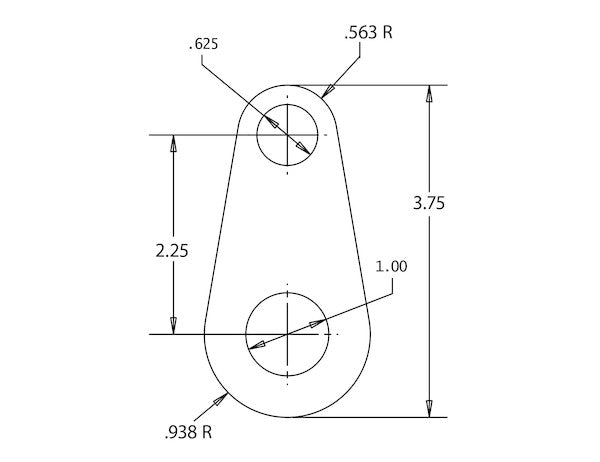
Buyers Products Tailgate Linkage Connecting Plate welds to the dump body tailgate and helps connect the tailgate release lever to the lower tailgate hinge. It is stamped from a 1/2 in. steel plate and available in several sizes.
Specifications
| A | 5/8 |
|---|---|
| B | 1.00 |
| Material | Carbon Steel |
| Mounting Holes Ctr to Ctr (in.) | 2-1/4 |
| Overall Length (in.) | 3-3/4 |
| Plate Thickness | 1/2 |
| Use With | Tailgate Latch Assembly |
The Crucial Role of the Tailgate Linkage Connecting Plate in Heavy-Duty Dump Body Operations
In the demanding environment of commercial and industrial applications, where dump bodies are subjected to rigorous operational cycles and heavy loads, the integrity and reliability of every component are paramount. The Buyers Products Tailgate Linkage Connecting Plate stands as a testament to precision engineering and robust material science, serving as an indispensable link in the critical mechanism governing dump body tailgate functionality. This component, engineered for permanent integration through welding, is not merely a piece of steel but a meticulously designed interface that ensures the safe, efficient, and reliable operation of the tailgate release system.
The primary function of this connecting plate is to facilitate the mechanical linkage between the tailgate release lever and the lower tailgate hinge. This connection is fundamental to the ability of an operator to securely latch and unlatch the tailgate, a process that must occur flawlessly whether the dump body is empty, partially loaded, or at its maximum rated capacity. The mechanism translates the operator's input from the release lever into the necessary motion at the hinge to disengage the tailgate, allowing for controlled and complete material discharge. Any compromise in this linkage can lead to operational inefficiencies, safety hazards, or even structural failure. Consequently, the design and material specifications of the Tailgate Linkage Connecting Plate are optimized to withstand the significant dynamic and static stresses inherent in dump body operations.
Material Science and Structural Integrity: The Choice of Carbon Steel
The selection of carbon steel as the primary material for this connecting plate is a deliberate engineering decision rooted in its superior mechanical properties and economic viability for heavy-duty applications. Carbon steel, defined by its composition primarily of iron and carbon (typically up to 2.1% by weight), offers an exceptional balance of strength, hardness, ductility, and weldability. For a component subjected to cyclic loading, abrasive wear, and potential impact forces, these properties are not just advantageous—they are critical.
The 1/2 inch (approximately 12.7 mm) plate thickness further enhances the structural integrity of the connecting plate. This substantial gauge provides an impressive resistance to deformation, bending, and shear forces that are routinely exerted during the tailgate's operation. When the tailgate is latched, the plate endures significant static loads from the retained cargo. During release and dumping, it experiences dynamic shock loads and stress concentrations as the linkages articulate. A thinner plate would be susceptible to plastic deformation or fatigue failure over time, leading to premature component degradation and necessitating costly repairs or replacements. The 1/2 inch thickness ensures that the component operates within its elastic limit under normal conditions, contributing to an extended service life and consistent performance.
Furthermore, the inherent weldability of carbon steel is a key factor in its suitability. The connecting plate is designed to be welded directly to the dump body tailgate. This method of attachment creates a permanent, monolithic bond, integrating the plate seamlessly into the structural framework of the tailgate. Unlike bolted connections, which can loosen over time due to vibration or require periodic torque checks, a properly executed weld provides an unparalleled level of strength and rigidity, eliminating potential points of failure often associated with mechanical fasteners. The metallurgical bond formed during welding ensures that the load transfer between the connecting plate and the tailgate body is distributed efficiently, minimizing stress concentrations and maximizing the overall durability of the assembly.
While carbon steel offers excellent mechanical properties, its susceptibility to corrosion in certain environmental conditions is a consideration. In typical dump body applications, exposure to moisture, road salts, chemicals, and abrasive materials is common. Although the product itself is supplied as bare carbon steel, it is standard industry practice for equipment manufacturers or end-users to apply appropriate protective coatings—such as robust paint systems or powder coats—to the entire tailgate assembly, including the welded-on connecting plate. These coatings create a barrier against corrosive elements, further extending the operational life of the steel component and preserving its structural integrity over decades of service.
Precision Manufacturing: The Stamping Process
The Tailgate Linkage Connecting Plate is manufactured using a stamping process. This method involves forming the 1/2 inch steel plate under high pressure using a die and punch. Stamping is a highly efficient and precise manufacturing technique, particularly well-suited for producing components with consistent dimensions and complex geometries in high volumes. For a critical component like this connecting plate, the advantages of stamping are manifold:
- Dimensional Accuracy and Repeatability: Stamping ensures that each plate is produced with extremely tight tolerances, guaranteeing consistent fit and function across all units. This precision is vital for proper articulation within the tailgate linkage system, preventing binding or excessive play that could lead to premature wear.
- Optimized Material Properties: The cold working involved in stamping can subtly refine the grain structure of the carbon steel, potentially enhancing its mechanical properties, such as yield strength and tensile strength, in certain areas.
- Surface Finish: Stamping typically produces a smoother and more consistent surface finish compared to other manufacturing methods, which can contribute to better adhesion of protective coatings and improved aesthetics.
- Cost-Effectiveness: For the heavy-duty components often required in truck equipment, stamping offers an economical way to produce strong, reliable parts without extensive machining, thereby keeping production costs competitive.
Quality control during the stamping process is rigorous. This includes material verification to ensure the incoming steel meets specified metallurgical standards, dimensional inspection of finished parts to confirm adherence to engineering drawings, and visual inspections for any surface imperfections or cracks that could compromise structural integrity. This commitment to manufacturing excellence ensures that every connecting plate delivered by Buyers Products meets the high standards required for heavy-duty applications.
Engineering Design: Critical Dimensions and Functional Integration
The detailed specifications of the Tailgate Linkage Connecting Plate underscore a design optimized for performance and compatibility within standard dump body systems. The plate features two primary connection points: a 5/8 inch diameter hole and a 1 inch diameter hole. These specific diameters are not arbitrary; they are engineered to accommodate standard pivot pins, bolts, or linkage rods commonly found in heavy-duty tailgate latch assemblies.
- 5/8 Inch Diameter Hole (A): This aperture is typically designed to interface with the tailgate release lever mechanism. The smaller diameter implies connection to a linkage rod or pin that transmits the initial force from the operator's lever. The fit between the pin and hole must be precise enough to minimize play, which could lead to sloppy operation or increased wear, but loose enough to allow free rotation without binding. The material around this hole is carefully engineered to withstand bearing stresses exerted by the pin and shear stresses from the applied force.
- 1 Inch Diameter Hole (B): The larger 1-inch diameter hole usually serves as the pivot point for a more substantial component, often connecting to the lower tailgate hinge itself or a primary actuating rod. This larger diameter allows for a stronger pivot pin, capable of handling greater shear and bending loads as the entire weight of the tailgate, and potentially some cargo, is momentarily supported or pivoted during release. The increased surface area for bearing stress distribution around this hole is crucial for prolonging the life of both the plate and the connecting pin.
The specified "Mounting Holes Ctr to Ctr (in.)" at 2-1/4 inches, along with the "Overall Length (in.)" of 3-3/4 inches, define the geometric relationship of the plate. These dimensions are crucial for ensuring proper mechanical advantage and alignment within the complex kinematics of a tailgate linkage system. The 2-1/4 inch center-to-center distance between mounting points (implied from typical illustrations, though not explicitly stated for two holes, it likely refers to welding alignment or connection points for the linkage system) facilitates compatibility with a wide range of standard tailgate latch assemblies. This adherence to industry-standard dimensions simplifies installation and ensures interoperability, reducing the need for custom fabrication in the field.
The overall length of 3-3/4 inches provides sufficient material for robust welding to the dump body tailgate without creating an overly cumbersome or exposed component. The compact yet sturdy design ensures that the plate fits within the often-confined spaces of tailgate mechanisms, while still offering ample surface area for a strong, structurally sound weld. This balance of size and strength is a hallmark of effective engineering in heavy equipment components.
Functional Integration and Operational Efficiency
The Tailgate Linkage Connecting Plate is a small yet pivotal element in a larger, interconnected mechanical system. Its robust design contributes directly to the overall reliability and operational efficiency of the dump body. When the operator engages the tailgate release lever, a sequence of mechanical actions is initiated. The force applied to the lever is transmitted through a series of rods and pivots, one of which directly engages with this connecting plate. The plate, in turn, transfers this force and motion to the lower tailgate hinge or a primary latch mechanism, causing the tailgate to unlatch and swing open for material discharge.
A precisely manufactured and securely welded connecting plate ensures that this force transmission is smooth, efficient, and free from excessive friction or binding. Any deviation in dimensions, material weakness, or improper installation could lead to a stiff or unreliable release mechanism, potentially causing delays on the job site or requiring excessive force from the operator. In extreme cases, a compromised connecting plate could fail, leading to an inability to open or close the tailgate, rendering the dump body inoperable until repairs are made. Given the demanding nature of applications such as construction, mining, agriculture, and waste management, minimizing downtime is critical for profitability and project timelines.
Safety and Durability Under Extreme Conditions
Beyond operational efficiency, the structural integrity provided by the Tailgate Linkage Connecting Plate has significant safety implications. A malfunctioning tailgate latch assembly can lead to unintended cargo spillage during transit, posing a severe hazard to other road users and pedestrians, as well as causing environmental contamination. A securely latched tailgate, facilitated by a reliable linkage system, prevents such occurrences. The 1/2 inch carbon steel plate, with its carefully sized holes and robust weld-on design, is engineered to maintain its structural integrity even under dynamic stresses, impacts, and prolonged exposure to harsh environmental factors, including temperature extremes, moisture, road salts, and abrasive materials commonly found on job sites.
The design accounts for fatigue resistance—the ability of the material to withstand repeated cycles of loading and unloading without fracturing. By utilizing high-quality carbon steel and a substantial plate thickness, the component is designed to endure hundreds of thousands of tailgate cycles over its service life. This durability translates directly into reduced maintenance requirements and lower lifetime operating costs for vehicle owners and fleet managers.
Buyers Products' Commitment to Excellence
The Tailgate Linkage Connecting Plate is a product of Buyers Products' unwavering commitment to engineering excellence and manufacturing quality in the heavy-duty truck and trailer equipment industry. With decades of experience, Buyers Products understands the critical demands placed upon components operating in the most challenging environments. Each product undergoes rigorous design, testing, and quality control processes to ensure it meets or exceeds industry standards for performance, reliability, and durability. By choosing Buyers Products, customers are investing in components that are engineered to perform consistently, minimize downtime, and contribute to the safe and efficient operation of their valuable equipment.
Conclusion
The Tailgate Linkage Connecting Plate, with its 5/8 and 1 inch diameter holes and robust 1/2 inch carbon steel construction, is a prime example of how meticulous engineering and material selection contribute to the overall functionality and safety of heavy-duty equipment. This essential component, designed for permanent weld-on integration, effectively bridges the mechanical gap between the tailgate release lever and the lower tailgate hinge. Its precision stamping ensures consistent dimensions and reliable performance, while the choice of carbon steel provides the necessary strength, durability, and weldability to withstand the rigorous demands of dump body operations. For professionals in construction, waste management, municipal services, and other demanding sectors, this connecting plate represents an indispensable element for maintaining operational efficiency, ensuring safety, and maximizing the service life of their dump truck fleet. It is a critical, yet often unseen, component that enables the seamless and secure operation of one of the most vital features of a dump body: its tailgate.