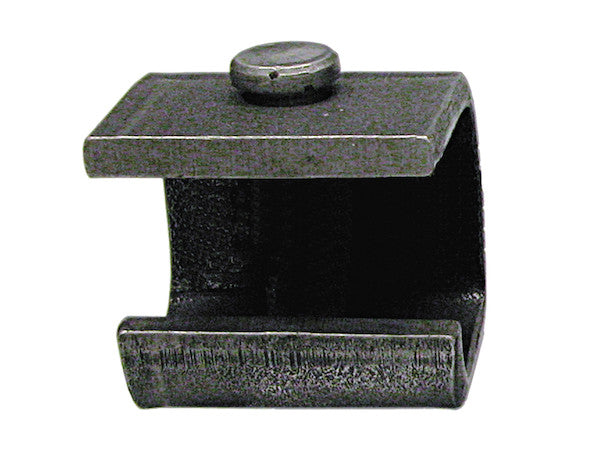
Buyers Products Clevis for Tailgate Latch
Specifications
| Description | Cast steel clevis for tailgate latch |
|---|---|
| Diagram No. | (2) |
Technical Overview: Cast Steel Clevis for Tailgate Latch - Diagram No. 2
This document provides a comprehensive technical overview of the Cast Steel Clevis for Tailgate Latch, specifically identified as Diagram No. (2), manufactured by Buyers Products. This component is engineered to serve as a critical interface within various tailgate latching mechanisms, primarily in commercial and heavy-duty vehicle applications. The selection of cast steel as the primary material, coupled with precision engineering, ensures its robustness, longevity, and reliable performance under demanding operational conditions.
1. Introduction to the Component
The clevis, in mechanical engineering, is a U-shaped fastener or connector that is typically pinned through two holes in its ends to an opposing component. In the context of a tailgate latch, the clevis serves as a pivotal link, facilitating the secure closure and release of the tailgate. Its design is fundamental to the overall functionality and safety of the vehicle's cargo containment system. Diagram No. (2) denotes a specific variant within the Buyers Products lineup, indicating a particular design, dimension, or application compatibility.
2. Material Specification: Cast Steel
The choice of cast steel for this clevis is a deliberate engineering decision driven by its superior mechanical properties. Steel casting involves pouring molten steel into a mold, allowing it to solidify into the desired shape. This manufacturing process offers several advantages over other metallic forming methods:
2.1. Mechanical Properties of Cast Steel:
- High Tensile Strength: Cast steel exhibits excellent resistance to breaking under tension, a critical factor for components subjected to significant pulling forces, such as those experienced during tailgate operation and vehicle movement. The typical tensile strength for common cast steels used in such applications can range from 450 MPa (65,000 psi) to over 700 MPa (100,000 psi), depending on the specific alloy and heat treatment.
- Yield Strength: This refers to the stress at which the material begins to deform plastically. High yield strength ensures that the clevis can withstand operational loads without permanent deformation, maintaining the integrity of the latching mechanism. Typical yield strengths for relevant cast steels often fall between 250 MPa (36,000 psi) and 450 MPa (65,000 psi).
- Impact Resistance (Toughness): Tailgate latches, particularly on commercial vehicles, are exposed to dynamic loads, shocks, and vibrations. Cast steel possesses inherent toughness, which is its ability to absorb energy and deform plastically before fracturing. This property is crucial for preventing brittle failure, especially in colder environments where materials can become more susceptible to impact damage.
- Wear Resistance: Given its function as a moving part within a latching mechanism, the clevis will experience abrasive wear. Certain cast steel alloys can be formulated or heat-treated to enhance their surface hardness and wear resistance, prolonging the operational lifespan of the component.
- Fatigue Strength: Components that undergo repetitive loading and unloading cycles, like a tailgate clevis, must possess high fatigue strength. Cast steel, when properly specified and manufactured, can endure millions of such cycles without fatigue failure, which is paramount for long-term reliability.
2.2. Advantages of Steel Casting for this Application:
- Design Flexibility: Casting allows for the creation of complex geometries and internal features that might be difficult or costly to achieve with other manufacturing methods like forging or machining from bar stock. This enables an optimized design for load distribution and integration with mating components.
- Cost-Effectiveness for Medium to High Volume: While initial tooling costs can be higher, casting becomes highly cost-effective for producing components in medium to high volumes, as individual unit costs are reduced.
- Good Weldability: For applications requiring assembly into larger structures or potential field repairs, many cast steel grades offer good weldability, provided appropriate welding procedures are followed.
- Corrosion Resistance (with coatings): While plain cast steel is susceptible to corrosion, it provides an excellent substrate for various protective coatings (e.g., powder coating, galvanization, electroplating) that significantly enhance its resistance to environmental degradation.
3. Design and Engineering Considerations
The design of the clevis, represented by Diagram No. (2), incorporates several critical engineering principles to ensure optimal performance and safety:
3.1. Geometry and Dimensions:
- U-Shape Configuration: The characteristic U-shape is fundamental to its function, providing two parallel ears that align with a mating component (e.g., a hinge pin or a latch strike).
- Pin Hole Precision: The diameter and concentricity of the pin holes are crucial. They must accommodate the specified connecting pin with appropriate clearance to allow for free rotation while minimizing excessive play that could lead to wear or structural instability. Tolerances for these holes are typically specified to tight standards (e.g., ISO H7 or similar) to ensure proper fit and function.
- Material Thickness and Web Reinforcement: The thickness of the clevis ears and the connecting web are engineered to withstand the anticipated tensile and shear loads. Reinforcing ribs or fillets may be incorporated at stress concentration points, such as the junction of the ears and the web, to distribute stress more evenly and prevent localized failure.
- Radius and Chamfering: Edges and corners are typically radiused or chamfered to reduce stress concentrations, improve fatigue life, and enhance safety during handling and assembly.
3.2. Load Bearing Capacity:
The clevis is designed to withstand the maximum static and dynamic loads exerted during tailgate operation, including the weight of the tailgate itself, the weight of any cargo exerting pressure against it, and forces from vehicle acceleration, deceleration, and road shock. Engineers use finite element analysis (FEA) to simulate these stresses and optimize the clevis geometry for maximum strength-to-weight ratio and minimal material usage.
3.3. Integration with Tailgate Latch System:
As Diagram No. (2) suggests, this clevis is part of a larger latch assembly. Its design must be compatible with the specific pin, pivot points, and release mechanism of the Buyers Products tailgate latch system. This includes:
- Pin Compatibility: The clevis is designed to mate with a specific diameter and length of pin, often a high-strength steel pin, secured by a cotter pin, circlip, or bolt.
- Articulation: It must allow for the necessary range of angular movement for the tailgate to open and close smoothly without binding or excessive friction.
- Interchangeability: As a replacement part, Diagram No. (2) ensures precise fitment with existing Buyers Products tailgate latch mechanisms, simplifying maintenance and repair.
4. Manufacturing Process and Quality Control
The production of the Cast Steel Clevis for Tailgate Latch involves stringent manufacturing processes and quality control measures to ensure product consistency and reliability.
4.1. Casting Process:
Typically, sand casting or investment casting methods are employed depending on the required precision and production volume. The process involves:
- Pattern Making: A pattern, often made from wood, metal, or plastic, is created to the exact dimensions of the clevis, with allowances for shrinkage.
- Mold Creation: For sand casting, the pattern is used to form an impression in a sand mold. For investment casting (lost-wax process), a wax pattern is created, coated with ceramic slurry, and then melted out.
- Melting and Pouring: High-quality steel alloys are melted in an induction or electric arc furnace. The molten metal is carefully poured into the molds at controlled temperatures to prevent defects.
- Solidification: The steel cools and solidifies within the mold, taking on the clevis shape.
- Shakeout and Fettling: Once solidified, the casting is removed from the mold. Excess material (risers, gates) is cut off, and the casting is cleaned through processes like shot blasting.
4.2. Heat Treatment:
After casting, the clevis often undergoes heat treatment, such as normalizing or quenching and tempering. This process refines the grain structure, relieves internal stresses, and enhances the mechanical properties (strength, toughness, hardness) of the cast steel, optimizing it for its intended application.
4.3. Machining:
Critical dimensions, especially the pin holes and potentially mating surfaces, are precision machined to achieve the required tolerances and surface finishes. This ensures smooth operation and proper fit with mating components.
4.4. Surface Finishing:
To protect against corrosion and enhance aesthetic appeal, the clevis typically receives a protective coating. Common options include:
- Powder Coating: Offers excellent durability, chip resistance, and a wide range of color options.
- Electroplating (e.g., Zinc Plating): Provides sacrificial corrosion protection, often with a clear or yellow chromate finish.
- Hot-Dip Galvanization: Offers superior long-term corrosion protection, especially in harsh outdoor environments, by forming a metallurgical bond with a layer of zinc.
4.5. Quality Control and Inspection:
Throughout the manufacturing process, strict quality control measures are implemented:
- Material Composition Analysis: Spectrographic analysis of raw materials and molten steel ensures correct alloy composition.
- Dimensional Inspection: Calipers, micrometers, and Coordinate Measuring Machines (CMM) are used to verify critical dimensions and tolerances.
- Non-Destructive Testing (NDT): Methods like magnetic particle inspection (MPI) or ultrasonic testing (UT) may be employed to detect internal or surface flaws in critical castings.
- Mechanical Testing: Sample castings may undergo tensile, impact, and hardness testing to verify mechanical properties meet specifications.
- Visual Inspection: Each clevis is visually inspected for surface defects, proper finishing, and overall quality.
5. Applications and Compatibility
The Cast Steel Clevis for Tailgate Latch (Diagram No. 2) is primarily designed for use in:
- Commercial Trucks: Dump trucks, utility trucks, service bodies, and flatbeds.
- Trailers: Utility trailers, enclosed trailers, and equipment trailers with heavy-duty tailgates.
- Specialty Vehicles: Custom fabrications requiring robust tailgate latching solutions.
Its designation as Diagram No. (2) indicates its specific compatibility within Buyers Products' extensive line of tailgate latch hardware. Users should refer to the relevant Buyers Products catalog or technical documentation to ensure proper selection for their specific vehicle make, model, and tailgate latch assembly.
6. Installation and Maintenance
Proper installation and routine maintenance are crucial for maximizing the lifespan and ensuring the safe operation of the clevis and the entire tailgate latch system.
6.1. Installation:
- Component Verification: Ensure the clevis (Diagram No. 2) is the correct replacement part for the specific tailgate latch assembly.
- Cleanliness: All mating surfaces should be clean and free of debris, rust, or old lubricant.
- Proper Alignment: Install the clevis, ensuring proper alignment with the connecting pin and other latch components.
- Secure Pinning: Secure the connecting pin with the appropriate retaining device (cotter pin, bolt, or circlip) as specified by the latch manufacturer. Ensure the retaining device is properly installed and seated.
- Functionality Check: After installation, operate the tailgate latch multiple times to confirm smooth and secure operation, ensuring there is no binding, excessive play, or improper engagement.
6.2. Maintenance:
- Regular Inspection: Periodically inspect the clevis and surrounding latch components for signs of wear, deformation, cracks, corrosion, or loose fasteners. Pay particular attention to the pin holes and areas of highest stress.
- Lubrication: Apply appropriate grease or lubricant to the pivot points and areas of contact between the clevis and mating components to reduce friction and wear, especially in environments exposed to moisture or dirt.
- Corrosion Prevention: Inspect the protective coating. If the coating is compromised, clean the affected area and apply a touch-up paint or rust preventative to prevent corrosion.
- Replacement: If significant wear, deformation, or damage is observed, the clevis should be replaced immediately with an authentic Buyers Products component (Diagram No. 2) to maintain safety and functionality.
7. Conclusion
The Cast Steel Clevis for Tailgate Latch, identified as Diagram No. (2) from Buyers Products, is a testament to robust engineering and material science. Its fabrication from high-quality cast steel, combined with meticulous design, manufacturing, and quality control processes, ensures exceptional tensile strength, impact resistance, and fatigue life. This component is specifically designed to deliver reliable and safe performance in demanding commercial and heavy-duty vehicle applications, serving as a critical link in the overall tailgate latching mechanism. Proper selection, installation, and routine maintenance are essential to leverage its full operational lifespan and maintain the integrity of the vehicle's cargo containment system.