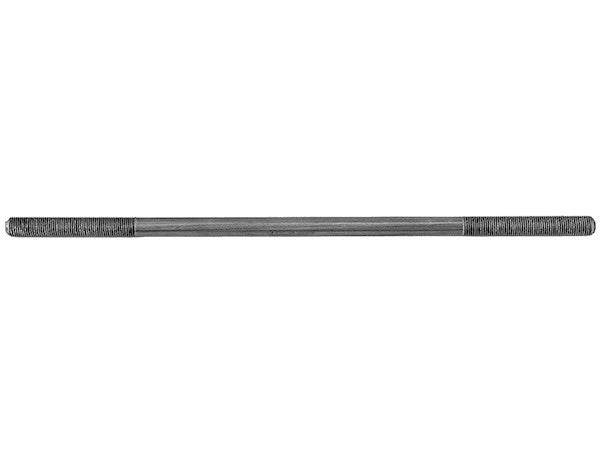
The Body Tie Down Rod from Buyers Products is a versatile, multipurpose rod used for mounting truck equipment to the chassis. Constructed of Grade 5 material, the rod is available in several lengths to fit various applications. An optional hardware kit is sold separately, which includes eight 5/8 in.-11 thread hex nuts and eight 5/8 in. ID split lock washers.
Specifications
| Finish | Plain |
|---|---|
| Length (in.) | 24.00 |
| Thread (in.) | 5/8-11 |
The Buyers Products 5/8-11 Thread x 24 Inch Body Tie Down Rod represents a critical component in the secure and reliable integration of auxiliary equipment onto vehicular chassis, particularly within the demanding environment of commercial trucking and specialized vehicle applications. Engineered for robust performance, this tie-down rod is a testament to precision manufacturing and material science, designed to meet rigorous operational standards.
At its core, the function of a body tie-down rod is to establish a high-integrity mechanical connection between a piece of truck equipment—ranging from utility bodies, dump bodies, plows, cranes, or toolboxes—and the underlying structural framework of the vehicle’s chassis. This connection is paramount for both operational safety and equipment longevity. In dynamic environments where vehicles are subjected to constant vibration, shock loads, and varying gravitational forces, the security of such an attachment cannot be overstated. A failure in this critical interface could lead to catastrophic equipment detachment, posing significant safety hazards and leading to costly operational downtime and repairs. The 5/8-11 Thread x 24 Inch Body Tie Down Rod is specifically designed to counteract these challenges by providing superior clamping force and structural support.
Central to the superior performance of this tie-down rod is its construction from Grade 5 material. In the realm of industrial fasteners and structural components, the Society of Automotive Engineers (SAE) J429 standard defines various grades of steel bolts and rods based on their mechanical properties. Grade 5 material, often designated by three radial lines on the head of a bolt, refers to a medium carbon steel that has undergone quenching and tempering. This heat treatment process significantly enhances the material’s mechanical properties. Specifically, Grade 5 steel typically exhibits a minimum tensile strength of 120,000 psi (pounds per square inch) and a minimum yield strength of 92,000 psi. This contrasts sharply with lower grades, such as Grade 2, which offers approximately 74,000 psi tensile strength. The elevated strength of Grade 5 ensures that the tie-down rod can withstand substantial axial tension and shear forces without deformation or failure, making it ideal for applications where heavy loads and dynamic stresses are commonplace. Furthermore, Grade 5 steel strikes an optimal balance between strength, ductility (the ability to deform plastically without fracturing), and cost-effectiveness. While higher grades like Grade 8 offer even greater strength (typically 150,000 psi tensile strength), their increased hardness can sometimes lead to reduced ductility and a higher susceptibility to hydrogen embrittlement if not properly manufactured and handled. For the demanding yet practical requirements of truck equipment mounting, Grade 5 provides the robustness required with an excellent margin of safety and service life.
The specific thread designation of 5/8-11 is another critical engineering detail. The "5/8" refers to the nominal major diameter of the rod in inches, indicating its robust cross-sectional area and inherent load-bearing capacity. The "-11" signifies 11 threads per inch, identifying this as a Unified National Coarse (UNC) thread series. UNC threads are characterized by their larger thread pitch (fewer threads per inch) compared to Unified National Fine (UNF) threads. This coarse pitch offers several distinct advantages for heavy-duty applications like truck equipment mounting. Firstly, UNC threads are less susceptible to stripping during installation, particularly in environments where perfect alignment may be challenging or where components are subjected to rough handling. Their larger thread profile also provides greater resistance to galling, a form of wear caused by adhesion between sliding surfaces. More importantly, UNC threads exhibit superior vibration resistance compared to UNF threads when used with appropriate locking mechanisms. The larger flank area of coarse threads distributes the clamping load over a greater surface, making the connection less prone to loosening under dynamic loads. The manufacturing process of these threads, typically through roll-forming rather than cutting, further enhances their strength. Roll-forming cold works the material, densifying the grain structure and imparting residual compressive stresses at the root of the thread, which significantly improves fatigue resistance.
The specified length of 24 inches for this particular body tie-down rod is chosen to accommodate a wide array of mounting scenarios. In truck and trailer fabrication, equipment bodies, subframes, and auxiliary components vary significantly in their structural dimensions and attachment points. A 24-inch rod provides sufficient length to span many common chassis rail widths and equipment mounting flanges, allowing for proper distribution of clamping force and secure integration. While Buyers Products offers various lengths to ensure versatility, the 24-inch variant is a frequently utilized size, indicative of its broad applicability. The precise length is crucial for ensuring proper fitment without excessive overhang, which could interfere with other vehicle components or expose the rod to unnecessary bending moments. For instances where a precise distance is required, a rod of this length offers the flexibility for minor adjustments or specific positioning requirements. Furthermore, the length influences considerations such as shear strength, bending resistance, and potential for buckling under compressive loads, all of which are optimized by the Grade 5 material properties for this specific dimension.
The finish of the tie-down rod is described as "Plain." A plain finish, sometimes referred to as "black" or "self-color," means the rod is supplied in its natural metallic state, without any additional surface coatings like galvanization or electroplating. This choice of finish offers several practical benefits. Primarily, it is the most economical finish, reducing the overall cost of the component. More critically for high-strength fasteners, a plain finish eliminates any risk of hydrogen embrittlement, a phenomenon where hydrogen atoms can migrate into the steel lattice during certain plating processes, leading to a reduction in ductility and potentially catastrophic brittle fracture under stress. For Grade 5 material, which relies on a precise balance of strength and ductility, avoiding hydrogen embrittlement is paramount. Additionally, a plain finish provides consistent friction characteristics for torque application, allowing for more predictable and accurate clamping force when tightened. While a plain finish is susceptible to corrosion, especially in harsh or marine environments, it often performs adequately within the enclosed or protected areas of a truck chassis. For applications where prolonged exposure to moisture, road salts, or aggressive chemicals is anticipated, end-users may apply post-installation corrosion inhibitors or protective coatings, or choose to utilize the plain finish in conjunction with robust anti-corrosion chassis treatments.
The comprehensive functionality of this tie-down rod is further enhanced by the availability of an optional hardware kit, sold separately. This kit includes eight 5/8 in.-11 thread hex nuts and eight 5/8 in. ID split lock washers. These components are integral to establishing and maintaining a secure fastened joint. The hex nuts, typically manufactured to match or exceed the strength grade of the rod itself (often Grade 5 or Grade C nuts are recommended for Grade 5 rods), are the primary means of converting applied torque into axial clamping force. This clamping force is what creates the friction between the joined components, preventing relative motion and securely holding the equipment in place. The "5/8 in.-11 thread" specification ensures perfect compatibility with the rod's threading, guaranteeing proper engagement and load transfer.
The inclusion of eight 5/8 in. ID (inner diameter) split lock washers is crucial for maintaining the integrity of the bolted joint, particularly in high-vibration applications. A split lock washer functions by exerting a spring-like tension against the nut after it has been tightened. When compressed, the split ends of the washer attempt to spring back, creating a localized friction between the nut face and the mating surface, as well as providing a slight resistance to loosening due to its spring action. This small but continuous tension helps to prevent the nut from backing off under dynamic loads, vibration, or thermal cycling. While not a definitive solution for all forms of loosening, split lock washers are a widely accepted and effective method for improving the security of bolted connections in numerous industrial and automotive contexts. Their effectiveness, combined with their cost-efficiency and ease of installation, makes them a standard component in tie-down hardware kits. For critical applications, understanding the nuances of torque application and the specific behavior of different locking mechanisms is essential. The general recommendation is to use the full hardware kit to optimize the security and lifespan of the installation.
Installation protocols for the 5/8-11 Thread x 24 Inch Body Tie Down Rod require adherence to best practices to ensure maximum performance and safety. Proper alignment of the equipment with the chassis mounting points is the first step, followed by the insertion of the rods through the designated apertures. Initial hand-tightening of the nuts should ensure full thread engagement without cross-threading. The most critical step is the application of the correct torque specification. For a 5/8-11 Grade 5 fastener, recommended torque values can range, but typically fall between 150-200 ft-lbs, depending on the specific application, lubrication, and whether plain or plated nuts are used. It is imperative to consult relevant industry standards (e.g., SAE, ASTM, or manufacturer-specific guidelines) and use a calibrated torque wrench to achieve the precise clamping force. Under-torquing can lead to insufficient clamping force, allowing the joint to loosen under vibration or load, while over-torquing risks yielding the fastener, damaging the threads, or causing premature fatigue failure of the rod itself or the components being joined. Sequential tightening in a star pattern (if multiple rods are used) or gradual tightening helps to ensure even load distribution across the mounting interface. Post-installation, a visual inspection for proper engagement and the absence of gaps is recommended.
Long-term maintenance involves periodic inspection of all tie-down rods and associated hardware. Checks should include verifying that nuts remain tight, there is no visible corrosion that could compromise the integrity of the rod or hardware, and that there are no signs of stress, fatigue cracks, or deformation. Any evidence of loosening, damage, or excessive corrosion warrants immediate attention, potentially requiring re-torquing or replacement of components. The service life of the tie-down rod is directly correlated with proper installation and diligent maintenance, ensuring continued safety and operational reliability of the mounted equipment.
In conclusion, the Buyers Products 5/8-11 Thread x 24 Inch Body Tie Down Rod is a meticulously engineered component designed to address the demanding requirements of truck equipment mounting. Its selection of Grade 5 material provides an optimal balance of strength, ductility, and fatigue resistance. The 5/8-11 UNC thread standard ensures robust engagement and resistance to loosening, while the 24-inch length offers broad applicability across various chassis configurations. The plain finish provides technical advantages in terms of cost and avoiding hydrogen embrittlement. When coupled with the optional hardware kit, including high-quality hex nuts and split lock washers, this system creates a highly reliable and secure attachment point. This tie-down rod is not merely a piece of metal; it is a critical safety and operational element, reflecting Buyers Products’ commitment to delivering high-performance, durable, and professionally specified solutions for the commercial vehicle industry. Its robust design and adherence to stringent material and dimensional specifications make it an indispensable choice for professionals seeking uncompromising reliability in their equipment installations.