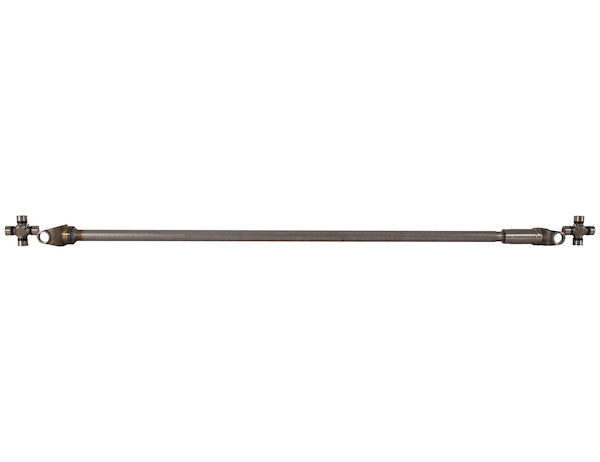
Buyers Products B1310 1-1/4 Inch Tubular Shaft Assembly can fulfill a variety of coupling applications due to its customizable length and heavy torque rating. Torque transfer is smooth and continuous, and the assembly comes to you unwelded so that it can be easily cut to length. Buy as a whole assembly, or choose the component that will fit your needs. The tubular shaft assembly includes a slip yoke, two journal assemblies, stub shaft, and tube with welded-on yoke. It can be extended using a Buyers Products Midship Stub Shaft.
Specifications
| Center of Journal Assembly to Center of Journal Assembly Length | 67.0 |
|---|---|
| Journal Assembly Part Number | 5153XBA |
| Overall Length | 72.00 |
| Series | B1310 |
| Slip Yoke Part Number | B23130 |
| Stub Shaft Part Number | SS |
| Tube and Weld Yoke Length | 58.5 |
| Tube and Weld Yoke Part Number | TS1372 |
The Buyers Products TSA13 Series Tubular Shaft Assembly, with an overall length of 72 inches and designated by part number B1310, represents a meticulously engineered and exceptionally robust solution for the precise transmission of rotational power across a broad spectrum of mechanical systems. This comprehensive technical description aims to delineate the intricate specifications, advanced design philosophy, operational characteristics, and versatile application potential of this critical power transmission component. Engineered to meet and exceed demanding operational requirements, the TSA13 series assembly is distinguished by its superior construction quality, precision engineering, and inherent adaptability, positioning it as an indispensable asset in various industrial, agricultural, and commercial vehicle applications.
Fundamentally, a tubular shaft assembly, often referenced as a driveshaft or propeller shaft, serves the crucial function of coupling two rotating components, such as a power take-off (PTO) unit, an auxiliary gearbox output, or a hydraulic pump drive, to a driven implement, axle, or other rotating machinery. This connection facilitates the efficient transfer of mechanical torque while simultaneously accommodating dynamic changes in angular alignment, axial distance, or both, which are common in mobile and articulated machinery. The TSA13 series, specifically the 72-inch B1310 model, is meticulously designed and fabricated to deliver consistent and high-performance torque delivery, even under challenging environmental and operational conditions.
Engineering and Design Philosophy: Precision Customization and Unyielding Performance
A hallmark feature of the Buyers Products B1310 Tubular Shaft Assembly is its inherent design for adaptability and precision customization. Delivered in an unwelded configuration, particularly regarding the interface between the primary tube and the stub shaft, this assembly offers unparalleled flexibility for on-site length modification. This "unwelded" attribute is paramount for applications demanding exacting shaft lengths to optimize operational angles, minimize dynamic vibrations, and ensure optimal engagement within the driveline. The capability to precisely cut the tubular section to the exact required length prior to final welding and assembly significantly streamlines the installation process, reduces labor expenditure, and enables a level of fitment that is often unattainable with pre-fabricated, fixed-length units. This bespoke customization ensures that the shaft assembly can be seamlessly integrated into a diverse array of unique machinery designs, custom builds, and retrofit projects, thereby enhancing overall system efficiency, operational stability, and component longevity.
Beyond its customizable aspect, the B1310 assembly is engineered with a heavy torque rating, unequivocally signifying its substantial capacity to withstand and efficiently transmit significant rotational forces without premature material fatigue, deformation, or catastrophic failure. This robust capability is a direct consequence of a synergistic approach encompassing judicious material selection, state-of-the-art manufacturing processes, and optimized geometric design. The constituent components are fabricated from high-strength alloy steels, specifically chosen for their superior torsional rigidity, remarkable tensile strength, and enhanced fatigue resistance. These metallurgical properties are critically important for components exposed to dynamic and cyclic loads, repetitive stress reversals, and the potential for severe shock loading. Such material integrity ensures that the assembly maintains its structural coherence and high-performance characteristics consistently, even under the most arduous operating conditions. The heavy torque rating directly correlates to enhanced operational reliability, significantly reduced equipment downtime, and an extended service life for the machinery relying on its power transmission capabilities.
Core Components and Their Intrinsic Functions
The TSA13 Series B1310 Tubular Shaft Assembly is a sophisticated mechanical system composed of several meticulously engineered integral components, each contributing uniquely to the overall functionality, durability, and performance of the unit. A comprehensive understanding of the design intent and operational role of each element is essential to fully appreciate the assembly's robust capabilities.
- **Slip Yoke (Part Number: B23130):** This critical component is designed to facilitate crucial axial movement within the driveline. The slip yoke enables the driveshaft to dynamically accommodate variations in the longitudinal distance between the connected driving and driven components. Such variations typically arise from suspension articulation in mobile equipment, thermal expansion and contraction of driveline components, or minor shifts during operational cycles. This "slip" action is achieved through a precision-machined splined connection, allowing the stub shaft to linearly slide in and out of the yoke bore while continuously and securely transmitting torque. The B23130 slip yoke features high-precision machining to ensure exceptionally smooth, low-friction axial travel and steadfast engagement with the stub shaft's corresponding splines. Its robust construction, often complemented by surface hardening treatments such as carburizing or nitriding, provides exceptional resistance to wear, fretting corrosion, and spline deformation, even under conditions of constant axial movement and high torsional stress.
- **Journal Assemblies (Part Number: 5153XBA):** The assembly incorporates two journal assemblies, universally recognized as universal joints (U-joints), which are fundamental to the driveshaft's capacity to transmit torque through varying angles. Each journal assembly is comprised of a cross-shaped spider element and four precision needle bearing caps. The trunnions (cylindrical ends) of the spider are fitted with high-efficiency needle roller bearings, which are precisely housed within the bearing caps. These caps are then securely retained within the yokes of the driving and driven shafts. This configuration permits significant angular deflection between the connected shafts, and crucially, when properly phased, enables the transmission of torque with minimal angular velocity fluctuation, thereby approaching constant velocity output. The 5153XBA journal assemblies are specifically chosen for their exceptional durability, precision-ground bearing surfaces, and the use of high-quality needle bearings, which collectively minimize rotational friction, efficiently dissipate thermal energy, and provide an extended service life even under continuous operation and substantial angular displacements. Optimal lubrication is paramount for these components, and they are typically equipped with accessible grease fittings for routine preventive maintenance. The "1310" series designation commonly refers to the specific U-joint size, indicating the standard dimensions and load capacities for the cross-spider and bearing caps, thus confirming its suitability for heavy-duty power transmission applications.
- **Stub Shaft (Part Number: SS):** The stub shaft is the male splined component designed for precise and secure engagement with the internal splines of the slip yoke. It functions as a robust, solid shaft responsible for transferring torque from the main tube and welded yoke assembly to the slip yoke, concurrently facilitating the necessary axial movement provided by the slip joint. The dimensional accuracy and surface finish of the splines on both the stub shaft and within the slip yoke are critical for achieving smooth torque transfer, minimizing operational backlash, and preventing premature wear due to fretting or impact. The "SS" designation signifies a standard stub shaft, meticulously engineered for optimal mechanical interface and performance within the TSA13 series, serving as the essential element for adjustable length and the kinematic function of the slip yoke.
- **Tube with Welded-on Yoke (Part Number: TS1372, Length: 58.5 inches):** This component constitutes the primary structural backbone of the driveshaft. The tubular shaft itself is engineered for exceptionally high torsional rigidity and minimal flexural deflection under operational loads, factors critical for maintaining dynamic balance, preventing resonant vibrations, and ensuring efficient power delivery. The specified length of 58.5 inches for the tube and welded yoke refers to the pre-fabricated segment that includes one end yoke already securely and precisely welded to the tubular shaft. This pre-welded yoke provides a structurally integral and robust attachment point for one of the journal assemblies. The tube's external diameter and wall thickness are meticulously selected to provide an optimal strength-to-weight ratio, ensuring both unwavering durability and a minimized rotational mass for superior dynamic performance. The "TS1372" part number strongly indicates a "Tubular Shaft for the 13 series, designed for a 72-inch overall assembly," directly correlating with the total extended length of the complete assembly.
Dimensional Specifications and Their Operational Implications
The precise dimensional attributes of the B1310 assembly are critically important for ensuring proper fitment, optimized operational parameters, and maximal performance within diverse mechanical power transmission systems.
- **Overall Length (72.00 inches):** This measurement denotes the total extended length of the complete shaft assembly, typically measured from the outermost point of one yoke to the outermost point of the opposing yoke when the slip yoke is fully extended, yet still maintaining adequate spline engagement. This overall length provides a fundamental baseline dimension for assessing compatibility with the installation space and the required spacing between the driving and driven components in a given application.
- **Center of Journal Assembly to Center of Journal Assembly Length (67.0 inches):** This is a paramount functional dimension, frequently referred to as the "working length," "compress-to-extend length," or "operating length." It represents the precise distance between the rotational centers of the two universal joints when the shaft is in its nominal or neutral operating position. This critical length directly influences the operational angles experienced by the U-joints and is indispensable for accurately calculating the critical speed of the driveshaft, ensuring proper driveline phasing, and effectively minimizing induced vibrations during operation. The differential between the overall length and this working length accounts for the dimensional contributions of the yokes and the necessary engagement depth of the stub shaft within the slip yoke.
- **Tube and Weld Yoke Length (58.5 inches):** As previously detailed, this dimension specifies the length of the primary tubular section that includes one factory-welded yoke. This particular measurement is exceptionally pertinent during the customization process of the shaft length. During installation, the open end of this tube section will be precisely cut to achieve the desired overall working length, after accounting for the dimensions of the slip yoke, stub shaft, and the two journal assemblies, prior to the final, secure welding of the stub shaft into position.
These detailed dimensions, combined with the "1-1/4 inch" specification (which most commonly refers to the cross-bearing cap diameter for the U-joint in the 1310 series), collectively provide a comprehensive technical profile for design engineers and maintenance professionals, facilitating accurate component selection, precise integration, and optimized system performance.
Advanced Engineering Principles Governing Driveshaft Performance
The superior performance of the TSA13 Series Tubular Shaft Assembly is meticulously grounded in the application of several advanced engineering principles that collectively dictate its operational efficiency, long-term durability, and inherent smoothness.
**Universal Joint Kinematics and Phasing:** The primary kinematic function of universal joints is to transmit continuous torque through an angle. However, a singular universal joint, when operating at an angle greater than zero, inherently produces a non-uniform output velocity when driven by a constant input velocity. This phenomenon, termed angular velocity fluctuation, can induce significant torsional vibrations within the driveline. To effectively mitigate this, driveshaft assemblies such as the B1310 utilize two universal joints interconnected by an intermediate shaft (the primary tube). Crucially, the proper "phasing" of these two U-joints is indispensable: they must be installed with their yokes oriented in the same plane (typically either 0 degrees or 180 degrees in phase, depending on the specific driveline configuration). This precise phasing ensures that the velocity fluctuations introduced by the first U-joint are precisely canceled out by the second U-joint, resulting in a nearly constant velocity output at the driven end. This kinematic cancellation minimizes vibration, reduces dynamic stresses on connected components, and enhances operational smoothness. Furthermore, adherence to the manufacturer's specified permissible operating angles for U-joints is a critical design and installation consideration, as exceeding these limits will lead to accelerated wear, premature failure, and reduced system efficiency.
**Dynamic Balancing:** For any rotating mechanical component operating at significant angular velocities, dynamic balancing is an absolute imperative. An improperly balanced driveshaft will generate considerable centrifugal forces that translate into excessive vibration, objectionable noise, and an accelerated rate of wear on critical driveline components such as U-joints, support bearings, and seals. The B1310 assembly components are manufactured to exceptionally tight dimensional tolerances, and post-assembly (particularly following custom cutting and welding procedures), the completed driveshaft should undergo a rigorous dynamic balancing process. This procedure involves strategically adding minute balance weights to specific locations on the shaft to precisely counteract any inherent mass imbalances, thereby ensuring smooth, vibration-free operation across its entire intended operational speed range.
**Critical Speed Phenomena:** Every rotating shaft possesses a "critical speed" – a specific rotational frequency at which the shaft's natural resonant frequency coincides with its rotational speed. Operation at or near this critical speed can induce severe, amplifying vibrations (known as whirling or resonant deflection) which can rapidly escalate to catastrophic structural failure. The design of the tubular shaft, encompassing its external diameter, wall thickness, effective length, and fundamental material properties (e.g., Young's Modulus, mass density), is meticulously optimized to ensure that its calculated critical speed is significantly above the absolute maximum operational speed anticipated in its designated applications. For a 72-inch driveshaft, precise consideration of these engineering parameters is essential to preclude any operation within the critical speed regime.
**Torsional Vibration and Fatigue Life:** Driveshafts are subjected to considerable torsional stresses, particularly during transient conditions such as acceleration, deceleration, and abrupt load changes. These stresses, especially when applied cyclically, can lead to torsional fatigue failures over time. The careful selection of high-strength alloy steels for the tube, yokes, and splines, coupled with appropriate thermal and mechanical heat treatments (e.g., quenching, tempering, induction hardening), significantly enhances the component's inherent resistance to fatigue crack initiation and propagation, thereby substantially extending its operational life. The explicitly stated "heavy torque rating" directly refers to the driveshaft's engineered capacity to endure these recurrent torsional loads without succumbing to fatigue-induced degradation.
**Spline Design Optimization:** The splined connection between the slip yoke and the stub shaft is precisely engineered for highly efficient torque transfer and consistently smooth axial movement. The involute spline profile, a common and highly effective geometry employed in high-torque power transmission applications, is chosen for its ability to distribute stress evenly across multiple spline teeth, significantly reduce wear, and minimize undesirable backlash, which can contribute to driveline clunking and premature component wear. The accuracy of spline geometry and the precision of machining directly influence the long-term durability and operational smoothness of the entire slip joint mechanism.
Material Science and Manufacturing Excellence
The intrinsic integrity and exceptional performance characteristics of the TSA13 Series assembly are directly attributable to the uncompromising quality of its constituent materials and the meticulous precision of its manufacturing processes.
**Advanced Material Selection:** Critical components such as the main tube, yokes, and stub shaft are typically forged or precision-machined from high-grade alloy steels. Common selections include SAE 4140, 4340, or similar low-alloy steel grades, which are renowned for their outstanding balance of high strength, superior toughness, and excellent machinability. These specialized steels undergo rigorous heat treatments, such as controlled quenching and tempering, to achieve specific desired levels of hardness, ultimate tensile strength, and impact resistance. These properties are paramount for parts subjected to high levels of dynamic stress, shock loading, and cyclical fatigue. Conversely, the journal cross and the bearing races within the universal joints necessitate specialized case hardening treatments to impart exceptional surface wear resistance, while simultaneously maintaining a ductile and tough core structure to resist impact and fatigue.
**Precision Welding and Machining:** The pre-welded yoke on the main tube section is subjected to stringent, quality-controlled welding procedures to ensure the creation of a structurally robust, homogeneous, and defect-free joint. This joint is engineered to reliably withstand extreme torsional and bending moments encountered during operation. Advanced welding techniques, such as Gas Metal Arc Welding (GMAW or MIG) or Gas Tungsten Arc Welding (GTAW or TIG), are meticulously employed under precisely controlled atmospheric and temperature conditions. Subsequent high-precision machining operations performed on all components guarantee exceptionally tight dimensional tolerances, which are critical for proper inter-component fitment, minimal rotational runout, and highly efficient torque transmission without energy loss or excessive heat generation. Precision grinding of the bearing surfaces within the journal assemblies is particularly vital for ensuring ultra-smooth operation and maximizing the service life of the needle roller bearings.
**Protective Surface Treatments:** Depending on the specific functional requirements of each component, various surface treatments may be judiciously applied. These include phosphating for enhanced corrosion resistance and improved lubricant retention, black oxide coating for a degree of corrosion protection and aesthetic finish, or shot peening to induce compressive residual stresses on the surface, thereby significantly improving the component's fatigue strength and resistance to stress corrosion cracking. These specialized treatments further contribute to the assembly's overall longevity, reliability, and performance consistency in challenging environments.
Versatile Applications Across Diverse Industries
The Buyers Products B1310 1-1/4 Inch Tubular Shaft Assembly's inherently robust design, coupled with its highly customizable nature and heavy torque rating, makes it exceptionally well-suited for an expansive array of demanding coupling applications across numerous industrial sectors.
- **Agricultural Machinery:** This assembly is indispensable for critical power take-off (PTO) drive lines, providing robust connections between tractors and a wide variety of implements such as balers, mowers, spreaders, rotary tillers, seeders, and specialized sprayers. In these applications, reliable and continuous torque transfer under dynamically changing field conditions, angular misalignments, and intermittent shock loads is absolutely paramount for operational efficiency and productivity.
- **Commercial Vehicles:** The TSA13 series finds extensive utility in auxiliary power systems, driveshafts for specialized utility vehicles, municipal refuse collection trucks, heavy-duty dump trucks, snowplows, and other commercial fleets where specific length requirements, high torque capacity, and consistent durability are essential for operational integrity.
- **Industrial Equipment:** This tubular shaft assembly is highly applicable in a broad range of stationary and mobile industrial machinery. This includes sophisticated conveyor systems, high-capacity pumps, industrial mixers, gear reducers, material handling equipment, and various power units, particularly in scenarios where angular misalignment and variable shaft lengths are inherent to the machine's design or operational environment.
- **Construction Equipment:** Suitable for primary or auxiliary driveshafts in heavy construction machinery such as excavators, wheel loaders, concrete mixers, road compactors, and trenchers, ensuring reliable and robust power delivery in intensely demanding and often abrasive construction environments.
- **Marine Applications:** While necessitating specific corrosion protection and material considerations, the fundamental design principles and robust construction of the TSA13 series can be adapted for various marine propulsion or auxiliary power systems, facilitating efficient power transmission between marine engines and gearboxes, water jets, or propellers.
Its heavy torque rating and engineered capacity to provide smooth, uninterrupted torque transfer, even under challenging conditions, cement its status as a reliable and high-performance choice for critical applications where sustained and uninterrupted operation is absolutely essential for productivity and safety.
Installation Best Practices, Essential Maintenance, and Modular Extensibility
**Precision Installation:** The unwelded configuration of the assembly is a significant advantage, facilitating precise customization to meet exact application requirements. During installation, the main tube can be cut with extreme accuracy to the required effective length. Following this cutting operation, the stub shaft is then carefully inserted and securely welded to the tube. The employment of proper, high-integrity welding techniques is critically important to preserve the structural integrity of the driveshaft and to maintain its dynamic balance. Post-welding, the entire assembly should ideally undergo a dynamic balancing procedure to eliminate any induced vibrations. Furthermore, precise alignment and correct phasing of the universal joints are non-negotiable for achieving smooth operation and preventing premature wear. Installers must rigorously adhere to all manufacturer specifications regarding permissible working angles, spline engagement depths, and recommended lubrication protocols.
**Proactive Maintenance:** Regular and diligent maintenance is absolutely vital for significantly extending the service life and maintaining the peak performance of the TSA13 assembly. This primarily involves the routine and scheduled lubrication of the universal joints (typically via accessible grease fittings on the bearing caps) and the slip yoke (via a dedicated grease fitting on the yoke body). Periodic visual and tactile inspections should be performed to detect any signs of wear, excessive play or looseness in the U-joints, evidence of corrosion, or any physical damage to the tube, yokes, or splines. Any unusual operational symptoms, such as excessive vibration, abnormal noise generation, or localized heat buildup, warrant immediate, thorough inspection and prompt corrective action to prevent minor issues from escalating into major failures.
**Modularity and Extension Capabilities:** The product description explicitly highlights that the assembly "can be extended using a Buyers Products Midship Stub Shaft." This critical statement underscores the inherent modular design capability within the Buyers Products driveline component ecosystem. For applications that necessitate exceptionally long driveshafts, often exceeding the practical critical speed limits of a single-piece shaft or requiring intermediate structural support, a midship stub shaft assembly can be seamlessly integrated. This typically involves the incorporation of a robust center support bearing and additional universal joints to construct a multi-piece driveshaft system. This configuration effectively extends the overall operational reach and significantly enhances the structural stability and dynamic performance of the entire power transmission solution. This inherent modularity further exemplifies the versatility and scalability of the TSA13 series, enabling its deployment in even the most complex and challenging driveline configurations.
Conclusion
The Buyers Products TSA13 Series Tubular Shaft Assembly, specifically the 72-inch B1310 model, stands as a paradigm of precision engineering and robust, high-performance design in the domain of power transmission technology. Its unique combination of customizable length, formidable heavy torque rating, and engineered capability to ensure smooth, continuous torque transfer positions it as an exceptional choice for an extensive array of demanding industrial, agricultural, and commercial applications. Comprising a meticulously selected array of high-quality components—including a durable slip yoke, two resilient journal assemblies (universal joints), a robust stub shaft, and a precisely fabricated tube with a securely welded-on yoke—this assembly is purpose-built for unwavering reliability and extended longevity. By rigorously adhering to stringent material specifications and employing advanced manufacturing processes, Buyers Products consistently delivers a component that excels in dynamic performance, inherently minimizes operational downtime, and offers unparalleled adaptability through its unwelded configuration and seamless compatibility with modular extension components such as the Midship Stub Shaft. For industries that demand exceptionally dependable, highly flexible, and high-capacity power transmission solutions, the TSA13 Series represents a strategic and premium investment in long-term operational efficiency, superior performance, and enduring durability.