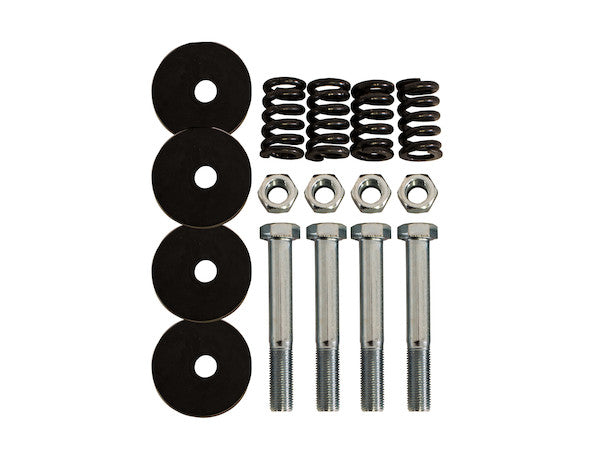
Buyers Products Replacement Spring Mount Kit for UR50A and UR50S Reservoirs replaces the springs and bolts needed to mount the tanks. Mounting brackets not included.
Specifications
| For Use With | UR50S |
|---|
Comprehensive Technical Overview: Spring Kit For Upright Steel Hydraulic Reservoirs UR50S And UR50A
This technical description provides an in-depth analysis of the Replacement Spring Mount Kit specifically designed for Buyers Products Upright Steel Hydraulic Reservoirs, models UR50S and UR50A. This kit is engineered to address the critical need for secure and stable mounting of these hydraulic reservoirs, ensuring optimal performance and longevity within demanding operational environments. It focuses on the technical specifications, material science, functional mechanics, installation considerations, and the broader implications of proper reservoir mounting in hydraulic systems.
Introduction to Hydraulic Reservoir Mounting Systems
Hydraulic reservoirs serve as integral components within any hydraulic circuit, storing the hydraulic fluid, dissipating heat, separating air and contaminants, and allowing for fluid volume changes due to system operation and temperature fluctuations. The stability and integrity of a hydraulic reservoir's mounting are paramount to the overall reliability and efficiency of the hydraulic system. Improper mounting can lead to a multitude of issues, including excessive vibration, premature component wear, fluid leakage, structural fatigue, and ultimately, system failure. Recognizing these critical factors, Buyers Products has developed a specialized Replacement Spring Mount Kit to maintain the engineered performance of their UR50S and UR50A upright steel hydraulic reservoirs.
Product Identification and Compatibility
The product, "Spring Kit For Upright Steel Hydraulic Reservoirs UR50S And UR50A," is a dedicated replacement kit. It is explicitly designed for compatibility with Buyers Products' UR50S and UR50A models. The 'UR' designation typically signifies 'Upright Reservoir,' while '50' likely refers to the nominal capacity in gallons, though specific volumetric capacity should always be confirmed against the original reservoir specifications. The 'S' and 'A' suffixes may denote variations in porting, construction, or ancillary features. Precise compatibility ensures that the spring and bolt dimensions, material properties, and load-bearing capacities are perfectly matched to the structural and dynamic requirements of these specific reservoir models. It is crucial to note that this kit comprises replacement springs and bolts only; the mounting brackets themselves are not included and are assumed to be existing components of the original installation or procured separately.
Technical Specifications of Components
Springs: Material Science and Engineering
The springs included in this kit are critical for accommodating the dynamic stresses inherent in mobile or heavy-duty hydraulic applications. These stresses arise from vehicle movement, equipment operation, and hydraulic system pressure fluctuations. The selection of spring material and design is paramount for durability and performance.
- Material Composition: Typically, springs designed for such applications are manufactured from high-tensile spring steel alloys. Common alloys include ASTM A228 (music wire), ASTM A227 (hard-drawn carbon steel), ASTM A229 (oil-tempered carbon steel), or various grades of chrome silicon or chrome vanadium steel for higher stress and fatigue resistance. The specific alloy chosen would depend on the anticipated load cycles, environmental conditions (e.g., temperature extremes, corrosive agents), and desired lifespan. These materials offer an excellent balance of strength, elasticity, and fatigue resistance.
-
Surface Treatment: To enhance corrosion resistance and improve fatigue life, springs are often subjected to surface treatments. These may include:
- Phosphate Coating: Provides a base for subsequent painting and offers a degree of corrosion protection.
- Electroplating (e.g., Zinc Plating): Offers sacrificial protection against rust. Care must be taken to mitigate hydrogen embrittlement, a potential issue with high-strength steels during plating.
- Powder Coating: Provides a durable, aesthetically pleasing, and highly protective layer against abrasion and corrosion.
- Shot Peening: A mechanical surface treatment that induces compressive residual stresses on the surface, significantly improving fatigue resistance and preventing crack initiation.
- Spring Design and Rate: The springs are likely helical compression springs, designed to provide a specific spring rate (force per unit deflection). The spring rate is critical for effectively isolating vibrations and absorbing shocks. A carefully chosen spring rate prevents the reservoir from experiencing excessive movement while still allowing for sufficient damping. The free length, solid length, wire diameter, mean coil diameter, and number of active coils are precisely engineered parameters that determine the spring's performance characteristics.
- Load Capacity and Deflection: Each spring is specified to handle a particular static load (weight of the reservoir, fluid, and brackets) and dynamic loads (inertial forces during operation). The design ensures that the springs operate within their elastic limit under all expected conditions, preventing permanent deformation or material fatigue.
Bolts: Fastening Integrity and Strength
The bolts supplied with the kit are crucial for securely attaching the reservoir to its mounting brackets through the springs. Their design and material properties are selected to withstand tensile, shear, and fatigue stresses.
- Material Grade: Fasteners for heavy-duty applications, particularly those subject to vibration and dynamic loads, are typically high-strength steel alloys. Common grades include SAE Grade 5 (equivalent to metric Class 8.8) or SAE Grade 8 (equivalent to metric Class 10.9). These grades offer high tensile strength, yield strength, and shear strength. Grade 8/10.9 bolts are particularly recommended for critical structural connections due to their superior resistance to fatigue and impact.
- Thread Specifications: The bolts will feature standard thread specifications (e.g., UNC coarse thread or UNF fine thread, or equivalent metric coarse/fine pitches) to ensure compatibility with corresponding nuts or threaded holes in the mounting structure. Precision in thread form, pitch diameter, and lead is essential for maximum clamping force and resistance to loosening.
-
Corrosion Protection: Similar to the springs, the bolts require robust corrosion protection. Common treatments include:
- Zinc Plating: A widely used, cost-effective method offering good corrosion resistance. Often chromate-finished for enhanced protection and appearance (e.g., yellow chromate).
- Hot-Dip Galvanizing: Provides a thicker, more durable zinc coating, ideal for highly corrosive environments, though it may affect thread fit and appearance.
- Mechanical Plating: A cold process that avoids hydrogen embrittlement risks associated with electroplating.
- Proprietary Coatings: Specialized coatings (e.g., zinc-flake coatings like Geomet or Dacromet) offer superior corrosion resistance and can be engineered for specific environmental challenges.
- Head Type and Drive: Common head types for these applications include hex head bolts (external wrenching) for strong clamping and ease of installation with standard tools.
- Tensile Strength and Shear Strength: The bolts are specified with minimum tensile and shear strengths to ensure they can withstand the forces exerted during operation without yielding or fracturing. The appropriate torque specification for these bolts is paramount for achieving the intended clamping force and preventing self-loosening.
Functional Mechanics of Spring Mounting
The integration of springs into the reservoir mounting system serves several critical engineering functions:
- Vibration Isolation: Hydraulic systems, particularly on mobile equipment, are inherently subject to significant vibration from engine operation, pump cavitation, hydraulic pulsations, and chassis movement. The springs act as mechanical filters, absorbing and dissipating these vibrations before they can transmit directly to the reservoir. This isolation protects the reservoir's welds, fittings, and internal components from fatigue damage, thereby extending its service life and reducing the likelihood of leaks.
- Shock Absorption: Sudden impacts, jolts, and uneven terrain can generate significant shock loads. The springs provide a degree of compliance, cushioning these shocks and preventing direct transmission of high-impact forces to the reservoir structure and the mounting frame. This helps to maintain structural integrity and prevent stress concentrations.
- Thermal Expansion and Contraction Accommodation: Hydraulic fluid volume changes with temperature, causing the reservoir to expand and contract. While the fluid level varies, the reservoir material itself (steel) also expands and contracts. Rigid mounting systems can induce stress in the reservoir material and mounting points due to differential thermal expansion between the reservoir and the chassis. Spring mounts introduce flexibility, allowing for minor relative movement and reducing thermally induced stresses.
- Load Distribution: Springs can help to distribute the static and dynamic loads more evenly across the mounting points, preventing localized stress concentrations that could lead to material fatigue or deformation of the reservoir shell or mounting brackets.
- Noise Reduction: By dampening vibrations, spring mounts also contribute to reducing structure-borne noise, improving the overall operational environment and complying with noise regulations.
Installation and Maintenance Considerations
The proper installation of this spring mount kit is critical for realizing its intended benefits. While mounting brackets are not included, their condition and compatibility with the new springs and bolts are crucial. Key considerations include:
- Torque Specifications: Adhering to manufacturer-recommended torque specifications for the bolts is paramount. Under-torquing can lead to loose connections, allowing for excessive movement and accelerated wear, potential bolt failure due to fatigue, and self-loosening. Over-torquing can stretch the bolts beyond their elastic limit, leading to reduced clamping force, potential bolt failure, and damage to the threads or mounting points. Use of a calibrated torque wrench is essential.
- Washer Usage: Proper washers (e.g., flat washers under the bolt head and nut to distribute load, lock washers or locking nuts for vibration resistance) should be used in conjunction with the bolts. Lock washers (e.g., split lock, external tooth) or prevailing torque nuts (e.g., nylon insert lock nuts, all-metal lock nuts) are recommended in high-vibration environments to prevent loosening.
- Inspection of Existing Brackets: Before installing the new spring kit, the existing mounting brackets must be thoroughly inspected for signs of wear, corrosion, cracks, or deformation. Damaged brackets can compromise the integrity of the entire mounting system, even with new springs and bolts. Any damaged brackets should be repaired or replaced.
- Alignment: Ensure proper alignment of the reservoir with the mounting points to prevent binding or uneven loading of the springs. Misalignment can induce lateral forces on the springs and bolts, leading to premature failure.
-
Preventative Maintenance: Regular inspection of the spring mounts (springs, bolts, and brackets) is essential as part of a comprehensive preventative maintenance schedule. Look for signs of:
- Corrosion or rust on springs and bolts.
- Cracks or deformation in springs.
- Loose bolts or nuts.
- Wear or damage to mounting brackets.
- Evidence of excessive movement or rubbing.
- Environmental Factors: Consider the operating environment. Exposure to road salt, chemicals, extreme temperatures, or abrasive materials can accelerate wear and corrosion. Selecting appropriate protective coatings and materials for replacement parts is essential.
Importance of Genuine Replacement Parts
Utilizing a genuine Buyers Products Replacement Spring Mount Kit ensures that all components meet the original equipment manufacturer's (OEM) stringent quality, material, and design specifications. Aftermarket or generic components, while sometimes cheaper, may not offer the same level of performance, durability, or precise fitment. This can lead to:
- Reduced vibration isolation efficiency.
- Premature fatigue and failure of springs or bolts.
- Increased wear on the reservoir and associated hydraulic components.
- Compromised safety and operational reliability.
Safety Implications
The secure mounting of a hydraulic reservoir is a critical safety consideration. A dislodged or improperly mounted reservoir, particularly one containing a significant volume of hydraulic fluid, presents several hazards:
- Projectile Hazard: In the event of a severe impact or sudden stop, a loose reservoir can become a dangerous projectile, endangering personnel and damaging other equipment.
- Fluid Spill: Damage to the reservoir or its fittings due to improper mounting can lead to a hydraulic fluid spill. Hydraulic fluid is typically under pressure, can be hot, and is environmentally harmful. Spills create slip hazards and can contaminate soil and water.
- System Malfunction: Compromised reservoir integrity can introduce air or contaminants into the hydraulic system, leading to pump cavitation, valve malfunctions, cylinder damage, and overall system failure, which can be catastrophic in operational machinery.
- Fire Hazard: Hydraulic fluid, especially when heated or atomized under pressure, can be a fire hazard if it comes into contact with hot surfaces or ignition sources.
Conclusion
The Buyers Products Replacement Spring Mount Kit for UR50A and UR50S Upright Steel Hydraulic Reservoirs is more than just a collection of springs and bolts; it is an engineered solution designed to maintain the critical integrity, performance, and safety of a hydraulic system. By providing optimal vibration isolation, shock absorption, and accommodation for thermal dynamics, this kit significantly contributes to the longevity of the hydraulic reservoir and the overall reliability of the equipment it serves. Understanding the technical specifications, material science, and installation best practices associated with this kit is essential for maintenance professionals and system designers alike to ensure uninterrupted and safe operation of hydraulic machinery. The investment in a genuine, high-quality replacement kit underscores a commitment to operational excellence and long-term system health.