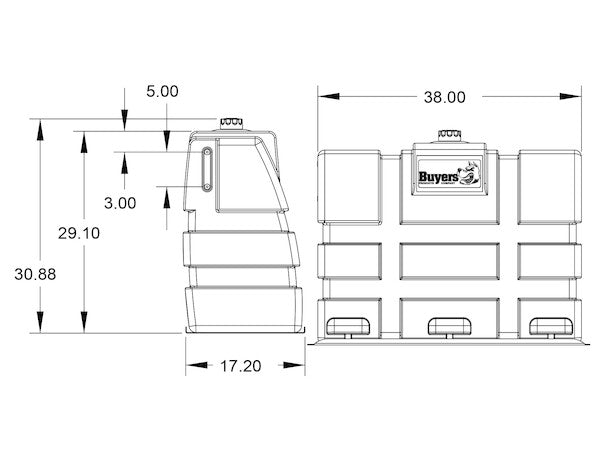
The large capacity, 55 gallon Upright Polymer Reservoir from Buyers Products is lightweight, rustproof, and virtually maintenance free. It's ideal for applications where weight is a factor. The reservoir is best for short run time hydraulic operations such as dump and roll-off applications. It features dual 2 in. NPT field serviceable ports, a 2 in. by 1-1/4 in. screw-in diffuser, and a chain-mounted 40 micron filler breather cap. Constructed of reinforced high-density polypropylene, the reservoir features a heavy duty strapless hold-down system.
Specifications
| Additional Port Size | 2 NPT |
|---|---|
| Capacity | 50 |
| Color | Black |
| Depth | 16.25 |
| Filter Head Material_1 | Aluminum |
| Hardware and Brackets Included (y/n) | Yes |
| Height | 29 |
| Included Valve (y/n) | No |
| Integral Brackets (y/n) | - |
| Integral Level Gauge (y/n) | Yes |
| Material | Polyethylene |
| Material Gauge | - |
| Mount Position | Upright |
| Mount Style | Upright |
| Oil Level Gauge (y/n) | Yes |
| Reservoir Shape | Rectangle |
| Style 1 Port Diameter | 2 |
| Suction Port Size | 2 NPT |
| Temperature Gauge (y/n) | Yes |
| Usable Capacity | 55 |
| Width | 38.00 |
Advanced Technical Overview: The 50/55 Gallon Upright Polymer Hydraulic Reservoir
In contemporary mobile and industrial hydraulic systems, the hydraulic reservoir serves as a critical component, fundamental to the overall efficiency, longevity, and operational integrity of the entire circuit. The Buyers Products 50/55 Gallon Upright Polymer Hydraulic Reservoir represents a significant advancement in reservoir design, engineered to meet the demanding requirements of various short-cycle hydraulic applications while offering unparalleled benefits in terms of weight reduction, corrosion resistance, and simplified maintenance. This detailed technical exposition will delve into the specific features, material science, and operational advantages that position this polymer reservoir as a superior choice for discerning hydraulic system designers and operators.
Material Science and Structural Integrity: Reinforced High-Density Polypropylene
The core innovation of this reservoir lies in its construction from reinforced high-density polypropylene (HDPE). Unlike traditional steel or aluminum reservoirs, HDPE offers a unique confluence of properties that make it exceptionally well-suited for hydraulic fluid containment. HDPE is a thermoplastic polymer produced from the monomer ethylene. Its high strength-to-density ratio, coupled with excellent chemical resistance, makes it a robust material for demanding environments. The "reinforced" aspect of this particular HDPE formulation further enhances its mechanical properties, including tensile strength, impact resistance, and rigidity, ensuring the reservoir maintains structural integrity under dynamic operating conditions and varying fluid pressures. This reinforcement can involve the incorporation of specific fillers or advanced molding techniques that orient polymer chains for improved performance.
The inherent properties of HDPE translate directly into several key operational advantages:
- Superior Corrosion Resistance: HDPE is inherently inert to a wide range of chemicals, including hydraulic fluids, water, and many common acids and bases. This eliminates the risk of internal corrosion and rust formation, which are pervasive issues with metallic reservoirs. Rust particles can contaminate the hydraulic fluid, leading to premature wear of pumps, valves, and actuators, significantly shortening the lifespan of expensive hydraulic components. The polymer construction completely mitigates this threat, ensuring cleaner fluid and extended system life.
- Significant Weight Reduction: With a density substantially lower than steel or aluminum, HDPE reservoirs contribute to a considerable reduction in overall vehicle or equipment weight. For mobile applications such as dump trucks, roll-off vehicles, and utility equipment, lighter components directly translate to increased payload capacity, improved fuel efficiency, and reduced operational costs. This advantage is particularly pertinent in industries where gross vehicle weight limits are strictly enforced.
- Enhanced Durability and Impact Resistance: While seemingly counterintuitive, certain polymer formulations can exhibit superior impact absorption compared to rigid metals, which might dent or deform. Reinforced HDPE is designed to withstand typical operational impacts and vibrations encountered in mobile applications without fracturing or developing leaks, providing long-term reliability in harsh conditions.
- Thermal Stability and Insulation: HDPE maintains its structural properties across a broad operational temperature range. Furthermore, its inherent insulating properties can help manage heat transfer, potentially offering slight advantages in maintaining optimal fluid temperatures in certain environments compared to highly conductive metallic tanks.
- Maintenance-Free Operation: The rustproof nature of the polymer eliminates the need for internal coatings, painting, or rust prevention treatments. This significantly reduces scheduled maintenance tasks and associated labor and material costs over the lifetime of the equipment.
Optimized Capacity and Application Suitability: 50/55 Gallon for Short-Run Cycles
The reservoir's generous 50/55 gallon usable capacity is specifically engineered for "short run time hydraulic operations," which includes a broad spectrum of applications such as dump body actuation, roll-off container systems, plows, spreaders, and other intermittent heavy-duty tasks. In these applications, the hydraulic pump operates for relatively brief periods, demanding a substantial volume of fluid to execute the required work cycle effectively and efficiently. The 50/55 gallon capacity ensures:
- Adequate Fluid Volume: Provides sufficient hydraulic fluid for the system's operational demands, preventing cavitation at the pump inlet during high flow rate requirements and ensuring the entire circuit remains properly primed.
- Effective Heat Dissipation: While primarily designed for short cycles, the large surface area and fluid volume of a 50/55 gallon reservoir contribute to the passive dissipation of heat generated during hydraulic operation. For intermittent tasks, this capacity is generally sufficient to prevent fluid overheating without requiring auxiliary cooling systems. Heat is a primary degradant of hydraulic fluid and seals; maintaining optimal temperatures prolongs fluid life and component integrity.
- Contaminant Settling: A larger fluid volume allows for a longer residence time for the hydraulic fluid within the reservoir. This extended period facilitates the settling of heavier particulate contaminants to the bottom of the tank, where they are less likely to be recirculated into the system. This passive filtration mechanism contributes to overall fluid cleanliness, complementing the active filtration provided by the breather cap and any in-line filters.
- De-aeration: Similar to contaminant settling, longer residence times and a larger fluid surface area aid in the natural release of entrained air from the hydraulic fluid. Air bubbles (aeration) in hydraulic fluid can lead to several detrimental effects, including reduced bulk modulus (making the fluid compressible), cavitation, increased noise, erratic component operation, and accelerated fluid degradation due to oxidation. The generous capacity supports effective de-aeration, crucial for system performance and longevity.
Advanced Fluid Management and Connectivity
The design incorporates several critical features for efficient fluid management and robust system integration:
Dual 2 in. NPT Field Serviceable Ports
The inclusion of dual 2-inch National Pipe Taper (NPT) field serviceable ports offers significant flexibility and ease of maintenance. NPT fittings are a widely recognized standard, ensuring compatibility with a vast array of hydraulic hose and pipe connections. The 2-inch diameter is critical for accommodating the high flow rates typically associated with 50/55 gallon systems, particularly for suction lines where minimizing pressure drop is paramount to prevent pump cavitation. "Field serviceable" implies that these ports are designed for easy replacement or modification in the field, reducing downtime and simplifying maintenance operations should a port become damaged or require a different configuration.
2 in. by 1-1/4 in. Screw-in Diffuser
A often-underestimated component, the 2-inch by 1-1/4-inch screw-in diffuser plays a vital role in optimizing fluid dynamics within the reservoir. Mounted on the return line, the diffuser's primary function is to introduce returned hydraulic fluid into the reservoir below the fluid level, dispersing it evenly and gently. The specific dimensions (2-inch entry, 1-1/4-inch diffusion) are engineered to:
- Reduce Turbulence: High-velocity fluid returning directly to the reservoir can create significant turbulence, leading to aeration, foaming, and re-suspension of settled contaminants. The diffuser minimizes this turbulence, promoting laminar flow and quiescent conditions within the bulk fluid.
- Prevent Foaming: By introducing fluid below the surface and at a reduced velocity, the diffuser significantly mitigates the formation of foam, which can lead to pump cavitation, spongy system response, and reduced heat transfer efficiency.
- Aid De-aeration: Gentle, submerged fluid introduction allows entrained air to separate more effectively from the fluid and rise to the surface, where it can be expelled via the breather cap.
- Promote Contaminant Settling: By reducing turbulence, the diffuser helps maintain quiescent zones within the reservoir, allowing heavier particulate contaminants to settle more effectively before they can be drawn back into the system.
The "screw-in" design ensures secure installation and allows for straightforward servicing or replacement, contributing to the reservoir's overall maintainability.
Chain-Mounted 40 Micron Filler Breather Cap
The quality of the air entering a hydraulic reservoir is as crucial as the quality of the fluid itself. The chain-mounted 40-micron filler breather cap serves multiple critical functions:
- Air Exchange: As the fluid level fluctuates during system operation (e.g., cylinder extension/retraction, accumulator charging), air must enter and exit the reservoir. The breather cap facilitates this exchange, preventing vacuum formation or over-pressurization.
- Particulate Filtration: The 40-micron filter element ensures that airborne particulate matter larger than 40 microns is prevented from entering the hydraulic system. Airborne dust and debris are significant sources of contamination, leading to abrasive wear of precision components. While 40 microns may seem large, it effectively blocks a substantial amount of common environmental dust and debris, complementing in-line filtration.
- Moisture Protection: Some breather caps also incorporate desiccant materials to absorb atmospheric moisture. While not explicitly stated for this model, the design inherently reduces direct ingress of water compared to an open vent.
- Filler Port: The cap doubles as a convenient port for adding new hydraulic fluid to the system.
- Chain-Mounted Design: The chain ensures that the cap remains tethered to the reservoir during filling or maintenance, preventing loss, misplacement, or accidental dropping into the fluid, enhancing workplace safety and efficiency.
Integrated Monitoring and Secure Mounting
The reservoir incorporates essential monitoring features and a robust mounting system:
Integral Level Gauge and Oil Level Gauge
These gauges provide immediate and accurate visual indication of the hydraulic fluid level within the reservoir. Maintaining the correct fluid level is paramount for optimal system performance. Too low a level can lead to pump cavitation and overheating, while an excessively high level can cause foaming and potential overflow. The integral design ensures these critical monitoring tools are always available and protected, contributing to proactive maintenance and preventing costly system damage.
Temperature Gauge
Monitoring hydraulic fluid temperature is critical. Elevated temperatures accelerate fluid degradation (oxidation, viscosity breakdown), reduce seal life, and can lead to component failure. The integrated temperature gauge allows operators and maintenance personnel to quickly assess the fluid's thermal state, enabling timely intervention if overheating occurs. This is particularly valuable for diagnosing issues such as insufficient cooling, excessive internal leakage, or improper fluid viscosity.
Heavy Duty Strapless Hold-Down System
The innovative "heavy duty strapless hold-down system" offers a secure and efficient method for mounting the upright reservoir. Traditional metallic reservoirs often rely on external strap bands or cumbersome bracketry. This integrated system likely utilizes molded-in mounting points or a robust, self-securing base design that eliminates the need for external straps, reducing installation time and complexity. The "heavy duty" aspect ensures the reservoir remains firmly anchored, resisting vibrations and dynamic forces encountered during vehicle operation, preventing movement that could damage hoses or plumbing. This strapless design also simplifies maintenance access and improves the aesthetic integration into the equipment.
Upright Configuration Advantages
The upright (vertical) orientation of the reservoir offers several design and operational benefits:
- Reduced Footprint: Vertical reservoirs occupy less horizontal space, making them ideal for applications with limited mounting area on a chassis or within an equipment enclosure. This is a critical consideration in modern mobile equipment design where space optimization is paramount.
- Enhanced De-aeration and Contaminant Settling: The vertical column of fluid in an upright reservoir provides an optimal path for air bubbles to rise to the surface and for heavier particulates to settle to the bottom. The greater fluid depth, relative to horizontal tanks of similar volume, aids these natural processes, contributing to cleaner, air-free fluid.
- Improved Suction Head: In certain mounting scenarios, an upright reservoir can facilitate a better suction head for the hydraulic pump, especially if the pump is mounted lower than the reservoir bottom. This reduces the risk of pump cavitation by ensuring a positive pressure at the pump inlet.
Conclusion: The Engineering Excellence of Polymer Hydraulic Reservoirs
The 50/55 Gallon Upright Polymer Hydraulic Reservoir from Buyers Products stands as a testament to advanced engineering in hydraulic system components. Its construction from reinforced high-density polypropylene delivers a compelling array of advantages over conventional metallic reservoirs, including significant weight savings, absolute corrosion resistance, and reduced maintenance demands. The carefully designed fluid management features—such as dual NPT ports, a sophisticated screw-in diffuser, and a protective 40-micron breather cap—ensure optimal fluid conditioning, minimizing aeration and contamination while maximizing system efficiency and longevity. Integrated level and temperature gauges provide crucial real-time operational data for preventative maintenance. Combined with its robust, strapless hold-down system and space-efficient upright configuration, this reservoir offers a highly reliable, durable, and cost-effective solution for a wide range of short-cycle hydraulic applications, from municipal vehicles to heavy construction equipment. Its comprehensive design contributes directly to enhanced system performance, extended component life, and a lower total cost of ownership, making it an indispensable asset for modern hydraulic power units.