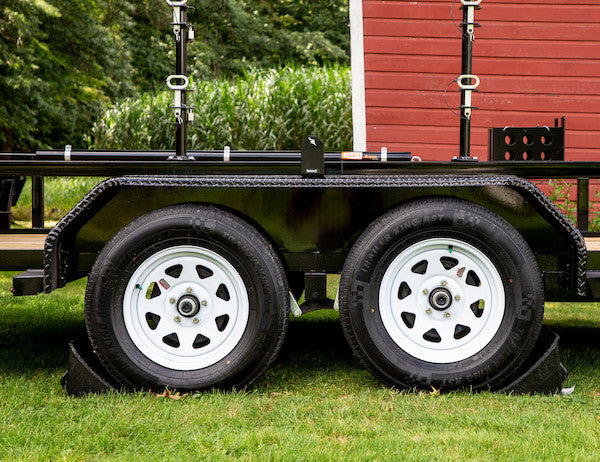
Buyers Products Heavy Duty Rubber Wheel Chock with Molded Handhold fits snugly under wheels to keep vehicles and trailers in place while they are serviced or parked. The chocks are ideal for shipping dock use. Their reinforced rubber construction resists oil, rust, salt, and sun to provide years of durable use. The chock is built to OSHA standards. Designed to handle very heavy loads, the wheel chock includes a molded handhold and chain eye for easy transport. Use the chain eye to store or link together additional wheel chocks.
Specifications
| Color | Black |
|---|---|
| Finish | Plain |
| Height (in.) | 8.00 |
| Material | Rubber |
| Thickness (in.) | 7.00 |
| Width (in.) | 10.00 |
Advanced Technical Overview: The Buyers Products Heavy Duty Rubber Wheel Chock – Engineered for Uncompromising Safety and Durability
The Buyers Products Heavy Duty Rubber Wheel Chock represents a critical component in comprehensive workplace safety protocols, meticulously engineered to prevent unintended vehicle movement in demanding industrial and commercial environments. This product is not merely an accessory but a fundamental safety device designed to meet and exceed the rigorous operational requirements of heavy-duty applications. Its robust construction, precise dimensions of approximately 7x10.25x8.13 inches, and integrated ergonomic features underscore its utility in securing a wide array of vehicles and trailers during critical operations such as loading, unloading, maintenance, or extended parking. The core philosophy behind its design is to deliver steadfast immobilization, thereby mitigating the significant risks associated with uncontrolled vehicle rollaways and enhancing overall operational safety and efficiency.
I. The Imperative of Vehicle Immobilization: Adherence to OSHA and Industry Standards
In any industrial or commercial setting involving vehicles or heavy equipment, the prevention of accidental movement is paramount. The Occupational Safety and Health Administration (OSHA) mandates stringent safety guidelines to protect workers from struck-by hazards, which include those posed by uncontrolled vehicle movement. Specifically, OSHA's general duty clause (Section 5(a)(1) of the OSH Act) requires employers to provide a workplace free from recognized hazards likely to cause death or serious physical harm. Furthermore, specific regulations, such as those pertaining to powered industrial trucks (29 CFR 1910.178) and commercial motor vehicle parking brakes (49 CFR 393.41), implicitly underscore the necessity of reliable vehicle immobilization methods. The Buyers Products Heavy Duty Rubber Wheel Chock is purpose-built to align with these regulatory imperatives, offering a compliant and effective solution for securing vehicles. Its design is a direct response to the need for a dependable physical barrier that resists the forces exerted by stationary vehicles on various terrains, ensuring that compliance is not just met but actively promoted through superior engineering.
Beyond regulatory compliance, the use of appropriate wheel chocks is a cornerstone of proactive risk management. Accidents involving runaway vehicles can result in catastrophic injuries, fatalities, significant property damage, and substantial financial liabilities for businesses. Implementing robust chocking procedures, supported by equipment like this heavy-duty rubber chock, contributes directly to a safer working environment, reduced accident rates, and enhanced operational integrity. The inherent limitations of parking brakes, especially under certain load conditions, on inclines, or during routine maintenance, necessitate a secondary, fail-safe mechanism. This wheel chock serves precisely that function, providing an additional layer of security that instills confidence in personnel operating near immobilized vehicles. Its construction and performance characteristics are engineered to withstand the dynamic and static forces encountered in real-world heavy-duty scenarios, ensuring reliable immobilization when it matters most.
II. Engineering for Maximum Stability: Dimensional Analysis and Geometric Optimization
The effectiveness of a wheel chock is fundamentally determined by its geometric design and how it interfaces with a vehicle's tire and the ground surface. The Buyers Products Heavy Duty Rubber Wheel Chock, with its specified dimensions of approximately 7 inches in thickness, 10.25 inches in width (or 10 inches in the specification table), and 8.13 inches in height (or 8 inches in the specification table), is meticulously engineered for optimal mechanical advantage. The substantial thickness (7 inches) provides a broad base for stability, distributing the load across a larger surface area, which is crucial for preventing the chock from sinking into softer ground or becoming dislodged under significant pressure. This width also ensures a robust contact patch with the tire, enhancing friction and minimizing the potential for slippage.
The height of the chock (approximately 8 inches) is critical in establishing the effective wedge angle against the tire's curvature. A carefully calculated angle ensures that the forces exerted by the vehicle's weight are efficiently translated into downward pressure, effectively "pinching" the tire against the ground and the chock. This geometric interaction creates a self-locking mechanism where any tendency for the vehicle to roll further embeds the tire into the chock, increasing the resistance to movement. The larger dimensions of this heavy-duty model, compared to standard chocks, allow it to accommodate larger tire diameters and heavier vehicle loads more effectively, providing superior resistance against rolling forces. This design philosophy is particularly vital for tractor-trailers, heavy construction equipment, and large commercial vehicles where the kinetic energy of a rolling mass can be immense.
Furthermore, the specific contours of the chock are designed to maximize surface contact with various tire profiles while minimizing deformation of the chock itself. The robust profile ensures that the chock maintains its structural integrity and wedge shape even under prolonged compression from extremely heavy loads. This careful balance of dimensions and form factor is what enables the chock to securely fit "snugly under wheels," providing consistent and reliable immobilization irrespective of minor variations in tire size or ground irregularities. The precision in these dimensions is not arbitrary; it is the result of engineering principles applied to real-world operational challenges, ensuring that the chock performs reliably across diverse industrial applications, from asphalt surfaces to gravel lots and concrete loading docks.
III. Superior Material Science: The Benefits of Reinforced Rubber Construction
The selection of reinforced rubber as the primary material for this wheel chock is a deliberate engineering decision based on its superior performance characteristics for this application. Unlike chocks made from wood, plastic, or even certain metallic alloys, heavy-duty rubber offers a unique combination of properties that are essential for reliable vehicle immobilization. The "reinforced rubber construction" implies a compound formulated for exceptional strength, resilience, and resistance to environmental degradation. Key material properties include:
- High Coefficient of Friction: Rubber naturally possesses a high coefficient of friction against various ground surfaces (asphalt, concrete, gravel) and tire compounds. This characteristic is paramount for preventing slippage of the chock itself, ensuring that once placed, it remains firmly in position, creating a secure barrier against tire movement.
- Durometer Hardness and Elasticity: The specific durometer (hardness) of the rubber is optimized to provide sufficient rigidity to resist crushing under heavy loads while retaining enough elasticity to conform slightly to the tire's shape, maximizing contact and grip. This balance prevents the chock from deforming excessively, which could compromise its wedge action, yet allows it to absorb impacts without cracking or shattering, unlike rigid plastics.
- Chemical Resistance: The description highlights resistance to "oil, rust, and salt." This is crucial in industrial environments where exposure to hydraulic fluids, lubricants, road salts, and other corrosive agents is common. The engineered rubber compound resists degradation from these chemicals, preventing material breakdown, softening, or embrittlement that could compromise the chock's structural integrity and effectiveness over time.
- UV and Ozone Resistance: Exposure to "sun" implies resistance to ultraviolet (UV) radiation and ozone, which are significant contributors to the aging and degradation of many rubber products. This advanced rubber formulation ensures that the chock maintains its physical properties, color, and structural integrity even with prolonged outdoor exposure, preventing premature cracking, hardening, or weakening.
- Temperature Stability: Heavy-duty rubber compounds are formulated to perform reliably across a broad range of temperatures, from extreme cold to intense heat. This ensures that the chock remains functional and effective whether used in freezing winter conditions or scorching summer environments, preventing brittleness or excessive softening.
- Impact and Abrasion Resistance: The reinforced nature of the rubber provides exceptional resistance to impacts, cuts, and abrasions, which are common stresses in heavy-duty operational settings. This extends the product's service life, reducing the frequency of replacement and contributing to a lower total cost of ownership.
- Non-Marring Properties: Unlike metal chocks, rubber chocks are inherently non-marring, preventing damage to sensitive flooring surfaces in garages, maintenance bays, or warehouses, protecting infrastructure investments.
The combination of these material properties ensures that the Buyers Products Heavy Duty Rubber Wheel Chock delivers "years of durable use," making it a reliable and long-lasting safety investment that withstands the most challenging operational conditions.
IV. Ergonomics and Operational Efficiency: Molded-In Handle and Chain Eye
Beyond its primary function of vehicle immobilization, the design of the Buyers Products Heavy Duty Rubber Wheel Chock integrates critical ergonomic and practical features that significantly enhance its usability and operational efficiency. The "molded handhold" and "chain eye" are not mere conveniences but thoughtfully engineered elements that contribute to safety, ease of deployment, and asset management.
The "molded handhold" is a distinct feature designed with the user's safety and comfort in mind. Its integrated nature means it is an intrinsic part of the chock's structure, eliminating weak points that might be present in bolted-on or separate handles. The ergonomic contour allows for a secure and comfortable grip, facilitating easy and safe placement and retrieval of the chock. This design minimizes the risk of finger pinching or crushing, a common hazard when handling heavy objects. Furthermore, a proper handhold reduces strain on workers, especially when deploying multiple chocks or operating in confined spaces, thus improving overall workflow and reducing the potential for musculoskeletal injuries. The ability to quickly and securely handle the chock is paramount in fast-paced environments like shipping docks, where rapid and precise placement can impact throughput and safety alike.
The "molded-in chain eye" is another critical feature that enhances both safety and operational logistics. This robust, integrated eyelet provides a secure point for attaching a chain, rope, or cable. Its primary uses are multifaceted:
- Secure Transport: The chain eye allows for the chock to be pulled or dragged over short distances, reducing the need for direct lifting and further mitigating ergonomic risks. This is especially useful for heavy chocks or when navigating uneven terrain.
- Loss Prevention: By chaining chocks to a vehicle, a dock, or a designated storage area, the risk of misplacement, theft, or accidental loss is significantly reduced. This ensures that chocks are readily available when needed, preventing operational delays due to missing equipment.
- Linking Multiple Chocks: In scenarios requiring multiple chocks for large vehicles or specific configurations, the chain eye enables linking them together. This can simplify storage and deployment, ensuring that a pair of chocks remains together.
- Storage and Organization: Utilizing the chain eye, chocks can be hung on hooks or racks, promoting tidy storage and easy access, which is a key aspect of good housekeeping in industrial settings. Organized storage also protects the chocks from unnecessary wear and tear.
These integrated features collectively transform the wheel chock from a simple wedge into a highly functional and manageable safety device, streamlining operations and reinforcing safety protocols.
V. Versatility Across Industries: Key Application Scenarios
The robust design and heavy-duty capabilities of this rubber wheel chock render it indispensable across a diverse spectrum of industries and operational settings. While "shipping dock use" and "servicing or parking vehicles" are highlighted, its utility extends far beyond these primary examples:
- Logistics and Transportation: Essential for securing tractor-trailers, box trucks, and flatbeds during loading and unloading operations at warehouses, distribution centers, and freight terminals. Prevents trailer creep, especially when forklifts are operating inside the trailer.
- Construction and Mining: Critical for immobilizing dump trucks, excavators, loaders, and other heavy machinery on job sites, particularly on uneven terrain or inclines, during maintenance, refueling, or operator breaks.
- Fleet Maintenance and Repair: A mandatory safety device in vehicle service bays, repair shops, and mobile repair units to prevent accidental vehicle movement when vehicles are lifted, jacked, or undergoing repairs, safeguarding mechanics and technicians.
- Emergency Services: Utilized by fire departments, ambulance services, and rescue teams to stabilize emergency vehicles or other vehicles involved in incidents, ensuring a secure work environment for first responders.
- Agriculture: Secures large agricultural machinery such as tractors, combines, and trailers during field maintenance, storage, or when parked on uneven farm terrain.
- Marine and Aviation: While primarily for ground vehicles, chocks are used to secure ground support equipment at airports and heavy trailers used in marine transport for boats and equipment.
- Manufacturing and Industrial Plants: Employed to secure industrial carts, specialized transport vehicles, and material handling equipment within large manufacturing facilities, ensuring safety during various production stages.
- Recreational Vehicles (RVs) and Commercial Coaches: Provides an additional layer of safety when parking large RVs or commercial buses, especially on sloped driveways or campgrounds, complementing parking brakes.
The inherent adaptability of this heavy-duty wheel chock makes it a versatile safety tool, providing peace of mind and accident prevention in virtually any scenario where large, heavy vehicles need to be reliably immobilized.
VI. Durability and Longevity: A Long-Term Investment
Investing in the Buyers Products Heavy Duty Rubber Wheel Chock is a commitment to long-term safety and operational efficiency, driven by the product's exceptional durability and longevity. The "reinforced rubber construction" is not merely resistant to immediate damage but is designed for sustained performance under continuous use in challenging environments. Unlike less robust materials, this chock is engineered to withstand:
- Repeated Compression: It resists permanent deformation even after enduring the static weight and dynamic forces of heavy vehicles over extended periods. The material's elastic memory allows it to return to its original shape, maintaining its effective wedge profile.
- Impact and Abrasion: The heavy-duty rubber formulation absorbs impacts from incidental vehicle contact or rough handling without cracking, chipping, or shattering, which is a common failure point for plastic or composite chocks. Its abrasion resistance also ensures that the contact surfaces maintain their integrity, preserving the high-friction grip over time.
- Environmental Stress: As previously detailed, its resistance to oil, rust, salt, and UV radiation significantly extends its operational life in outdoor and corrosive environments. This comprehensive protection against environmental stressors means the chock will not degrade prematurely, avoiding the need for frequent replacements.
The extended service life translates directly into a lower total cost of ownership. While the initial investment might be higher than for lighter-duty or less durable alternatives, the reduced frequency of replacement, combined with the avoidance of potential accident costs, makes it a highly economical choice in the long run. Businesses can rely on these chocks to perform consistently, year after year, contributing to an uninterrupted safety culture and predictable operational expenses. This durability ensures that safety standards are consistently met without compromise, establishing the Buyers Products Heavy Duty Rubber Wheel Chock as a resilient and reliable asset in any safety equipment inventory.
VII. Integrating into Comprehensive Safety Programs and Environmental Considerations
The effective deployment of the Buyers Products Heavy Duty Rubber Wheel Chock extends beyond its physical attributes to its integration within a broader safety management system. For optimal safety, organizations should implement clear procedures for chock usage, including:
- Training: Personnel involved in vehicle operations, loading/unloading, or maintenance must be thoroughly trained on the proper placement and removal of wheel chocks, understanding the forces involved, and recognizing when chocks are required.
- Inspection Protocols: Regular visual inspections of chocks are crucial to identify any signs of wear, damage, or degradation that could compromise their effectiveness. Damaged chocks should be immediately removed from service.
- Designated Storage: Utilizing the integrated chain eye, chocks should be stored in easily accessible, designated locations, ensuring they are not misplaced and are protected from unnecessary abuse.
- Paired Use: In many scenarios, particularly with larger vehicles or inclines, using chocks in pairs (on both sides of one wheel or on wheels on opposing sides of the vehicle) is recommended to maximize stability and redundancy.
From an environmental perspective, the use of durable, long-lasting products like this heavy-duty rubber chock contributes to sustainability by reducing waste. Its extended lifespan means fewer chocks are manufactured, transported, and ultimately discarded. While specific details on recycled content are not provided, the inherent durability of reinforced rubber, engineered for years of service, aligns with principles of resource efficiency and waste reduction. Furthermore, its reliable performance prevents accidents that could lead to environmental spills or damages, indirectly contributing to environmental protection.
Conclusion
The Buyers Products Heavy Duty Rubber Wheel Chock with its molded-in handle and chain eye, measuring approximately 7x10.25x8.13 inches, stands as a testament to intelligent engineering in the realm of industrial safety equipment. It is far more than a simple wedge; it is a meticulously designed safety solution, crafted from reinforced rubber to resist the harshest elements—oil, rust, salt, and sun—while consistently delivering dependable vehicle immobilization. Its adherence to OSHA standards underscores its role as a fundamental tool for preventing rollaway incidents, safeguarding personnel, and protecting valuable assets. The ergonomic molded handhold and practical chain eye elevate its utility, simplifying deployment, enhancing transport, and streamlining storage and accountability. From the high-stakes environment of shipping docks to demanding construction sites and meticulous maintenance bays, this heavy-duty wheel chock offers unparalleled stability, enduring durability, and unwavering compliance. Investing in this product is an investment in uncompromising safety, operational efficiency, and long-term reliability, establishing it as an indispensable component of any professional safety regimen. Its robust construction and thoughtful features ensure that vehicles and trailers remain securely in place, providing the confidence necessary for continuous, safe operations in any heavy-duty application.