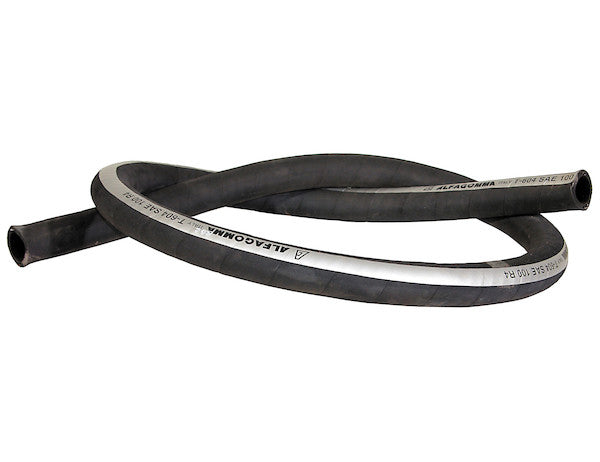
The Suction Hose from Buyers Products is built strong and internally reinforced for long-lasting performance. The SAE 100R4 hose has an internal wire wrap that prevents it from collapsing. It's available for either suction or return line functions, in a range of lengths. It should not be used in pressure applications.
Specifications
| Burst Pressure | 1000 |
|---|---|
| Fitting Side 1 | - |
| Fitting Side 2 | - |
| Hose Application | Suction |
| Hose Construction | Rubber/ reinforced |
| Inner Diameter | 1.00 |
| Length (in.) | 72 |
| Swivel Side 1 | - |
| Swivel Side 2 | - |
| Working Pressure (PSI) | 250 |
In the intricate world of hydraulic and fluid transfer systems, the selection of appropriate components is paramount for ensuring operational efficiency, safety, and longevity. The 1 Inch I.D. Suction Hose, 6 Foot long, from Buyers Products, represents a critical component engineered specifically for demanding suction and low-pressure return line applications. This technical exposition delves into the engineering principles, material science, performance specifications, and application suitability of this specialized hose, highlighting its adherence to the SAE 100R4 standard and its inherent design advantages.
The Foundational Role of Suction Hoses in Fluid Dynamics
Fluid power systems rely on a continuous and unobstructed flow of hydraulic fluid to transmit power. While high-pressure hoses typically capture much of the attention due to their visibly arduous tasks, suction and return lines are equally vital. A suction hose, such as this 1-inch I.D. variant, operates under negative pressure – a vacuum condition – as it draws fluid from a reservoir or tank towards a pump inlet. The fundamental challenge in this application is preventing the hose from collapsing under the external atmospheric pressure, a phenomenon that would severely restrict or halt fluid flow, potentially damaging the pump through cavitation or starvation.
Conversely, return lines manage the flow of fluid back to the reservoir, typically at very low pressures, but still requiring robust construction to withstand internal turbulence and the general rigors of industrial environments. The design of the Buyers Products 1 Inch I.D. Suction Hose meticulously addresses these specific operational demands, ensuring reliable performance across its intended service life.
Adherence to SAE 100R4 Standard: A Benchmark of Quality and Performance
The designation "SAE 100R4" is a critical indicator of this hose's engineering and performance characteristics. The Society of Automotive Engineers (SAE) J517 standard, specifically section 100R4, defines the requirements for wire-reinforced, rubber-covered hydraulic hoses suitable for suction and return line applications. This standard is not merely a guideline; it is a stringent set of specifications that dictate material composition, dimensional tolerances, construction methodology, and performance criteria. By meeting the SAE 100R4 standard, the Buyers Products suction hose assures users of a product that adheres to industry-recognized benchmarks for safety, reliability, and durability in non-pressure fluid transfer. The core requirements of SAE 100R4 emphasize:
- Collapse Resistance: The most critical aspect, achieved through robust internal reinforcement, specifically a wire helix.
- Flexibility: Despite the reinforcement, the hose must maintain a degree of flexibility for ease of routing and installation within complex machinery.
- Fluid Compatibility: The inner tube material must be compatible with a wide range of hydraulic fluids, oils, and other industrial liquids without degradation.
- Temperature Resistance: Ability to operate effectively across a specified temperature range, crucial for diverse environmental and operational conditions.
- Abrasion and Weather Resistance: The outer cover must protect the internal layers from external damage, environmental exposure, and ozone.
Engineering for Durability: The Internal Wire Wrap and Multi-Layer Construction
The hallmark of the Buyers Products 1 Inch I.D. Suction Hose is its internally reinforced construction. The most prominent feature, as highlighted, is the internal wire wrap. This continuous helical wire, typically made of high-tensile steel, is strategically embedded within the hose structure. Its primary function is to act as a skeletal framework, providing structural rigidity that counteracts the inward forces exerted by atmospheric pressure when a vacuum is created during fluid suction. Without this wire reinforcement, a conventional rubber hose would flatten and collapse, impeding flow and potentially leading to pump damage due to cavitation.
Beyond the wire helix, the hose's construction is a sophisticated multi-layer composite designed for optimal performance:
- Inner Tube: The innermost layer is crafted from a high-quality synthetic rubber compound. This material is chosen for its excellent compatibility with a broad spectrum of hydraulic fluids, including petroleum-based oils, water-glycol mixtures, and certain synthetic fluids. Its smooth bore minimizes flow restriction and turbulence, ensuring efficient fluid transfer. Furthermore, the synthetic rubber offers superior resistance to chemical degradation, swelling, and thermal aging, which are common challenges in hydraulic systems.
- Reinforcement Layers: Surrounding the inner tube and integrating the internal wire helix are one or more layers of textile braid. These textile plies, often composed of high-strength synthetic fibers, provide additional structural integrity, preventing expansion under moderate internal pressures (as might occur in return lines) and contributing to the hose's overall burst strength. The synergy between the textile braids and the helical wire creates a composite structure that is both strong and flexible, resisting both collapse and minor pressure surges.
- Outer Cover: The outermost layer is a robust, weather-resistant synthetic rubber cover. This cover serves as the primary defense against external environmental factors and mechanical damage. It is formulated to resist abrasion, ozone exposure, UV radiation, and incidental contact with oils and chemicals. This protective layer ensures the internal components, particularly the reinforcement, remain intact and functional over extended periods, even in harsh operating conditions.
This meticulously engineered layering guarantees the "built strong and internally reinforced" claim, delivering a product designed for long-lasting, reliable performance.
Performance Specifications: Decoding Working and Burst Pressures
The provided specifications for Working Pressure (250 PSI) and Burst Pressure (1000 PSI) are crucial metrics that define the operational limits and safety characteristics of this suction hose. It is imperative to understand their significance, especially in the context of a hose explicitly designated "not to be used in pressure applications."
- Working Pressure (250 PSI): This is the maximum continuous pressure the hose is designed to safely withstand during normal operation. For a suction hose, while its primary function involves negative pressure, return lines can experience transient positive pressures, albeit typically low. The 250 PSI working pressure ensures the hose can adequately handle these minor pressure fluctuations and the internal pressure generated by fluid returning to the reservoir. It also provides a margin of safety against unexpected pressure spikes in low-pressure systems.
- Burst Pressure (1000 PSI): This value represents the theoretical pressure at which the hose is expected to fail catastrophically under static conditions. The ratio of burst pressure to working pressure provides a safety factor, which for this hose is 1000 PSI / 250 PSI = 4:1. A safety factor of 4:1 is a widely accepted industry standard for hydraulic hoses, indicating a robust design that can withstand pressures significantly higher than its rated working pressure before failure. This margin is critical for safety, accounting for potential pressure surges, material fatigue over time, and variations in operating conditions. It is important to reiterate that operating any hose consistently near its burst pressure is extremely dangerous and strictly prohibited.
The distinction between suction/return line pressure capabilities and high-pressure applications is vital. While the hose possesses a burst pressure of 1000 PSI, its internal structure, particularly the wire helix for collapse resistance, is optimized for negative pressure, not for sustained high positive pressure containment like a true pressure hose (e.g., SAE 100R2). Attempting to use this suction hose in a high-pressure hydraulic circuit would bypass its design intent, leading to potential catastrophic failure, severe fluid leaks, and significant safety hazards.
Optimal Dimensions for Fluid Transfer: 1 Inch I.D. and 6 Foot Length
The dimensions of this specific hose—1 inch Inner Diameter (I.D.) and 6 feet (72 inches) in length—are critical parameters influencing its hydraulic performance and application versatility.
-
1 Inch I.D.: The internal diameter directly impacts the flow rate and the velocity of the fluid. A 1-inch I.D. is a common and highly versatile size for medium-to-large volume fluid transfer in suction and return line applications.
- Flow Rate: A larger I.D. allows for higher flow rates at lower fluid velocities, which is particularly beneficial in suction lines to minimize pressure drop (vacuum) and prevent cavitation. For example, a system requiring the rapid transfer of coolant, lubricants, or even water (non-potable) will benefit from this generous I.D.
- Reduced Pressure Drop: In return lines, a larger I.D. helps dissipate fluid energy, minimize back pressure, and reduce turbulence as fluid returns to the reservoir, thereby improving overall system efficiency and reducing heat generation.
- System Integration: The 1-inch I.D. is compatible with a wide array of industrial pumps, filters, and reservoir ports, making it a flexible choice for various OEM and aftermarket installations.
-
6 Foot Length (72 Inches): The 6-foot length offers a practical balance between reach and manageability.
- Versatility: This length is suitable for a multitude of applications where the pump is located relatively close to the fluid reservoir or return point. It minimizes excess hose length, which can reduce material costs, simplify routing, and decrease overall system footprint.
- Reduced Friction Loss: While suction hoses aim to minimize internal resistance, shorter lengths inherently contribute to lower friction losses, further aiding efficient fluid transfer.
- Ease of Installation: A 6-foot segment is typically easy to handle, route, and connect, facilitating quicker installation and maintenance procedures compared to longer, heavier hoses.
Diverse Applications Across Industries
The Buyers Products 1 Inch I.D. Suction Hose, 6 Foot long, finds extensive utility across numerous industrial, agricultural, and mobile equipment sectors where reliable fluid transfer in non-pressure environments is essential:
- Agricultural Equipment: Used in irrigation systems for drawing water from tanks or ponds to pumps, for refilling sprayer tanks, or as return lines for hydraulic systems on tractors and implements.
- Construction Machinery: Often employed on excavators, loaders, and other heavy equipment for hydraulic return lines, allowing spent fluid to return to the reservoir, or for draining sumps and tanks on site.
- Industrial Fluid Transfer: Ideal for transferring coolants, low-pressure lubricants, cutting fluids, or non-corrosive chemicals in manufacturing plants, machine shops, and processing facilities. This includes applications in hydraulic power units (HPUs) where the suction line draws fluid from the tank to the main pump.
- Vehicle Systems: Can be utilized in various vehicle auxiliary systems, such as engine cooling circuits (non-pressurized sections), fuel transfer (low pressure, non-gasoline), or waste removal systems in utility vehicles.
- Marine Applications: Suitable for bilge pump suction lines, low-pressure fuel return lines, or freshwater transfer systems on boats and marine vessels.
- Power Generation: In power plants or generator sets, for oil return lines or cooling fluid circulation in non-pressurized loops.
Its robust construction and adherence to SAE 100R4 make it a reliable choice for environments demanding resistance to vacuum collapse, moderate heat, and exposure to various fluids.
Installation and Maintenance Best Practices for Extended Service Life
To maximize the operational life and ensure the safety of the Buyers Products 1 Inch I.D. Suction Hose, proper installation and diligent maintenance practices are indispensable:
- Correct Routing: Always ensure the hose is routed with appropriate bend radii to prevent kinking or undue stress on the hose walls, especially at connection points. Avoid sharp turns that could compromise the internal structure or restrict flow.
- Secure Connections: Utilize appropriate hose clamps or crimped fittings designed for suction hoses to ensure a leak-free and secure connection. Loose connections can lead to air ingress in suction lines, causing cavitation and pump damage, or fluid leaks in return lines.
- Avoid Twisting: Do not twist the hose during installation. Twisting can create localized stress points, accelerate material fatigue, and compromise the integrity of the reinforcement layers.
- Protection from Abrasion: Shield the hose from external abrasion, sharp edges, and excessive heat sources. Consider using protective sleeves or routing away from potential contact points.
- Regular Inspection: Periodically inspect the hose for any signs of wear, cuts, cracks, bulges, kinks, or deterioration of the outer cover. Pay close attention to the areas near fittings. Any visible damage warrants immediate replacement.
- Fluid Compatibility: Always verify the compatibility of the hose's inner tube material with the fluid being transferred. While synthetic rubber is versatile, certain aggressive chemicals may require specialized hose types.
- Temperature Management: Ensure the operating temperature of the fluid and the ambient environment remains within the hose's specified temperature range to prevent material degradation.
- Proper Storage: If the hose is stored before installation, keep it in a cool, dry place away from direct sunlight, ozone-generating equipment (e.g., electric motors), and corrosive chemicals to prevent premature aging.
Adhering to these guidelines will significantly extend the service life of the hose, reduce downtime, and maintain the safety and efficiency of the fluid transfer system.
Conclusion: The Unyielding Strength of Purpose-Built Design
The Buyers Products 1 Inch I.D. Suction Hose, 6 Foot long, embodies a critical solution for fluid transfer challenges in non-pressure applications. Its engineering prowess, rooted in the rigorous SAE 100R4 standard, specifically targets the unique demands of suction and return lines. The robust internal wire wrap is a testament to its anti-collapse capability, ensuring an unimpeded flow of fluids where vacuum conditions prevail. Constructed with high-grade synthetic rubber for fluid compatibility and an abrasion-resistant outer cover for durability, this hose is designed to deliver sustained performance in demanding industrial and mobile environments.
With a working pressure of 250 PSI and an impressive burst pressure of 1000 PSI, coupled with a practical 1-inch I.D. and 6-foot length, this product offers an optimal balance of strength, flow capacity, and installation flexibility. It serves as a prime example of how specialized engineering, focused on specific operational contexts, leads to superior product reliability and system efficiency. For engineers, technicians, and system integrators requiring a dependable, high-quality solution for suction or low-pressure return line functions, the Buyers Products 1 Inch I.D. Suction Hose stands as an exceptional choice, built to withstand the tests of time and demanding operational cycles.