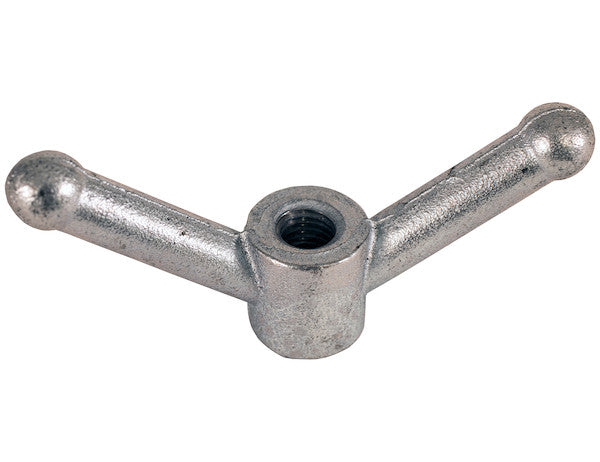
Buyers Products Cast Iron Wing Style Clamp Handle is ideal for securing doors, chutes, and tailgates using a 5/8-11 rod. The handle is zinc plated for corrosion resistance.
Specifications
| Diameter | 0.63 |
|---|---|
| Finish | Zinc Plated |
| For Use With | 5/8-11 Threaded Rod |
| Length - Hole to End (in.) | 5.50 |
| Material | Forged Steel |
| Offset | 2.38 |
| Thread Size | 5/8-11 |
Technical Overview: Zinc Plated Wing Nut Clamp Handle with 5/8-11 Full Thread
The Zinc Plated Wing Nut Clamp Handle, specifically designed with a 5/8-11 full thread and dimensions of 5.5 x 2.38 inches, represents a robust and versatile solution for industrial and commercial fastening applications. This component is engineered for optimal performance in demanding environments where secure and reliable clamping is paramount. Its construction integrates several key engineering principles and material science advantages, ensuring longevity, enhanced operational efficiency, and superior resistance to degradation.
Material Science Excellence: Forged Steel Construction
At the core of this clamp handle's exceptional durability is its construction from forged steel. Forging is a manufacturing process involving the shaping of metal through localized compressive forces, typically performed using a hammer or press. Unlike casting, which involves pouring molten metal into a mold, forging mechanically deforms the metal, resulting in a superior grain structure that aligns with the shape of the part. This alignment eliminates internal voids, porosity, and shrinks, which are common in cast components, thus imparting significantly enhanced mechanical properties.
The benefits of utilizing forged steel for this application are manifold. Firstly, forged components exhibit higher tensile strength and yield strength compared to their cast counterparts. This superior strength translates directly into the handle's ability to withstand greater clamping forces and operational stresses without deformation or failure. Secondly, forging enhances the ductility and toughness of the steel. Ductility, the ability of a material to deform plastically without fracturing, is crucial for components subjected to cyclic loading or sudden impacts, as it allows the material to absorb energy and prevent brittle fracture. The improved toughness ensures the handle can resist crack propagation and maintain structural integrity even under adverse conditions. Thirdly, the refined grain structure of forged steel contributes to superior fatigue resistance. In applications involving repetitive tightening and loosening cycles, fatigue is a common mode of failure. The uniform and compact grain structure of forged steel significantly extends the operational lifespan of the handle by mitigating the initiation and propagation of fatigue cracks. Lastly, the forging process also refines the surface finish and provides better dimensional consistency, which is critical for ensuring proper thread engagement and overall fit and function within an assembly. This meticulous material selection underscores a commitment to providing a fastening solution that surpasses conventional standards in terms of strength, reliability, and service life.
Advanced Corrosion Protection: Zinc Plating Technology
To ensure the prolonged integrity and aesthetic appeal of the clamp handle in diverse operating conditions, it undergoes a meticulous zinc plating process. Zinc plating is an electrodeposition technique where a thin coating of zinc is applied to the surface of the steel substrate. This finish is not merely cosmetic; it provides a highly effective barrier against corrosion through a combination of physical protection and sacrificial galvanic action.
The primary mechanism of corrosion protection offered by zinc plating is sacrificial. Zinc is an electrochemically more active metal than steel. In the presence of an electrolyte (such as moisture, humidity, or corrosive agents), the zinc coating corrodes preferentially, thereby protecting the underlying steel base metal from oxidation. This sacrificial behavior ensures that even if the zinc coating is scratched or compromised in small areas, the adjacent zinc will continue to provide cathodic protection, preventing rust from forming on the exposed steel. This characteristic is particularly vital for components exposed to outdoor environments, industrial wash-downs, or areas with high humidity or chemical exposure, where maintaining structural integrity is critical for safety and operational continuity.
Beyond sacrificial protection, the zinc layer also acts as a physical barrier, isolating the steel from direct contact with corrosive elements. The uniformity and adherence of the zinc layer achieved through professional electroplating processes ensure comprehensive coverage, even on complex geometries. This finish not only extends the operational life of the handle but also reduces maintenance requirements and associated costs. Furthermore, zinc plating contributes to a cleaner appearance, resisting the unsightly red rust that can degrade the perceived quality and functionality of equipment. This strategic application of zinc plating aligns with industry best practices for durable fasteners, providing a robust defense against environmental degradation and ensuring consistent performance over its intended lifespan.
Precision Threading: The 5/8-11 UNC Full Thread Specification
The selection and execution of the thread specification are fundamental to the clamp handle's effectiveness and reliability. This handle features a 5/8-11 full thread, adhering to the Unified National Coarse (UNC) thread series. Understanding this designation is crucial: '5/8' refers to the nominal major diameter of the thread in inches, indicating a robust thread profile suitable for heavy-duty applications. The '-11' signifies 11 threads per inch, placing it within the coarse thread series.
The UNC thread series is distinguished by its larger thread pitch, resulting in a deeper thread profile compared to fine thread series (UNF). This characteristic offers several significant advantages for a clamp handle application. Firstly, coarse threads are inherently stronger and more resistant to stripping under high torque or shock loads. The larger cross-sectional area of the thread root reduces stress concentrations, enhancing the thread's ability to distribute load effectively. Secondly, UNC threads are less susceptible to galling or cross-threading during assembly, which is particularly beneficial in field applications where perfect alignment may be challenging or where components are frequently assembled and disassembled. The more forgiving nature of coarse threads ensures quicker and more reliable engagement, even if minor contaminants are present.
The term "full thread" further emphasizes the engineering commitment to maximum engagement and clamping efficiency. A full thread extends completely through the threaded bore of the handle, providing the maximum possible thread engagement with the mating 5/8-11 threaded rod. This complete engagement ensures that the applied torque is distributed over the largest possible surface area of the thread flanks, maximizing the clamping force that can be achieved and maintained. This design choice is critical for applications demanding high preload and resistance to vibration-induced loosening. By specifying a 5/8-11 full thread, this clamp handle ensures a secure, high-integrity mechanical connection that can withstand the rigors of industrial operations, providing dependable performance and minimizing the risk of premature loosening or failure.
Ergonomics and Operational Efficiency: The Wing Style Design
The distinctive "wing style" design of this clamp handle is not merely an aesthetic choice but a deliberate ergonomic and functional engineering decision. The winged profile significantly enhances the user's ability to apply and release clamping force manually, making it ideal for applications requiring frequent adjustments or quick fastening without the need for additional tools. The broad, contoured wings provide a comfortable and secure grip, allowing operators to exert substantial torque with minimal hand fatigue.
In industrial and commercial settings, where operators may wear gloves or where dexterity might be compromised by environmental conditions, the large surface area of the wing handle is a considerable advantage. It distributes the pressure across a wider portion of the hand, reducing the risk of discomfort or injury during repeated operations. This ergonomic consideration directly contributes to improved operational efficiency, as operators can work more quickly and comfortably, thereby increasing productivity. The design also facilitates quicker visual confirmation of the handle's position, enhancing safety protocols by making it easy to see if a clamp is engaged or disengaged.
Compared to other handle types, such as knurled knobs or simple nuts requiring wrenches, the wing style handle offers superior convenience and speed. It eliminates the need for tool retrieval, saving valuable time in dynamic work environments. This self-contained fastening mechanism is particularly advantageous in scenarios where rapid changes or adjustments are essential, or where space constraints make tool manipulation difficult. The thoughtful integration of this ergonomic wing design underscores a commitment to not only mechanical robustness but also to the practical needs and comfort of the end-user, thereby elevating the overall utility and value of the clamp handle.
Dimensional Precision and Application Versatility: 5.5 x 2.38 Inch Tall
The specified dimensions of 5.5 inches (Length - Hole to End) and 2.38 inches (Offset) are critical parameters that define the functional envelope and application versatility of this wing nut clamp handle. These precise measurements are instrumental in ensuring proper fit, optimal leverage, and adequate clearance in a wide array of mechanical assemblies.
The 5.5-inch length, measured from the center of the threaded hole to the farthest end of the wing, directly influences the leverage that an operator can apply. A longer handle provides greater mechanical advantage, allowing for the generation of higher clamping forces with less effort. This is particularly beneficial in applications where substantial preload is required to prevent movement or vibration-induced loosening. The extended length also provides ample grip for the user, accommodating a full hand grasp for maximum torque application and control. This dimension ensures that the handle can be effectively manipulated even when access is somewhat restricted, or when the threaded rod requires significant travel to achieve the desired clamping position.
The 2.38-inch offset, defined as the vertical distance from the center of the threaded hole to the highest point of the handle’s wing (or effectively, the clearance height from the mounting surface), is a crucial design feature for managing clearance issues. In many industrial and machinery applications, components are mounted in close proximity to other structural elements, frames, or moving parts. This offset ensures that the handle clears adjacent surfaces, obstructions, or equipment housings, allowing for full rotation and unobstructed operation without interfering with other components. This clearance is vital for both ergonomic manipulation and for preventing damage to the handle or surrounding equipment. Furthermore, the offset can contribute to the ease of engaging and disengaging the handle, especially when the threaded rod extends through a panel or structure, by providing sufficient hand room above the engagement point.
Together, these dimensions are meticulously balanced to offer a handle that is not only powerful in its ability to generate clamping force but also highly adaptable to complex mechanical layouts. They ensure that the handle can be integrated effectively into diverse machinery, equipment, and structural applications, providing a reliable and accessible fastening point without compromising on operational space or user ergonomics. This thoughtful dimensional design amplifies the handle's utility across a broad spectrum of industrial and commercial sectors.
Comprehensive Application Spectrum
The robust design, material integrity, and precise engineering of the Zinc Plated Wing Nut Clamp Handle position it as an indispensable component across an extensive range of industrial and commercial applications. While initially highlighted for securing doors, chutes, and tailgates, its utility extends far beyond these specific examples, encompassing scenarios where reliable, hand-operable fastening is critical.
- Industrial Machinery and Equipment: This handle is ideally suited for securing access panels, guarding, and inspection covers on manufacturing equipment, processing machinery, and automation systems. Its ability to provide secure closure and quick access is crucial for maintenance, cleaning, and operational adjustments, enhancing both safety and productivity.
- Agricultural Equipment: In the agricultural sector, machinery such as spreaders, harvesters, and planters often require robust fastening solutions for various components like adjustable guides, chute diverters, and protective shields. The handle's corrosion resistance and ease of use make it perfect for the harsh, outdoor environments typical of farming operations.
- Transportation and Logistics: Beyond tailgates, this clamp handle finds application in securing cargo, fastening removable partitions in commercial vehicles, and locking down specialized equipment on trailers. Its durability ensures components remain fixed even under dynamic stresses encountered during transit.
- Construction and Material Handling: For securing forms, temporary structures, scaffolding components, or adjustable stops on conveyor systems and material hoists, the handle provides a strong, reliable, and easily manipulated fastening point. Its robust forged steel construction withstands the heavy loads and impacts common in construction environments.
- Custom Fabrication and OEM Applications: Due to its standardized 5/8-11 thread, the handle is a versatile choice for original equipment manufacturers (OEMs) and custom fabricators designing bespoke solutions. It offers a readily available, high-quality component for quick-release mechanisms, adjustable fixtures, and reconfigurable assemblies in diverse product lines.
- Marine and Outdoor Enclosures: While zinc plating offers good corrosion resistance, for extreme marine environments, additional protective measures might be considered. However, for general outdoor and less corrosive marine applications, it provides an excellent balance of cost-effectiveness and durability for securing hatches, covers, and vents.
In each of these applications, the handle's combination of strength, corrosion resistance, and ergonomic design translates into enhanced operational safety, reduced downtime, and improved overall system reliability. It serves as a testament to engineering a component that not only performs its primary function flawlessly but also contributes significantly to the efficiency and safety of the larger system it serves.
Engineering Principles and Performance Integrity
The performance of the Zinc Plated Wing Nut Clamp Handle is underpinned by sound engineering principles related to mechanical fastening and material behavior. When the handle is tightened onto a 5/8-11 threaded rod, it generates an axial clamping force, which creates a preload in the bolted joint. This preload is crucial for preventing relative motion between the clamped components. The efficacy of this clamping force is a direct result of several design factors:
- Torque-to-Tension Conversion: The precise 5/8-11 thread profile ensures efficient conversion of the manual torque applied to the wing handle into the axial tension required for clamping. The coarse thread minimizes friction within the threads compared to finer pitches, allowing for more of the input torque to contribute to tensile preload.
- Stress Distribution: The robust forged steel construction distributes the localized stresses generated during tightening and operation across the material effectively. This prevents stress concentration points that could lead to premature material fatigue or fracture, ensuring the handle can repeatedly sustain significant clamping loads without structural degradation.
- Vibration Resistance: A properly tightened clamp joint, facilitated by the high preload achievable with this handle, provides inherent resistance to loosening due to vibration or dynamic loading. The friction generated by the preload between the clamped surfaces, combined with the secure thread engagement, works to counteract rotational forces that might otherwise loosen the connection.
- Durability under Cyclic Loading: Many applications require components to be repeatedly clamped and unclamped. The fatigue resistance of forged steel, coupled with the robust thread design, ensures the handle maintains its structural integrity and fastening capability over thousands of operational cycles, far exceeding the performance of lesser materials or designs.
The integrity of this clamp handle is not left to chance. Manufacturing processes adhere to stringent quality control protocols, ensuring that each unit meets specified dimensional tolerances, thread accuracy, and material property requirements. This commitment to precision engineering and quality assurance guarantees that the Zinc Plated Wing Nut Clamp Handle provides not just a connection, but a reliable, high-performance mechanical link critical for the safety and efficiency of diverse industrial systems.
Conclusion: A Benchmark for Reliable Clamping Solutions
In summary, the Zinc Plated Wing Nut Clamp Handle with a 5/8-11 full thread and its carefully considered dimensions of 5.5 x 2.38 inches represents a meticulously engineered fastening component. Its foundation in forged steel construction provides unparalleled strength, ductility, and fatigue resistance, ensuring exceptional durability in the most demanding operational environments. The advanced zinc plating offers robust, sacrificial corrosion protection, extending the handle's service life and reducing maintenance overhead. The precision-engineered 5/8-11 UNC full thread guarantees secure, high-integrity connections, capable of withstanding significant operational stresses and vibrations. Furthermore, the ergonomic wing style design, combined with optimized dimensions, provides superior leverage, ease of operation, and critical clearance, making manual adjustments efficient and comfortable.
This product is more than a simple fastening device; it is a critical engineering component designed to meet the rigorous demands of industrial, commercial, and heavy-duty applications. From securing vital machinery components and agricultural attachments to facilitating quick adjustments in material handling systems and transportation equipment, its versatile utility is matched only by its steadfast reliability. By integrating superior material science, advanced surface treatments, and thoughtful ergonomic design, this Zinc Plated Wing Nut Clamp Handle stands as a benchmark for robust, dependable, and user-friendly clamping solutions, offering long-term value and unwavering performance across a broad spectrum of critical applications.